

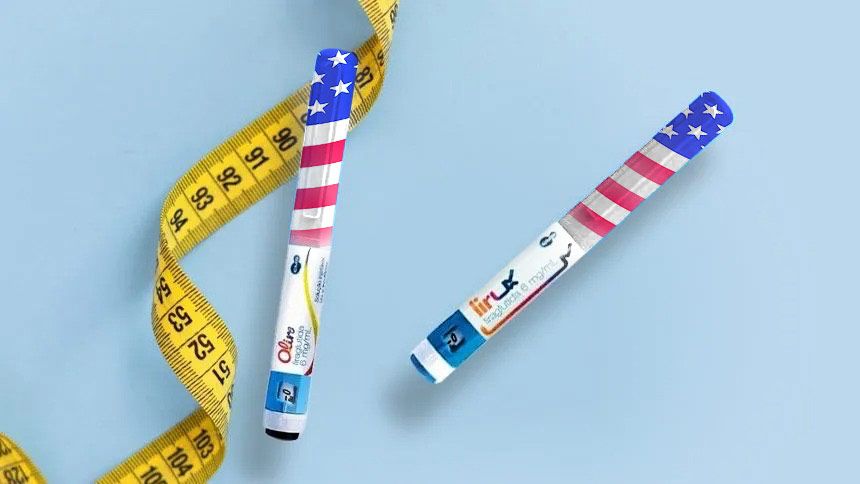
Three months after starting to market the Olire (for obesity) and Lirux (for treating diabetes) slimming pens, which have liraglutide as their active ingredient, the first produced in Brazil, the pharmaceutical company EMS is already putting into practice its plan to export the medications to the United States.
Similar to the national distribution, the pens destined for the United States will also be produced at the factory in Hortolândia, São Paulo, the main plant in Brazil for the Sanchez family company.
The sales process in the United States will be via licensing with a local pharmaceutical company. Authorization from the Food and Drug Administration (FDA) for the Brazilian product to enter the US market is expected in the second quarter of 2026. The registration request was made in October 2023.
With this, EMS is working towards a scenario where it will begin selling the Brazilian medications in the first half of 2026. By the end of next year, the expectation is to have approximately 500,000 units in American pharmacies.
In the 12-month scenario, starting from the drug's launch, the plan is to sell 1 million domestically produced liraglutide -based pens to the American market, in a market that is on track to be larger than the Brazilian market for this product, according to EMS.
“We see the Brazilian market as well-supplied, with a volume higher than we anticipated. Therefore, our focus for 2026 is exporting the product and entering the United States market,” says Marcus Sanchez , vice president of EMS, in an interview with NeoFeed .
Just as in the case of Brazil, the patent for liraglutide in the United States, which had Saxenda and Victoza from the Danish company Novo Nordisk as reference drugs, expired in November of last year.
According to a recent report by BTG Pactual , the market for slimming pens in Brazil is expected to reach between R$6 billion and R$7 billion, with a projection of R$9 billion for 2026. This value includes medications based on liraglutide, semaglutide, and tirzepatide ( Mounjaro ), from Eli Lilly, approved by Anvisa in June, and brands produced by Novo Nordisk .
Although expanding rapidly in Brazil, the shelf space for these medications in the American market is much higher. Data from the consulting firm Fortune Business Insights shows that the global market is worth US$62 billion. The United States accounts for 55%. Brazil has about 3%.
“It is the most important market for obesity drugs in the world. Compared to Brazil, the reference drug liraglutide has a greater market penetration. And it is important for EMS to occupy this space,” says Sanchez.
EMS already knows it won't use the same name for the pens in the United States, but it hasn't yet decided what Olire and Lirux will be called when they're on the shelves of American drugstores .
Unlike the domestic market, where it still has no direct competition for liraglutide (besides the original drug), EMS is expected to face fiercer competition in the United States. Hikma Pharmaceuticals USA began selling its generic version of the pen last December.
Teva Pharmaceuticals also sells generic liraglutide in the country led by Donald Trump, but in that case, through an agreement with Novo Nordisk. In June 2024, it launched its copy of Victoza and, in June of this year, that of Saxenda.
Pricing has not yet been defined, but according to the vice president of EMS, the product should be sold at a price 30% lower than that of Novo Nordisk, which is found at around US$500.
The start of liraglutide exports will mark EMS's entry into the United States. The NC Group, which controls EMS, owns 70% of Vero Biotech, a biopharmaceutical company based in Atlanta that specializes in developing innovative technologies for the sector.
“We don’t have EMS products there yet. These will be our first, and the strategic plan is to be in the United States with a few medications, in very large markets, such as GLP-1,” says Sanchez.
Growth in Brazil
The plan to enter the American market comes at a time when the performance of the products on the shelves of Brazilian pharmacies has reached a level above what the company expected.
As NeoFeed exclusively revealed, EMS products arrived in pharmacies in early August. The initial plan was to reach a volume of 250,000 pens by December, but this forecast has already been surpassed. The expectation is that there will be a 60% growth over the previous plan.
Last week, EMS distributed 270,000 pens to retail chains, adding to the 100,000 units already sold of the two products. With another 30,000 currently in production, EMS will end the year with 400,000 pens on the Brazilian market.
“Demand is far exceeding our expectations. That's why we decided to restock the market this year. With this, we hope to maintain this high performance,” says Sanchez. “The market is very large.”
This also means that the company should meet its sales target for 12 months, which was half a million pens. The new plan, according to Sanchez, is now to surpass the mark of 600,000 units of the medication by August.
In terms of revenue, drug sales are exceeding the pharmaceutical company's projections. By the end of the year, the two products are expected to generate R$ 65 million in revenue. This means the plan to reach R$ 100 million in revenue by the first year of sales (in August) will be surpassed much sooner and should reach close to R$ 150 million.
Although the patent for liraglutide expired just over a year ago, EMS is the only Brazilian pharmaceutical company producing the drug, in addition to Novo Nordisk's medication. This, according to the businessman, puts it at an advantage over competitors who still intend to enter this market.
In practice, many pharmaceutical companies are waiting for the patent on semaglutide (the active ingredient in Ozempic), also from Novo Nordisk, to expire, as its exclusivity is expected to end at the end of March. There are at least 12 registrations with the National Health Surveillance Agency for the production of the pen, starting next year.
In addition to EMS, pharmaceutical companies Biomm , Prati-Donaduzzi, União Química, Hypera, and others have already announced that they will produce their own national versions.
In an interview with NeoFeed in November, Cimed's CEO, João Adibe Marques , revealed that the company has changed its local production plans and will now bring its version of Ozempic through licensing with a foreign pharmaceutical company that does not yet have a presence in Brazil.
To support the volume that would come with the market entry of LPG-1 analogs, EMS delivered, last year, a unit attached to the Hortolândia factory, solely for this demand. The investments reached R$ 500 million. In the coming months, another R$ 100 million will be invested for the arrival of semaglutide.
According to the company's vice president, the factory has the capacity to produce eight million pens per year. With new equipment arriving in 2026 as part of the investment package, the forecast is to reach 12 million in 2027.
But in practice, the volume produced is still much lower than the total capacity, which shows the long window for growth. In 2026, the factory will produce, for the Brazilian market alone, 1.4 million units of Olire and Lirux, and between 500,000 and 600,000 of the Ozempic equivalent.
The NC group is expected to close the year with revenues of around R$ 10 billion. EMS alone, which leads the generic drug market in the country, is expected to account for R$ 7 billion.