

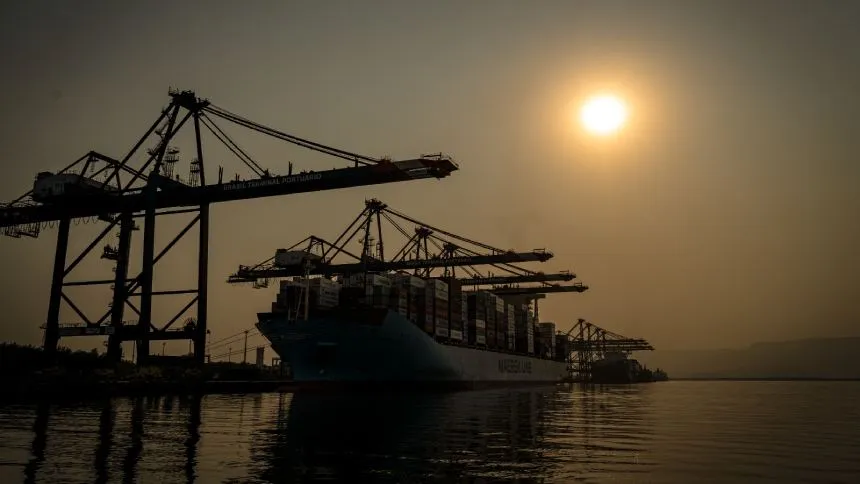
The war between Iran and the United States , which began at the end of February, is already threatening to affect the pace of cargo movements at the Port of Santos . In this sense, April should be a key month for the revenue of operators who use the largest port terminal in South America.
The biggest concern is grain shipments. Of the total volume of corn exported from the Santos terminal, 31% goes to Iran. This means that, in 2025, 4.7 million tons of the product were sent to the Iranian market, out of a total of 15.2 million tons that left Santos from ships.
By 2026, 1.1 million tons of corn had already been shipped abroad from Santos. Thus, in the first two months of this year, approximately 350,000 tons of the grain traveled to the country currently in conflict.
The largest share came from the Teag terminals (which has Cargill as a partner), T-Grão, and CLI/Sul (controlled by IG4 Capital and which has Rumo Logística as a shareholder).
The situation is further aggravated by the closure of the Strait of Hormuz , a natural route for ships departing from Santos bound for the Middle Eastern country. The greatest fear is that the conflict will last at least another two weeks and up to a month, which will directly affect the volume and future orders of Brazilian products.
It takes approximately 25 days for a shipment to leave the coast of São Paulo and reach the Iranian port. On the other hand, Iran is the largest exporter of urea (a type of fertilizer) to Brazil. Besides the risk of disruption, the war has increased the price of the product.
“If it goes on for another 15 or 20 days and the channel remains closed, the war will start to affect the port, yes. Iran is our major importer of corn,” says Anderson Pomini, president of the Santos Port Authority (APS), in an interview with NeoFeed .
According to him, the port terminal's management has been monitoring ship departures daily and has already initiated dialogue with cargo operators at the port. There is a possibility of changes to the destinations of these cargoes, although Pomini acknowledges that this commercial process is not so quick.
"The port of Santos serves 600 destinations in almost 200 countries. And there is a great demand for Brazilian corn. That is the advantage of producing commodities, even though the industrialized product has a higher added value," he says.
NeoFeed has learned from sources in the port sector that there are already requests from companies in the Middle East for cargo not to leave the port of Santos. As a result, ships are expected to remain waiting in the port's anchorage area, and in other situations, cargo will remain in warehouses for the time being.
According to Pomini, the current scenario is different from what was experienced in the days leading up to the tariff hikes imposed by the President of the United States, Donald Trump. On that occasion, there was a rush to send Brazilian cargo to American ports without being affected by the new tariffs.
“Those who had the taxed products did everything they could to get them there sooner. In the case of corn, either the shipment will go through another channel or the buyer will change. So, it is possible that we will see changes in routes for this cargo,” he says. “There is also a chance of a price increase, mainly due to increased logistics.”
According to him, up to this point the role of the Santos Port Authority and the Ministry of Ports and Airports has been to closely monitor and guide the port terminals regarding the interruption of access to Iran.
In 2025, the port achieved recurring profit of R$ 938.9 million, a 22.3% increase over the previous year's result. Cash generation reached R$ 1 billion, with an EBITDA margin of 59.1%. The port ended the year with R$ 4 billion in cash.
Last year, Santos reached a record in cargo handling, totaling 186.4 million tons. Containers accounted for 62.3 million tons, and the soybean complex, 44.9 million tons. The volume of cellulose was 9.9 million tons.