

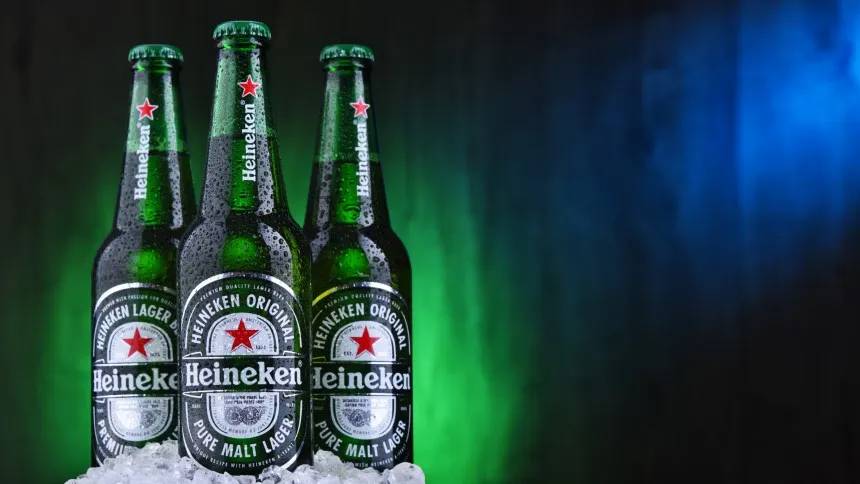
The "hangover" caused by the drop in beer consumption in Heineken 's balance sheet, with Brazil being one of the markets where demand slowed the most, led the Dutch brewery to announce a profound restructuring of its operations, which will result in the dismissal of 6,000 employees worldwide.
The cut, equivalent to 7% of its workforce, is part of a broad adjustment plan announced on Wednesday, February 11th. Other measures include factory closures, consolidation of operations in smaller markets, and centralization of back-office activities.
“[The restructuring] really reaches all levels of the organization,” said Harold van den Broek, CFO of Heineken, in the 2025 results conference call, according to the Financial Times .
The situation led Heineken to present a more modest guidance for 2026. The company now expects profit growth of 2% to 6% in 2026, down from the 4% to 8% range projected for last year.
According to analyst Ed Mundy of Jefferies, the projection could be considered "slightly disappointing," but given the leadership transition with the departure of CEO Dolf van den Brink, "there was no incentive to set a very ambitious goal."
The restructuring presented by Heineken means significantly altering the current structure, composed of relatively autonomous operations around the world. It is a change aimed at adapting to the new market situation, in which people are consuming less and less alcoholic beverages .
The drop in demand was evident in the 2025 results. Heineken reported a 1.2% reduction in beer volume sold compared to 2024, even though net revenue increased by 1.6% to €28.9 billion.
Sales were negatively impacted by declines in Europe and the Americas, where beer sales volume fell by 3.4% and 2.8%, respectively.
Brazil was one of the negative highlights of Heineken's earnings report. According to the company, beer volume decreased by a "mid-single digit" and revenue fell by a "low single digit," reflecting a weak market and a temporary reduction in inventory at retailers to rebalance the portfolio and customer composition at the beginning of the year.
"The category's dynamism was impacted by predominantly cyclical factors in Brazil, where consumer demand weakened due to the fall in real disposable income and the withdrawal of government subsidies for low-income families," says an excerpt from the report.
Heineken has been suffering from the stagnation of the premium beer market in Brazil. A survey conducted by the Brazilian Association of the Beer Industry (CervBrasil) shows that, in the first nine months of 2025, the beer market shrank by about 6% in the country.
This translates to a projected volume of 14.7 billion liters of beer by 2025. This amount represents a revenue of R$ 205 billion. The premium sector, where the company's main brand operates, represents 14% of the sector.
The situation led Citi analysts to question, at the beginning of the year, whether Heineken might reconsider its investments in Brazil. By the end of 2025, a new factory in the Minas Gerais city of Passos is expected to guarantee an increase of up to 500 million liters of the beverage per year, with the possibility of expansion.
The construction of the factory in Minas Gerais alone represented an investment package of approximately R$ 2.5 billion, over two and a half years of construction, using the greenfield model. This amount is part of a larger R$ 6 billion package, invested since 2019, in expansion and modernization initiatives.
Given the current poor state of the domestic market and the announced restructuring, the new global management may reduce the pace of new investments.