

JBS, the world's largest protein producer, with operations in more than 20 countries and owner of brands such as Seara , Friboi, Swift, and Pilgrim's Pride , is incorporating a new ingredient – or rather, several ingredients – into its already vast portfolio of operations.
The Brazilian group will inaugurate the JBS Biotech Innovation Center on Wednesday, April 1st. This biotechnology hub, applied to the food supply chain, will bring together advanced research, process engineering, and data science.
The new center, the result of a four-year project, is located in Sapiens Parque, in Florianópolis (SC), in a total area of four thousand square meters. To date, it has represented an investment of US$ 37 million (approximately R$ 193 million).
“This project is fully aligned with our strategy of investing in added value,” Gilberto Tomazoni , global CEO of JBS, told NeoFeed . “And we have a complete range with a lot of scale, variety and availability of raw materials to do this.”
From this broad menu, he emphasizes that JBS began developing this project when many of the concepts that guide and support this initiative – super proteins, in particular – were still quite nascent.
“Today, these issues have accelerated significantly due to a generational shift, with a greater focus on well-being,” he states. “So, we’ve reached a point where we have the skills and a market demand to meet.”
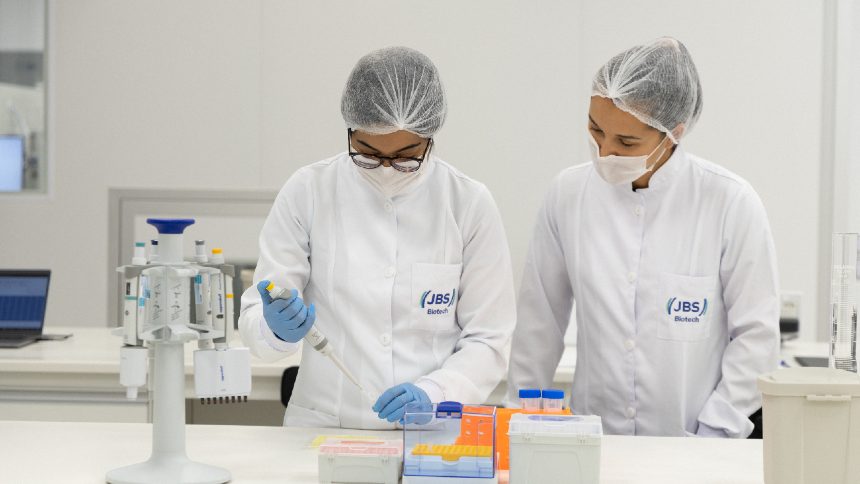
To meet this demand, the new center will have 20 laboratories and 28 professionals, including engineers, veterinarians, biologists, chemists, and related fields. It will be led by Fernanda Berti, a postdoctoral researcher at the European Institute of Excellence in Tissue Engineering and Regenerative Medicine.
“A large part of this team is made up of Brazilian scientists whom we repatriated,” says Berti. “It’s a very broad range of knowledge that comes packed into each of these people’s backpacks so that we can think of solutions in the short, medium, and long term to meet JBS’s strategies.”
With this orientation, the hub will focus on three main areas: the search for technologies or materials that allow for the improvement of products already offered by the group, as well as new ingredients to be incorporated into its portfolio.
The first is the development of proteins with differentiated characteristics. Among them are proteins whose formulation allows for the definition of amino acid levels, digestibility, and functionality, even reaching levels of customization.
"It's possible, for example, to understand how I can build technologies that can deliver functional and alternative proteins that can be targeted towards muscle mass gain for people who use weight-loss pens," says Berti.
Tomazoni adds: “When we talk about super protein, we’re talking about designing a specific protein for a group of people,” he says. “So, this center was built so that, in the end, we can have these ingredients or their application in our traditional products.”
A second aspect involves animal health, based on materials research and the development of solutions that can bring more efficiency and productivity to JBS's business units.
The third direction, also closely linked to the value-added strategy and the group's production field, involves mapping potential new applications, ingredients, and products that can be developed from raw materials that are currently underutilized in these operations.
One example that helps to understand this trend is Genu-in, an operation created in recent years by JBS, specializing in collagen, whose portfolio is aimed at sectors such as the food industry, in segments such as supplements.
“We already have several product portfolios in development,” says Tomazoni, who keeps some of the studies already underway at the center under wraps. “When they’re ready, we’ll take them and invest in factories to produce them.”
Genu-in itself is one example of this journey from "laboratories" to industrial scale at JBS. The operation had a factory inaugurated in 2022 in Presidente Epitácio (SP) and has already concentrated an investment of R$ 400 million.
Another example that connects to the center was the investment made by JBS at the end of 2021 to take control of the Spanish company BioTech Foods. With the agreement, the company entered the market for cultivated proteins – the production of food from animal cells, without the need for slaughter.
Founded in 2017, BioTech Foods already operated a pilot plant in the city of San Sebastián. And, following the acquisition of a 51% stake in the operation by JBS, it announced the construction of a new factory, with an estimated investment of over R$ 200 million, in an area of 20,000 square meters.
“When we made the acquisition, Biotech already had the technology and needed to invest to reach the commercial level,” says Tomazoni. “That’s a bit of what will happen at the center. We will develop the technologies and put them in factories to scale up.”