

The shopping center sector is experiencing a period of pause in 2026, mainly due to the high cost of capital, stemming from an interest rate currently at 14.75% per year, but without a clear prospect of an effective downward cycle.
In this scenario, most companies in the sector decided to slow down their allocation of new investments. As a result, the segment leaders had to change their focus and implement expansion projects and internal restructuring initiatives that involve fewer resources and are faster.
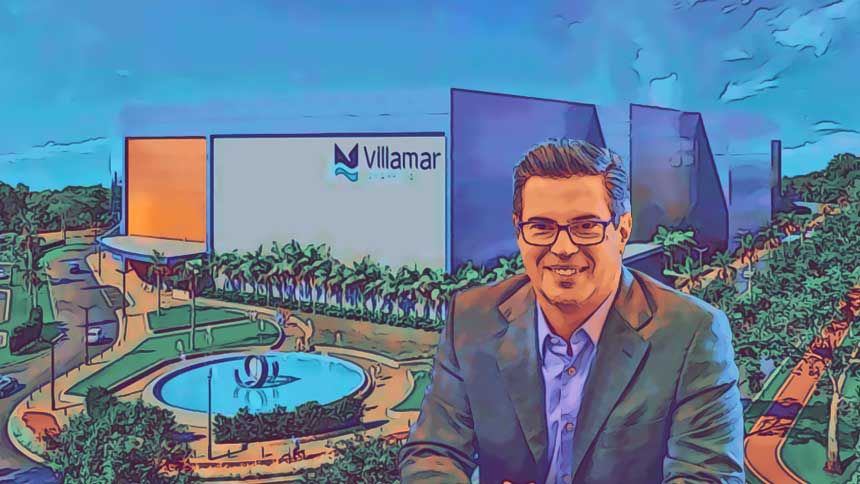
However, the Mendes Group, which operates in the areas of malls , civil construction, and solar energy, and owns two shopping malls in the Baixada Santista region, decided to go against the grain. The company has allocated R$ 500 million to build its largest shopping center in the city of Praia Grande.
In addition to the construction costs, the company also spent another R$ 70 million on purchasing the land, which was owned by Eztec and a local entrepreneur. Part of the funding will come from equity capital and another part from the market, possibly through debentures.
VillaMar Shopping is scheduled for completion in September 2027. With 156,300 square meters (m²) of built area and 42,800 m² of gross leasable area, the shopping center will have 335 stores.
“Even though the current economic situation in Brazil is unfavorable, our project is for the medium and long term. And we will continue investing,” says Paulo Mendes, shareholder and CEO of the Mendes Group, in an interview with NeoFeed .
For the businessman, the strategy adopted is to create a scenario of a "stressed market," imagining the peak of interest rates to price investments. If the outlook becomes more favorable, it eases the impact of the cost.
“We have the entire group's budget outlined until 2029. And in this scenario, we are considering a linear Selic rate of 15% per year, although it may possibly decrease by then. We are working with the worst-case scenario, in order to have a positive surprise,” says Mendes.
In February, NeoFeed spoke with the CEO of the Allos Group, Rafael Sales , who discussed the group's plan to "retrofit" its shopping malls to boost revenue during this period of high interest rates. According to Mendes, this decision is understandable.
“The pandemic has had a major impact on companies, which have had to take on debt in a scenario of rapidly rising interest rates. That's why shopping mall operators are still very selective in attracting retailers. And the result is that companies are holding back on new construction projects a bit,” says the businessman from Santos.
According to him, the original idea was to launch VillaMar in 2020, but the plan had to be aborted because of the Covid-19 pandemic. Even so, the Mendes Group improved the project and expanded the initiative.
“We strongly believe in the project and in the city of Praia Grande, which has been growing a lot. Our idea is to make our cost attractive for us, as investors, and for our retail partners.”
Today the company has one unit in Santos (Praiamar Shopping, with 240 stores in 40,000 m² of GLA) and another in São Vicente (Brisamar Shopping, with 120 stores and a GLA of 21,000 m²).
Still within the mall segment, the Mendes Group also works on the construction of mixed-use projects. The medium-term plan is to advance in the construction of projects in São Paulo. “We have a 25,000 m² area on the Marginal Tietê, near the Ponte do Limão. We are going to build something, but not necessarily a shopping mall. We will do that later, because we have several investment fronts now,” he says.
One of these ventures, in addition to the shopping mall, is in the real estate development segment of the Mendes Group, with the construction company Miramar. By the end of the year, the company will deliver the first phase of the Navegantes Complex, which will be the tallest building on the coast of São Paulo, with 155 meters and 309 units.
With properties ranging from 218 m² to 500 m², the development has a total sales value (VGV) of R$ 2.3 billion. The second phase of construction will be delivered at the end of 2027.
Sun as an alternative for growth
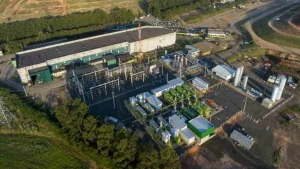
With a business diversification plan, the Mendes Group also plans to invest R$ 200 million in 2026 to expand Ineer Energia, which currently has the largest number of solar parks in the state.
“Our decision to enter the segment was precisely during the pandemic, due to the impact that the shopping mall sector suffered. And so we focused on an essential segment, one that would be more resilient, regardless of the scenario,” explains Mendes.
Since its creation in 2023, Ineer has been a leader in distributed generation in São Paulo, with a presence in 485 municipalities in the state. The company operates in the concession areas of CPFL Piratininga, CPFL Paulista, and Neoenergia Elektro.
To date, the company has already received R$ 1 billion in investments. Today, Ineer has approximately 270 megawatts-peak (MWp) in about 77 solar farms. The plan is to reach 310 MWp of installed capacity by the end of the year, enough energy to supply a city of 420,000 inhabitants (practically the size of Santos).
The new investment of R$ 200 million will guarantee the construction of 23 more solar parks, bringing the total to 100 wind farms in the state.
Today, 60% of the portfolio is concentrated in Piratininga, a company whose concession area is the Baixada Santista region. The volume generated by the Mendes Group's energy company is destined for the free energy market.
“We are approaching the ideal distributed generation portfolio. And, if we have entered the renewable energy sector, it is also reasonable that we produce for ourselves. That is why we also intend to enter centralized generation later on,” says the businessman.
All three sectors – malls, real estate development, and energy – saw growth last year. The plan is for each segment to represent one-third of revenue by 2029. Solar energy currently accounts for 17% of revenue.
In 2025, the Mendes Group recorded a 72% growth in EBITDA. They do not disclose their revenue. "We've grown sevenfold in the last eight years. It's accelerated growth, but with conservative planning. We don't take more risks than necessary," Mendes adds.