

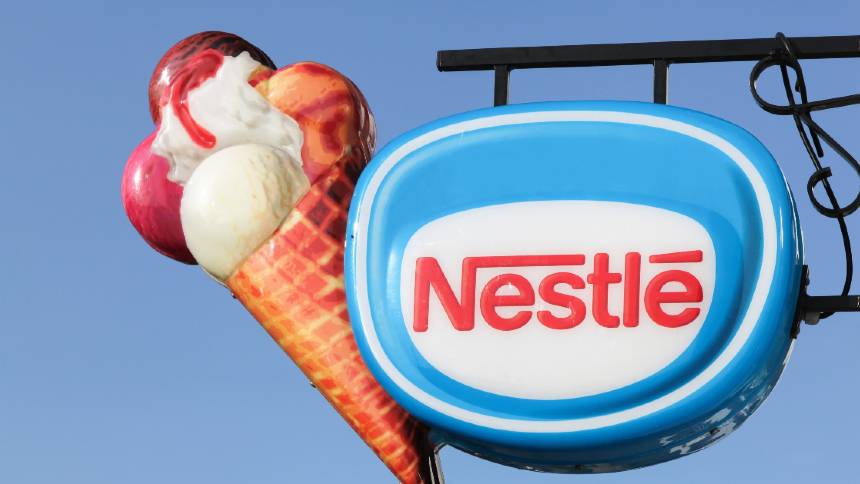
Nestlé announced on Thursday, February 19th, that it is in advanced negotiations to sell its ice cream division in Canada, Chile, Peru, China, Malaysia, and Thailand to Froneri, a joint venture between the company and the investment firm PAI. With this development, the brand, which also owns major names like Häagen-Dazs, will hold 100% of Nestlé's business.
The move was announced by Nestlé's new president, Philipp Navratil, following the release of the financial results for the fourth quarter of 2025. With the exit from the ice cream division, the executive seeks to reverse the complex situation of the Swiss multinational, which has seen its shares fall by more than 18% in the last five years.
Navratil's strategy now is to focus on the coffee , pet care, nutrition, food, and snack businesses. "We are concentrating our portfolio into four businesses, led by our strongest brands, with prioritized resources and a simplified organization," the executive stated.
In this wave of divestments, the executive also continued his predecessor's plans by selling the water business, a division that includes globally recognized brands such as Perrier and Henniez. In addition, Nestlé is divesting its vitamins and supplements divisions.
With these strategic changes, the company reported that it has already achieved 20% of the CHF 3 billion in cost savings projected by the end of 2027.
For 2026, the company's internal projection is around 3% to 4% growth in organic sales, similar to what the multinational reported in the last quarter of the year, with an increase of 3.5%.
Thus, the company seeks to increase its operating profit margin, which ended 2025 at 16.1%. During the period, the multinational's net profit fell from 10.8 billion Swiss francs (approximately US$14 billion) to 9.03 billion Swiss francs (US$11.6 billion).
To achieve these goals, Nestlé will need to take into account a loss of 75 million Swiss francs (almost US$100 million) in sales due to the recall of its infant formulas, which were accused by Anvisa (the Brazilian health regulatory agency) of containing bacterial contamination. In addition, the company is also expected to suffer losses of 110 million Swiss francs (US$142 million) in inventory write-downs.
Amid all this turmoil of change, the company still needs to regain the confidence of investors, who have begun to doubt its ability to rebuild in recent years.
According to Cedric Besnard, an analyst at Citi, the short-term reaction should be positive. "We expect a positive reaction today, but we fear that continuity may be limited unless more tangible portfolio actions are mentioned in the company's upcoming presentations," he told the Financial Times .