

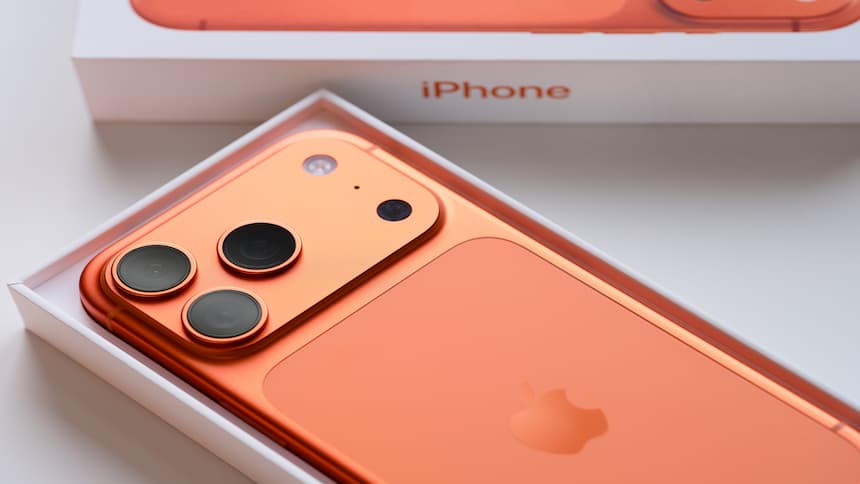
If the barometer of the tech retail market in 2025 was the iPhone 17, Allied knew how to gauge that temperature like no other. In the fourth quarter of 2025, the company not only rode the wave of Apple's global launch, but also transformed product scarcity into a competitive advantage.
For the first time in history, the iPhone surpassed Samsung in global sales in the last quarter of the year, and at Allied, the sales highlight was the Pro Max model, which recorded a 30% growth compared to its previous launch.
"We saw a very interesting trend in this launch. The model that grew the most was the Pro Max. This shows that the Brazilian consumer is looking for the top of the pyramid, which reinforces our strategy of offering services and insurance coupled with these high-value devices," says Silvio Stagni , CEO of Allied, to NeoFeed .
This consumer "hunger" for the top of the pyramid has fueled a circular ecosystem that is now the company's great differentiator. Through the "iPhone for Life" program, created in partnership with Itaú, Allied ensures the collection of pre-owned devices, which return to the market via Trocafy, its refurbished arm that is growing at a compound annual growth rate (CAGR) of 160%.
Allied's performance is also noteworthy when viewed within the context of the Brazilian macroeconomic scenario. By 2025, the smartphone distribution market in Brazil was projected to shrink by 9%. The main reason was the exit of large fashion retailers, such as C&A and Riachuelo, which ceased to be traditional electronics distributors.
However, where the market saw contraction, Allied saw opportunity. The company compensated for the loss of these clients and grew its distribution operation by 5.6%, consolidating a gain in market share. In notebooks, the movement was similar: while national distribution fell by 7%, Allied advanced by 15%.
"We found ways and grew in several other clients to compensate for those departures," says Stagni.
Less is more
The strategy for physical retail also underwent a review. Allied reduced its base from 112 to 98 stores throughout 2025, closing locations that did not deliver the desired profitability and migrating to premium locations, such as the Pátio Paulista and Ibirapuera shopping malls – the brand operates Samsung stores.

The result of this "cleanup" was a leap in productivity. Revenue per point of sale, which was R$206,000 per month in 2020, ended 2025 at R$545,000. This efficiency is driven by aggressive consultative selling. The calculation is that for every cell phone sold, Allied attaches, on average, 2.4 accessories and one insurance policy for every three devices.
For the investor, the bottom line is on the balance sheet. In a sector where the cost of debt has decimated profits, Allied operates with almost non-existent leverage, at just 0.2 times. This has allowed the company to become one of the highest dividend payers on the B3 (Brazilian stock exchange).
"We activated this cash preservation module in 2023 and we're not giving it up. It's a strategy that makes life difficult for the sales team, but it allows us to sleep soundly with a leverage of 0.2x in a market where the cost of debt is killing retail," says Thalita Basso, CFO of Allied.
A dividend yield of 14.2% in 2025 would already be noteworthy, but when combined with the effect of the capital reduction carried out in the third quarter, the total return to shareholders reached 37.5% for the year.
With a robust cash reserve of R$ 375.9 million, Allied enters 2026 protected against interest rate volatility and ready to expand Trocafy to new platforms, such as Shopee, where the operation debuted in the last quarter.
On the stock exchange, Allied's stock has appreciated by 6.25% in 12 months. By 2026, ALLD3 stock is projected to fall by 8.7%. The company's market capitalization is R$ 392.7 million.