


The Brazilian wind energy sector begins 2026 with a barrier that could hinder the progress of the main companies operating in the segment. There are two headwinds in this direction: the long period of the interest rate set at 15% per year and the lack of a solution from the federal government to end curtailment (the forced interruption of renewable energy generation).
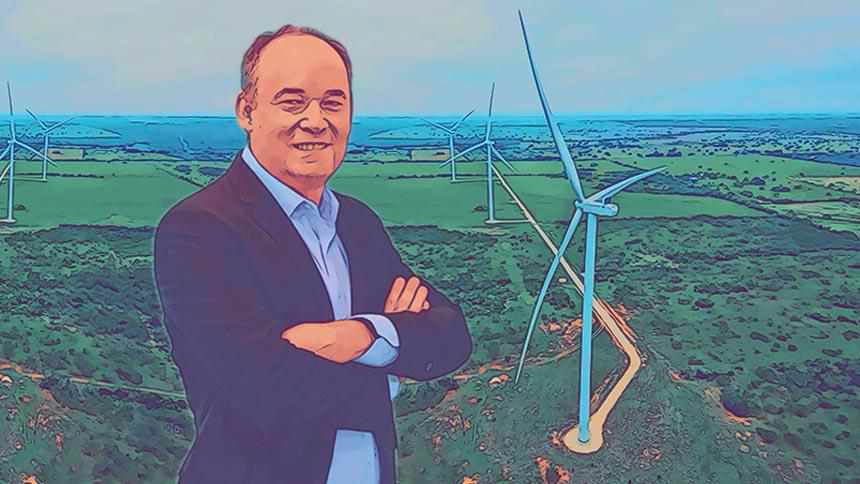
The assessment of the difficulties faced by companies in the energy sector comes from Eduardo Ricotta, CEO for Latin America of the Danish giant Vestas. According to him, the lack of mobilization to resolve these problems has caused Brazil to lose important data center construction projects to other countries, such as Mexico and Argentina.
“We are still experiencing a very significant structural difficulty. There are many incentives for distributed generation that unbalance energy sources and create inefficiency in the electricity sector. This has caused many problems in the market,” says Ricotta, in an interview with NeoFeed .
According to the executive, Brazil lacks a broader understanding of the differences between renewable energy sources to explain this imbalance. Solar energy, which benefits from federal incentives for the installation of solar panels that form the distributed generation system, registers a peak during the day and goes to zero at night.
In the case of wind power, the model is more consistent during the day, and at night, when there is a peak in electricity demand, production increases by 22%. "And with investments only in solar energy, based on federal subsidies, the numbers don't add up," he says.
In the case of interest rates, the impact has led to project delays due to the high cost of capital resulting from the need for financing. In this regard, Vestas has managed to mitigate the problem by undertaking projects in Argentina and Chile.
“This balanced Vestas’ revenue in Latin America in 2025. While Brazil was stagnant, we made progress in the region,” he explains. The realization of the difficulty of expansion in Brazil is that, at the end of 2025, a project unlocked the sector, but it was the only major contract signed in three years.
Vestas announced a R$ 5 billion contract with Casa dos Ventos for the construction of the 828-megawatt (MW) Dom Inocêncio wind farm in Piauí. In addition to building the project, the company will also be responsible for its maintenance for 25 years.
Ricotta acknowledges, however, that this was just a 'breath of fresh air' for the company in the country and that there is still a long way to go to reverse the downward trajectory of the wind energy segment in recent years.
“This was the biggest announcement made by the sector since 2023. The positive side is that we had a very good backlog . Since our cycle is every two years, we continued production. But if this scenario were to continue for longer, it would be difficult to maintain the current production chain,” says the CEO of Vestas.
“After so much time, a contract of this size has been very helpful in maintaining revenue in Brazil. I want to believe that this will send a new signal to the market, since the country now has one of the highest capacity factors in the world,” he added.
The project will begin construction in January of this year and will continue until the second quarter of 2028. It is expected to generate 8,500 jobs during this period. The wind farm in Piauí is projected to provide the equivalent of enough energy for two million homes.
"Casa dos Ventos has studies to determine precisely where there will be the least curtailment , and this is factored into the site evaluation for the project's construction." The equipment will be built at the Vestas factory in Ceará.
National Data Center Plan at Risk
But the fact is that there is a real risk that Brazil will continue to lose ground in Latin America to future artificial intelligence (AI) data center projects. Recently, OpenAI announced investments of up to US$25 billion to build mega-facilities in Argentina.
“We cannot miss the opportunity to export data, bits, instead of energy. Brazil could process all this information and send it to the world. But we have seen investors drawn to other countries in Latin America,” says Ricotta.
The magnitude of the problem becomes more evident when one observes that the National Data Center Plan aims to attract R$ 2 trillion in investments to Brazil over a decade. Brazil currently has 195 data centers, 57 of which are in São Paulo, according to the Data Center Map. And energy is precisely the largest resource for these facilities.
A provisional measure published in September by the federal government guarantees exemption from import taxes for products not manufactured in Brazil, in addition to other taxes. However, without changes to ensure a fairer cost for the energy source, part of the plan may remain just on paper.
And it is precisely this factor that may lead major investors to look more closely at other countries in the region. Chile, for example, has 66 data centers; Mexico, 62; Argentina, 43; Colombia, 41; Bolivia, 5.
“For Vestas, the outlook in Latin America is positive. In Brazil, these changes in the sector are necessary. And I hope the government doesn't fail to make the necessary changes just because we're in an election year,” points out the CEO. In the Latin American context, he sees projects in Argentina, Peru, and Mexico.
But, according to the Vestas executive, as long as the 75% subsidy rate for distributed generation remains, to the detriment of companies operating in the wind energy sector, the generation of energy from sustainable sources in Brazil will remain unregulated.
"Brazil can attract investors, but it's important to have a regulatory framework that reduces curtailment . There have been some changes, but we haven't solved the key problem."
While no new projects are emerging in Brazil, Vestas has been expanding its participation in the service provision division of existing wind farms. Today, the company is responsible for managing the equivalent of 12 gigawatts (GW) of energy.
Five years ago, that number was 1.6 GW. This area of the company experienced the most growth in terms of revenue. The company does not disclose revenue by country or continent. Brazil, however, is among Vestas' five largest markets in the world.
“We have grown almost tenfold over these years in operation and maintenance contracts. In addition to construction, we sign contracts to manage the wind farm for 25 years. And not just necessarily the ones we built,” says Ricotta.
Between January and September 2025, Vestas reported net revenue of €12.5 billion, a 12.53% increase over the same period of the previous year, when it reached €11.15 billion.
Over the past 12 months, Vestas' shares on the Copenhagen stock exchange have appreciated by 83%. The company is valued at US$28.7 billion.