

Led by Pope Leo XIV, the Vatican, the world's smallest sovereign state, has once again recorded a budget surplus after decades of financial difficulties.
A report released by the Holy See this Wednesday, November 26, shows a positive result of €1.6 million in 2024, reversing a deficit of €51.2 million recorded in 2023. In 2020, for example, the deficit was €66.3 million.
Vatican authorities hailed the improvement as a potential turning point in the quest to strengthen the fragile state finances. But they acknowledged that the change was made possible by restructuring the investment portfolio to meet guidelines set by an investment committee created by Pope Francis, who died in April of this year.
The structural deficit — which excludes one-off effects — reached €44.4 million in 2024, a 46.8% reduction compared to the €83.5 million of the previous year. According to the figures, the Catholic Church's financial revenue in 2024 rose to €75 million, compared to €45.8 million in 2023.
“Part of these results stem from extraordinary operations related to the reallocation of the portfolio in accordance with the new investment policy,” says Maximino Caballero Ledo, a Spanish executive who currently holds the position of prefect of the Vatican's Secretariat for the Economy, according to the Financial Times .
“The capital gains generated in this phase cannot be replicated with the same intensity in subsequent years,” Ledo told the state-run Vatican News agency.
He called for “prudent control of expenses and a constant effort to improve operational efficiency,” as well as initiatives to raise more donations in order to place the Holy See on a sustainable financial footing.
Nevertheless, the results should encourage Leo XIV, who faces the task of cleaning up the Vatican's precarious finances, including a huge pension fund liability, as well as restoring confidence in the notoriously deficient management of charitable donations.
Unable to incur debt, the Vatican relies on revenue from its vast real estate holdings, ticket sales for the Vatican Museums, and donations from the faithful to finance itself and distribute money to Catholic dioceses around the world.
But the Holy See was hit hard by the Covid-19 pandemic, which directly affected tourism. Donations also decreased by 23% between 2015 and 2019, a trend that continued in subsequent years after high-profile scandals, such as the case of Cardinal Giovanni Angelo Becciu, who was prosecuted and sentenced to five and a half years in prison by the Vatican Tribunal in 2023 for financial irregularities.
Although Francis has promised to eradicate financial corruption, the reform process has been turbulent. In recent years, the Argentinian had embarked on a strong cost-cutting campaign, which resulted in three salary reductions for cardinals between 2021 and 2024.
The Vatican lost around £100 million in a failed London real estate deal in 2021, after investing over €350 million of philanthropic funds in the project between 2014 and 2018.
In any case, donations to the Church registered a small increase in 2024, growing by about €20 million. "After years of slowdown, the fact that contributions have grown gives hope for a renewed participation of the faithful in the mission of the Holy See," stated Ledo.
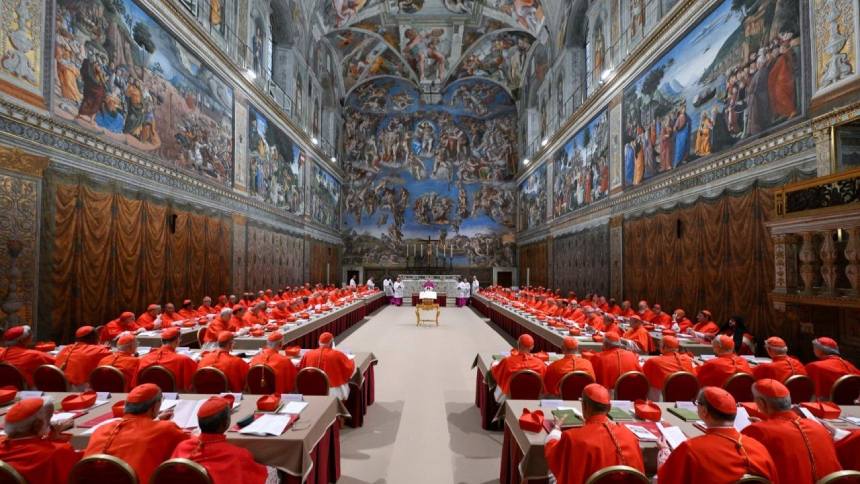
A few weeks after the conclave that elected him to lead the Vatican in May, the American Robert Francis Prevost, who would become Pope Leo XIV, launched an American-style fundraising campaign, with sophisticated promotional videos, QR codes, and online payments, to encourage Catholic faithful around the world to support his mission.
He also began reforming a fundraising committee that Francis had established in February while he was ill, and which included neither professional fundraisers nor Americans, traditionally the church's largest donors.
In October, the pontiff also revoked a decree from the Francis era that required all assets and investments of the Holy See to be managed by the so-called Vatican Bank, which some clergymen complained had excessively concentrated power.