

Just hours after arresting Venezuelan President Nicolás Maduro, the United States left no doubt about its main objective in the country. "We are going to extract an enormous amount of wealth from the ground," said Donald Trump during a press conference, adding that the U.S. would keep a portion of the profits "as a form of compensation for the damage caused by that country."
But this will not be a simple mission. On one hand, companies want political stability to invest – and the scenario is still unclear. On the other hand, Venezuela's production infrastructure is dilapidated and will require billions of dollars in investment to revive. Furthermore, mechanisms need to be established for the return of oil companies to Venezuela.
Analysts interviewed by the American newspaper The Wall Street Journal (WSJ) believe that Venezuela could facilitate a process that would allow companies to bid on oil and gas blocks, and question whether European companies could also compete for the right to enter the country. Currently, only the American company Chevron operates in Venezuela, through various joint ventures with PDVSA, the Venezuelan state-owned oil company.
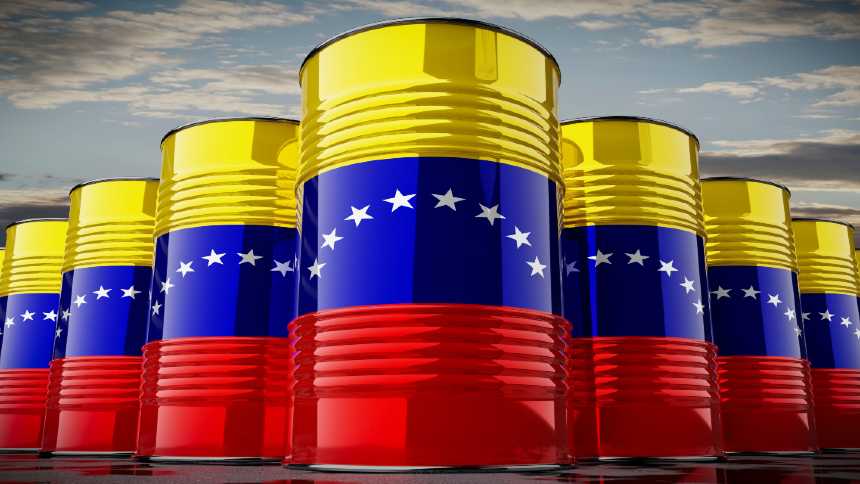
Venezuela possesses approximately 17% of the world's known oil reserves, equivalent to more than 300 billion barrels, a volume almost four times greater than that of the United States and exceeding that of Saudi Arabia, according to international energy sector organizations.
Currently, the country produces around 900,000 barrels of oil per day, a far cry from its heyday when production exceeded 3 million barrels per day. Chevron, which employs 3,000 people in Venezuela, is responsible for a third of this extraction. For this reason, it is believed that the impact on the price of a barrel of oil will be low.
The type of crude oil produced by Venezuela is denser than most crude oils consumed in the global market. Refineries from the US Gulf Coast to China and India are able to extract more profit from it than from other types of crude oil, making it highly attractive to the fuel industries.
Other major oil companies potentially interested in returning to Venezuela will certainly take time to assess the situation, as the country has a history of misappropriating oil assets, as it did in the 1970s and 2000s, analysts told the WSJ.
ConocoPhillips and ExxonMobil left Venezuela in 2007 after then-President Hugo Chávez nationalized its assets. Conoco subsequently sued the Venezuelan government for over US$20 billion, and Exxon for US$12 billion. The companies received partial settlements in lengthy arbitration proceedings.
Orlando Ochoa, an economist based in Caracas and visiting researcher at the Oxford Institute for Energy Studies, described the Herculean task of revitalizing Venezuela's moribund energy industry, which has seen tens of thousands of skilled professionals flee the country under Maduro's authoritarian regime.
According to him, a comprehensive economic stabilization plan will be necessary to attract the funding that Venezuela so desperately needs from multilateral institutions to rebuild its deteriorated infrastructure and oil facilities.
In his view, local laws need to be modified to allow private energy companies to operate without state interference. And the government that takes office after Maduro's arrest needs to restructure some $160 billion in debt and resolve pending arbitration proceedings with foreign companies to convince them to return.
“What the U.S. needs to do is implement a form of Marshall Plan,” Ochoa said, referring to the economic program that helped rebuild Europe after World War II. “It’s about much more than just getting into the oil and gas sector to extract crude oil from the ground.”
In short, the easy part was removing Maduro from power.