

Brasilia - After a seemingly endless imbroglio that has lasted almost 40 years regarding the complete paving of the BR-319, an 885 km highway linking Manaus to Porto Velho, the government is now trying to move forward with the licensing of the controversial stretch of road that is still unpaved.
NeoFeed has learned that the Minister of Transport, Renan Filho , is studying with his team the possibility of including the BR-319 highway on the list of projects to be considered strategic by the Government Council so that the highway can receive the so-called Special Environmental License (LAE). This is the new environmental license created by provisional measure (MP) and approved by Congress in December 2025, which streamlines the licensing process for large infrastructure projects in the country.
But there is a clash within the government. Minister Marina Silva (Environment) has always been critical of the project, arguing that deforestation would explode in the region and that the project would require environmental impact studies.
With the advent of the LAE (Special Environmental License), Ibama, the federal environmental agency, will have to issue a single license for these projects that are considered strategic (without complying with the traditional three-stage process: preliminary, installation, and operation licenses), within a maximum period of one year.
The idea for LAE was conceived and embraced by the president of the Senate, Davi Alcolumbre (União-AP), during the discussion of the controversial Licensing Bill, with the aim of trying to accelerate the licensing of large projects, such as oil drilling in the Amazon River estuary, on the Equatorial Margin .
The law, which has been the target of harsh criticism from environmentalists and the government's environmental sector, received 63 vetoes from Lula, most of which were later overturned by Congress. It is currently being challenged in the Supreme Federal Court (STF) following a lawsuit filed by the PSOL party and the Articulation of Indigenous Peoples of Brazil (APIB). The government also discussed whether to file a similar lawsuit in the Supreme Court, but ultimately backed down.
To ensure that projects can enter this new, more streamlined environmental licensing process (LAE), however, the government decided to regulate the Government Council, a body created in the 1990s but which has rarely met since then. Last October, President Lula issued a decree establishing a "Chamber of Strategic Activities and Projects" within the Council, exclusively to define which projects will be considered strategic.
The Council is not meeting for the time being, but government sources say that the government's infrastructure ministries are already preparing their lists for the body's analysis. The Council also includes the following ministries: Civil House; Attorney General's Office (AGU); Mines and Energy; Ports and Airports; Transport; Environment; Integration and Regional Development; Agrarian Development; Culture; Health; and Indigenous Peoples.
However, after decades of environmental disagreements and related discussions, there is an assessment within the government that there is now greater convergence between ministries and the issue is progressing more quickly.
The Civil House coordinates an interministerial group that has even been advancing a PPP (public-private partnership) model to handle environmental management and governance, a crucial point of resistance from the government's environmental area for years, since Lula's first two terms, according to information obtained by NeoFeed .
"The engineering project already complies with all Ibama regulations, and they looked at it in detail. But this will only be finalized next year. These are delicate matters that we can't afford to get wrong. I think the model will be finalized this year, and the contract will be signed next year," said a government source.
Hope in the Amazon
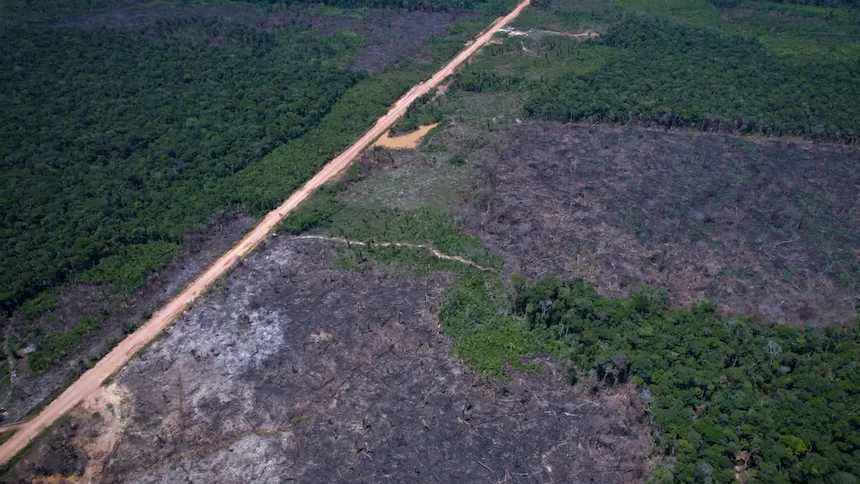
There is even an expectation that President Luiz Inácio Lula da Silva (PT), during a trip to Amazonas scheduled for the end of March, will announce the long-awaited release of the license for the "middle section" of the BR-319 highway - a 400 km corridor, surrounded by forest and indigenous communities, which has not received maintenance since 1988 due to environmental disputes.
“If we obtain the license during the president's visit at the end of March, that will mean that in April the bidding process will begin for the remaining 446 km, which is the middle section,” said Senator Eduardo Braga (MDB-AM), former governor of the state and a long-time advocate for the highway project, in an interview with the Amazonian press.
Braga is the author of an amendment incorporated into the new environmental licensing law, which came into effect at the end of last year, to facilitate the licensing of highways with already paved sections.
"It is precisely because of this new law that we are very hopeful that, when the president comes, he can finally grant the license," he stated. "If we put it out to tender in April and start in 2026, the work would be completed in the summer of 2030," he added.
Environmental bias
The BR-319 highway runs through one of the most socio-environmentally sensitive regions in the Amazon. Its route passes through indigenous lands, conservation units, rural settlements, public lands without a defined purpose, and private properties without land regularization.
It is not uncommon for the environmental licensing process itself, necessary to enable the paving of the unpaved section of the highway, to be the subject of a long legal battle that has already seen several twists and turns. Most recently, in 2022, the BR-319 highway obtained its preliminary license (the first stage of environmental licensing), during the administration of former President Jair Bolsonaro (PL).
In 2024, a preliminary injunction from the Federal Court suspended the reconstruction and paving of the "middle section" of the BR-319 highway, but within months a decision reinstated the license. Then, in July of last year, the Federal Court (TRF-1) again suspended the preliminary license for the highway. To this day, the discussion continues in the Federal Courts, in tribunals both in Brasília and in Amazonas.
In a statement to NeoFeed , the Ministry of the Environment did not comment on the prospects regarding the licensing of the BR-319 highway, but explained that the government has intensified actions to combat deforestation since 2023, "expanding oversight and coordinating the joint action of different institutions."
The Ministry also reported that the task force, led by the Civil House, has been conducting measures for "environmental protection and promotion of the socio-bioeconomy in the region, through integrated socio-environmental governance." "Governance consists of adopting instruments for inspection, monitoring, and territorial planning capable of ensuring that the highway's progress occurs sustainably," the ministry continued.
Among the measures, the Ministry of the Environment continues, are the "Strategic Environmental Assessment," aimed at mapping potential impacts in the BR-319 area, and also "emergency socio-environmental governance actions for the region of the road, within a 50 km strip on each side, to be promoted by federal agencies in coordination with states and municipalities."
"The goal is not only to halt the deforestation processes already identified but also to prevent their resumption in the future, while simultaneously creating an environment conducive to the development of sustainable productive activities linked to the socio-bioeconomy," the ministry stated.