



New York – In the Harvard Club's ballroom, a governor and a former governor were on stage at the Brazilian Regional Markets event, promoted by Apex Partners, and shared similar diagnoses about Brazil, although with different political styles.
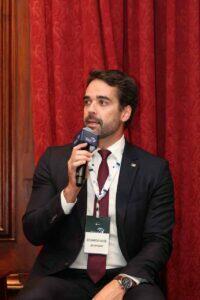
Eduardo Leite, from Rio Grande do Sul (PSD-RS), and Romeu Zema, who left the government of Minas Gerais (Novo-MG) to run for president, spoke to an audience of managers, businesspeople, and investors at a time when the market is trying to understand whether there is room, in 2026, for a center-right or right-wing candidacy capable of escaping the polarization between President Luiz Inácio Lula da Silva and Flávio Bolsonaro.
According to a national survey conducted by Futura Inteligência, an institute of the Apex group, carried out between May 4 and 8, 2026 with two thousand interviews, the electoral race appears competitive and volatile. Lula and Flávio Bolsonaro are technically tied in the first round and, in the most tested scenario for the second round, Bolsonaro has a narrow advantage — 46.9% against 44.4%.
"Brazilians will only start worrying about the election the day before," said Zema, who, in a presidential campaign tone, mixed liberal rhetoric, anti-PT sentiment, and an outsider narrative.
When asked about the possibility of running for vice president on a ticket, Zema jokingly replied that he had "good news and bad news." "We'll be together in the second round," he said, drawing laughter from the audience.
Then, he cited the example of Chile, where right-wing candidates ran separately in the first round before later uniting. He also mocked rumors about political negotiations, stating that "the only invitation" made was his to Flávio Bolsonaro—and that he never received a formal response. Regarding the opposite, he stated that it was just "talk."
Having lost to Ronaldo Caiado in the PSD's internal race, Leite has not decided which path he will take in these elections. Therefore, he has appeared as an institutional manager, attempting to sell Rio Grande do Sul as a laboratory for governance, concessions, and fiscal reorganization.
“I want to draw attention to fiscal adjustment, which seems extremely harsh and unpleasant. And it is. But it remains in the debate as if it weren't,” Leite stated. “If the Brazilian state implements adjustments, will it be more absent from people's lives? No, on the contrary, it will be strongly present.”
Below are the main highlights of Zema and Leite's participation.
Privatizations: a political, not a financial, disruption.
With the approach of the elections, the issue of privatization comes to the forefront of debates due to the agenda of right-wing candidates regarding public companies.
Leite defended the privatizations carried out in Rio Grande do Sul as a structural change in the role of the State and not just a fiscal agenda.
“A public company will always be privatized, in some way. Either it will be captured by the employees' union, serving corporate interests, or it will be captured by a political party. And we see this at the national level as well,” said the governor of Rio Grande do Sul.
"So, public in the sense of belonging to the people, it isn't. That's the truth. But the problem is this: those who are there aren't directly responsible because the losses will also be borne by the people," he added.
Leite cited the privatization of the state's energy, gas, and sanitation companies as an example. According to him, Corsan invested around R$ 400 million per year at its peak under state control. After privatization, investments jumped to approximately R$ 1.5 billion per year.
According to Leite, governments should focus their political energy on areas such as public safety, education, and infrastructure, and not on managing internal conflicts within state-owned companies.
On the economic agenda, the debate on public safety
Public safety emerged as an economic focus in Eduardo Leite's speech, who directly linked the fight against crime to attracting investments and retaining talent.
According to Leite, Brazil will need to treat public security as a national agenda coordinated by the President of the Republic, but respecting the autonomy of the states.
"It's not a matter of choosing between fighting crime in the outskirts of the city or financial crimes. You have to confront both," said Leite.
The governor stated that organized crime has now gone beyond the outskirts of cities and reached sophisticated sectors of the economy.
According to him, the key difference was not new legislation, but a permanent structure for data monitoring, accountability for results, and integration between security forces, the Public Prosecutor's Office, and the Judiciary.
"It's not about having another law. It's about governance dynamics," he stated.
The third way between rejection and admiration.
A national survey conducted by Futura Inteligência, with a margin of error of 2.2 percentage points, shows that the race is not only numerically tight, but also marked by high rejection of the leading candidates and a tense institutional environment.
President Lula's approval rating is below 50%, while the Supreme Federal Court (STF) and the National Congress register significantly lower rates, placing institutional issues at the center of the electoral dispute.
The dynamics suggest that the election tends to be decided more by whoever manages to reduce their rejection rate than by whoever expands their support base.
"Brazilians will only worry about the election the day before. Next month we have the World Cup, and most Brazilians are more than busy doing odd jobs to survive. So, Brazilians will only focus on the election the day before," said Zema.
"Elections, I can say from the sidelines, are something totally uncertain and unpredictable. I'm not saying this year is a repeat. Each election has its own particularities. But, for more than 20 years, Brazilians have only voted against someone or something. They are driven more by rejection than by admiration," he added.
The "new CLT" and the end of the 6x1 work schedule.
Romeu Zema, former governor of Minas Gerais.
While the National Congress decides on ending the 6x1 work schedule, Romeu Zema criticized the proposals defended by the federal government.
According to Zema, labor measures discussed on the eve of the election have a strong populist component and do not address the main problem of the Brazilian economy, which is low productivity.
The former governor stated that Brazilian workers need more income and advocated for the creation of new employment formats beyond the CLT (Consolidation of Labor Laws).
"Today, there's only one system for working. But we should have hourly contracts, as already exists in several countries," Zema stated.
The proposal advocated by the Novo party's presidential candidate would be to maintain the current CLT (Consolidation of Labor Laws), but allow for more flexible parallel models, negotiated directly between companies and workers.
The former governor also stated that Brazilian labor legislation has become excessively rigid and criticized decisions by the Labor Courts which, according to him, weakened advances promoted by the 2017 labor reform.
The feverish unfolding
With Brazilian families' debt exceeding 80%, Zema was questioned about Desenrola 2.0, the federal government's program to reduce the burden of interest payments on people's finances.
For Zema, the program is like putting a feverish patient in an ice bath: the fever goes down, but the problem isn't addressed.
"The day Brazil experiences the shock I'm talking about, which is the relentless plan: save, privatize, don't steal, and prosper, we will move forward," said the former governor.
“A 6% interest rate in Brazil is entirely possible. When interest rates fall, projects that are currently unfeasible will become viable. Investment will increase. When investment increases, industry modernizes, becomes more competitive, more productive, and consequently, income increases. It's about leaving the vicious cycle and entering a virtuous one,” he added.