


An artificial intelligence algorithm named Giuseppe. Capable of analyzing and mapping an extensive database of molecular properties of animal-derived foods. And of reproducing their flavors and textures in new products developed from plant-based ingredients.
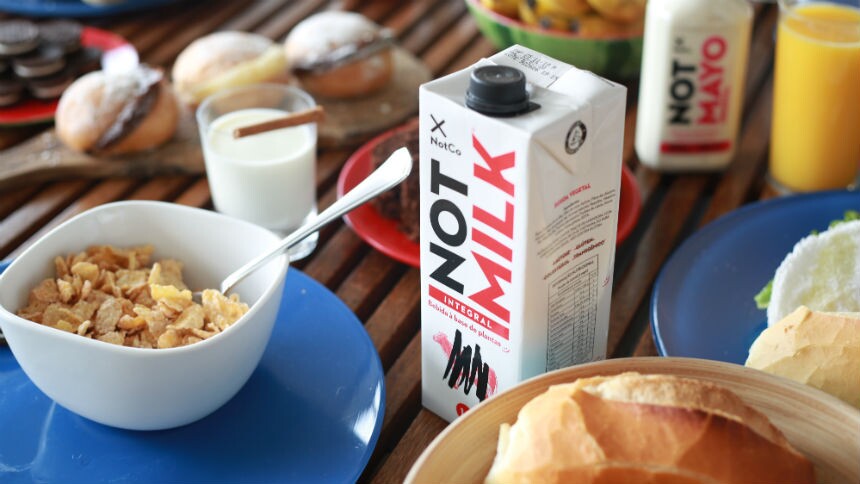
With this formula, the Chilean foodtech company The Not Company, founded in 2015, created recipes such as NotMayo mayonnaise and NotMilk milk. And it piqued the appetite of Bezos Expeditions. In March 2019, billionaire Jeff Bezos' fund led a US$30 million funding round in the startup, its first and only investment in South America.
Investors in the Chilean startup also include other big names, such as the Argentinian asset manager Kaszek and Maya Capital, owned by Lara Lemann , daughter of Jorge Paulo Lemann.
Around the same time it received funding from Bezos, the startup, better known as NotCo, launched in Brazil. Now, it needs to overcome some obstacles to ensure its products aren't limited to the budgets of a select few consumers in the country, which is seen as its main market for the coming years.
“We had to slightly change our positioning in Brazil,” says Matías Muchnick, CEO and co-founder of NotCo, to NeoFeed . He cites the impact of higher local taxation on plant-based products on operations. “Today, we are a premium product company in the country.”
A one-liter carton of NotMilk, for example, sells for an average of R$17.90. According to Muchnick, this is the main reason for the low share of plant-based milk in total milk consumption in Brazil, at around 2%. Meanwhile, in countries like the United States, Mexico, and Chile, this figure is 14%, 7%, and 5%, respectively.
“It’s strange to think that a healthy and sustainable product is subject to this burden,” he says. “But we will do everything we can to lower prices and allow more people to have access to our products.”
The first step was investing in local manufacturing. At the end of last year, NotCo closed three partnerships for the production of each item in its portfolio – the names of the partners are not revealed. In addition to milk and mayonnaise, this menu includes ice cream, launched in Brazil in December.
With Brazil's rich biodiversity, the company is also seeking partners to develop research and local ingredients that offer lower costs compared to the inputs currently used in its products. Still in its initial phase, the strategy aims to establish agreements with producers and in sectors such as the pharmaceutical industry.
This approach is directly related to the plan to establish a research laboratory in the country. And to the anticipated expansion of the Brazilian office team, currently composed of 16 employees and led, since August, by Luiz Augusto Silva, a former Danone executive. The goal is to end 2020 with 50 professionals.
The company is also investing in expanding its retail presence. After the initial partnership with Pão de Açúcar, the company has been seeking large chains and distributors, especially in São Paulo. It has already closed deals with brands such as Carrefour, St. Marche, and Sam's Club, as well as the Zona Sul chain in Rio de Janeiro and Angeloni in Santa Catarina.
The expansion of this distribution chain, a factor cited by Muchnick as another major challenge for NotCo, is also part of the efforts to reduce prices at the point of sale. "As we gain scale, we will have more leverage to negotiate better terms with suppliers and partners," says the CEO.
Trending
While factors like taxation still hinder supply, according to the CEO of NotCo, the same cannot be said about the demand for more sustainable products. "This issue has gone from being a trend to becoming mainstream," says Muchnick. "Increasingly, how a product is manufactured, its origin, and its impacts on the climate and the environment are weighing heavily on consumers' decisions."
Some projections follow this optimistic view. The Swiss bank UBS, for example, predicts that the global market for plant-based proteins will grow 28% annually until 2030, increasing from revenues of US$4.6 billion in 2018 to US$85 billion.
Today, there are already examples that reinforce these positive prospects. One of the pioneers in the production of plant-based burgers, the American company Beyond Meat, went public in May 2019. In the process, it raised US$241 million and was valued at approximately US$1.5 billion. And, despite fluctuations since then, today the company has a market value of over US$7 billion.
“Our model is similar to Beyond Meat’s offering,” says Muchnick. “But we’re aiming for a better product. And in four categories, not just one.” In this context, NotCo plans to launch its burger in the coming months. And it’s already developing new lines, including one with tuna.
The founding trio of NotCo: Karim Pichara (left), Matías Muchnick and Pablo Zamora
Meanwhile, the startup sees intense activity from large, traditional companies seeking to gain a presence in this space, whether through partnerships or by acquiring stakes in foodtech companies.
Nestlé has been one of the most active in this process. On January 24, the Swiss giant announced its most recent strategy in this direction, closing a partnership with the Canadian companies Burcon Nutrascience and Merit Functional Foods for the development and production of plant-based proteins.
One of the world's largest animal protein companies, the American firm Tyson Foods, is also making moves. During the World Economic Forum in Davos, the company announced the creation of the Global Protein Coalition, with the goal of promoting sustainable proteins.
In addition to launching a brand to bring together its plant-based products, Tyson Foods has already invested in companies in the sector, including Beyond Meat and the American companies Memphis Meats and New Wave Foods .
The long list of examples also includes partnerships between McDonald's and Beyond Meat, and between Burger King and the American company Impossible Foods , to test and sell vegan burgers. Impossible Foods, one of the world's leading foodtech companies, has already attracted investments from funds such as Temasek and Google Ventures.
Aware of this race, NotCo doesn't seem to fear the increased competition, especially from the traditional giants of the food industry. "We are ahead of these companies in terms of technology and also in how we communicate with consumers," says Muchnick.
He emphasizes that NotCo was born into this world, unlike these companies, which need to convince the new consumer profile that they are sincerely embracing this cause. And not just from the perspective of market opportunity.
“Our barrier is still distribution. But their challenge is greater than ours,” observes Muchnick, who says he is open to partnerships. He rules out, however, any acquisition proposal made by these companies. “We are a reaction to the model they propose. If we accepted any agreement, we would lose our entire purpose.”
Follow NeoFeed on social media. We're on Facebook ,LinkedIn , Twitter , and Instagram . Watch our videos on our YouTube channel and subscribe to our newsletter to receive daily news.