



Anyone who rides a bicycle knows that when you stop pedaling, a fall is inevitable. In recent years, a number of urban mobility startups have emerged with aggressive expansion plans and are heavily funded by venture capital funds.
Companies like the American Lime and the Latin American Grow (a merger of the Mexican Grin and the Brazilian Yellow) have changed the landscape of large cities, such as São Paulo and Rio de Janeiro, with their shared bicycles and electric scooters.
But since the beginning of this year, these two startups have been slowing down. Lime, for example, has ended its operations in Brazil. Grow announced on Wednesday, January 22nd, that it would reduce its operations and exit 14 cities, remaining only in São Paulo, Rio de Janeiro, and Curitiba.
Not only that, Grow also stated that it would temporarily suspend its bike-sharing service in all cities "for a process of checking and verifying operating and safety conditions," according to a statement from the startup.
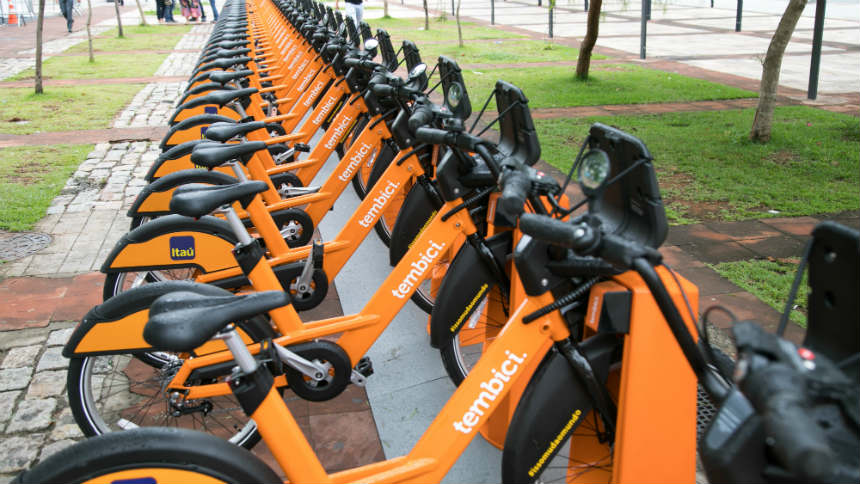
Meanwhile, there is a company that is bucking the trend of this crisis in the shared bike and scooter sector. It's the Brazilian company Tembici, founded in 2009 by entrepreneurs Tomás Martins and Maurício Villar, which became known for its orange bicycles in a project sponsored by Itaú.
“We are going against the grain and betting on product quality,” said Martins, CEO of Tembici, in an interview with NeoFeed . “And we have very ambitious plans.”
The entrepreneur did not provide details about Tembici's expansion project, which counts Joá Investimentos, owned by TV presenter Luciano Huck, a potential presidential candidate in 2022, among its investors. However, NeoFeed has learned that the company plans to expand to new cities and will invest in electric bicycles.
Today, Tembici operates in São Paulo, Rio de Janeiro, Salvador, Recife, Porto Alegre, Belém, Manaus, and Vila Velha (ES). Last year, the company also began its internationalization project in Buenos Aires, Argentina, and Santiago, Chile.
In 2019, there were 22 million trips, more than 80,000 per day, using Tembici's 16,000 bicycles, which are produced in its own factory in Extrema (MG). According to the company, this represented a 106% increase in the number of trips.
Tembici has a different business model than its rivals. Unlike Grow, for example, the company's bikes need to be picked up and returned to stations. Consumers pay for daily, monthly, or annual packages and can use the bicycles unlimitedly, but in one-hour increments. If they exceed that time, they pay an additional fee depending on the extra time.
One of Tembici's main sources of revenue is the presence of sponsors in its projects. Itaú is the main one. But the company also relies on other companies, such as the Banestes bank, the health plans Hapvida and Unimed, and the Mastercard credit card brand. "It's a beneficial way to link the brand to a city project," says Martins.
Last year, Tembici conducted tests with electric bicycles in São Paulo. And, according to Martins, it was a success. Trips with this type of bike are two to three times more frequent than those made with traditional bikes.
The company also tested electric scooters in a project with Petrobras in Rio de Janeiro. But the project did not move forward. One of the reasons, according to Martins, was the cost, which was not very accessible to the user. "We were unable to address a scalable solution and decided not to proceed with the investment," says the CEO of Tembici.
Although he doesn't reveal specific figures, Martins says the operation is financially sustainable and affirms that competitors are always welcome. "We've never been alone," he says, believing that more companies will help promote bicycles and scooters as a viable mode of transportation in large cities.
Crisis in the sector
The bike and scooter sharing business has never been easy. Who doesn't remember images of thousands of abandoned and piled-up bicycles in China in 2018, where several companies went bankrupt?
Even so, venture capital funds supported several initiatives around the world. Grow was one of them. Created in January 2019, the company received US$150 million shortly after the merger. The investment included participation from funds such as Monashees, 500 Startups, DCM, GGV Capital, and Base10 Partners.
The Brazilian company Yellow, whose founders were the former president of Caloi, Eduardo Musa, and the entrepreneurs Ariel Lambrecht and Renato Freitas, founders of 99, the first Brazilian unicorn, had also been heavily funded. In total, it had received US$72 million before the merger.
But everything went wrong for Grow. According to a report in the newspaper O Estado de S. Paulo , the company failed to secure US$150 million that was being negotiated with Softbank in a new investment round. And it had to change its plans.
Differing visions about the company's future also contributed to the disagreements between the partners. Musa and Freitas left the partnership. Lambrecht is no longer with the company and is only a shareholder.
“Planning this restructuring has presented us with difficult but necessary decisions to improve our service offerings and consolidate our operations in Latin America,” said Jonathan Lewy, CEO of Grow, in a statement. “The micromobility market is fundamental to revolutionizing how people move around cities, and we continue to believe that this market has room to grow in the region.”
Before Grow, Lime had already decided to leave Brazil, six months after starting its operations in the local market. In a statement, the company said the decision was part of a global strategy to achieve financial sustainability. In Brazil, it operated in São Paulo and Rio de Janeiro. The decision also affected 12 cities around the world, seven of them in Latin America.
Tembici now has a window of opportunity to pedal practically on its own – at least for a while. It just can't stop. Otherwise, a fall will be inevitable.