


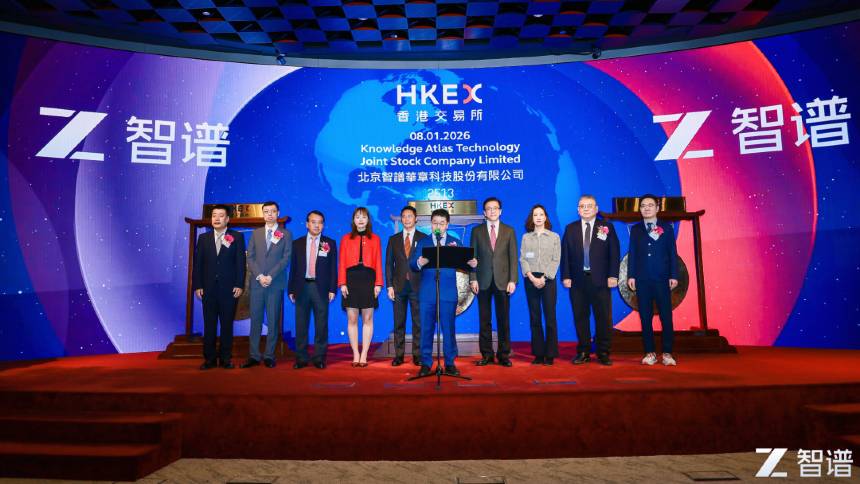
Zhipu's debut on the Hong Kong stock exchange served as a barometer of investors' appetite for Chinese artificial intelligence companies at a time of intense global competition, geopolitical constraints, and increasingly selective capital.
Shares of Knowledge Atlas Technology JSC, better known as Zhipu, rose as much as 15% in its initial public offering, after the company raised US$558 million.
With this, the Beijing-based startup became the first major Chinese developer of programming languages to go public, a move that helps to give clearer outlines to China's strategy to compete for leadership in AI with the United States.
The IPO valued Zhipu at approximately HK$4.3 billion (US$551 million), a significant valuation for a company founded in 2019, but still far from the American giants in the sector.
Nevertheless, analysts see the operation as a significant step toward institutionalizing the Chinese AI ecosystem, at a time when the government is encouraging the creation of national champions in technologies considered strategic.
Zhipu is part of the group known in the market as China's "AI tigers"—startups focused on developing large language models (LLMs) with the ambition of rivaling companies like OpenAI and Anthropic. The group includes names like DeepSeek, which gained global prominence after launching models considered competitive in performance and cost.
In the case of Zhipu, Beijing's support is one of the main pillars of the investment thesis. Founded by researchers from a major Chinese university, the company positions itself as a strategic asset in a scenario where China seeks to reduce its technological dependence on the West, especially in sensitive areas such as artificial intelligence and semiconductors.
This state backing, however, comes with risks. In January of last year, Zhipu was included on the U.S. Department of Commerce's Entity List, under the allegation of collaborating with the Chinese armed forces. The decision limits the company's access to advanced technologies and expertise in semiconductors, a structural bottleneck for any developer of large-scale AI models.
Despite restrictions imposed by the US, Zhipu has managed to advance its international expansion strategy. The company maintains offices in the United Kingdom, Singapore, and Malaysia, in addition to operating in the Middle East and Southeast Asia, where it runs joint innovation center projects in countries such as Indonesia and Vietnam.
This move suggests a clear attempt at geographic diversification and mitigation of regulatory and political risks. At the same time, it raises questions about the company's ability to sustain economies of scale and technological competitiveness without unrestricted access to global supply chains for cutting-edge hardware.
From a financial standpoint, Zhipu is still in its early stages. In 2024, the company recorded revenue of 312.4 million yuan (approximately US$44 million), a modest figure when compared to the investments needed to train and operate large-scale language models. Not surprisingly, the company stated in its prospectus that it intends to allocate approximately 70% of the funds raised in the IPO to research and development.
The positive performance of the shares on their debut indicates that, at least in the short term, the market is willing to bet on the long-term narrative of Chinese AI — especially when backed by state support and a clear sectoral consolidation strategy.
At the same time, the Zhipu case highlights the dilemma faced by these companies: growing fast enough to compete globally, but within an environment increasingly fragmented by technological barriers and geopolitical tensions.
Expectations now turn to the sector's next moves. MiniMax, another Chinese AI startup, is expected to file its own initial public offering in the coming days, once again testing investor appetite. The market response will help indicate whether Zhipu's IPO was an outlier—or the start of a new window for Chinese AI companies in the capital markets.