






















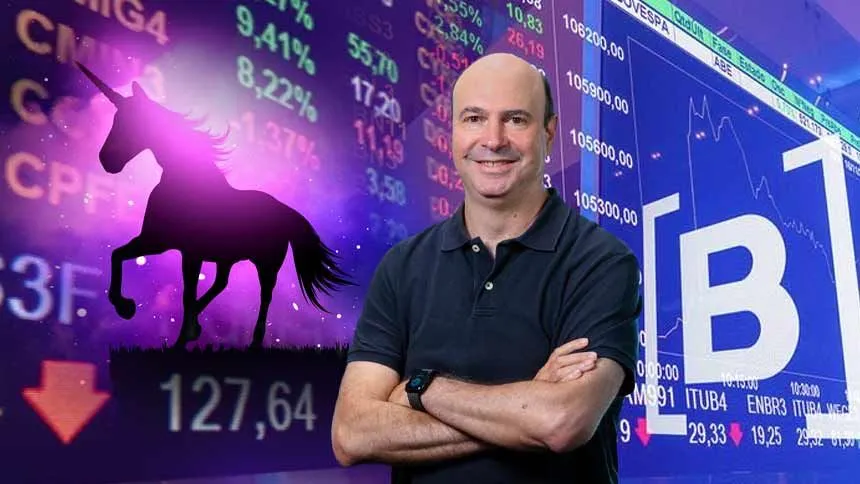

















































The Brazilian stock market is trading near all-time highs, but the support for this movement is concentrated in one central factor: foreign capital. According to Felipe Guerra, founding partner of Legacy Capital, an asset management firm with R$15 billion under management, the recent appreciation of local assets does not reflect a structural improvement in the domestic economy.
“If foreign investors leave, the stock market will plummet,” Guerra said on Café com Investidor , a program that interviews Brazil's leading investors, a partnership between NeoFeed and CNN Brasil, which will now air bi-weekly on CNN Money.
According to Guerra, local investors remain detached from the stock market due to high real interest rates. With the Selic rate at 14.5%, fixed income continues to offer returns considered high compared to the potential of stocks.
"Investing in the stock market becomes very unattractive when you look at the rate of return of companies," said Guerra, explaining the continuous reduction in domestic allocation to equity funds.
This space is being filled by foreign investors, who operate in an environment of lower interest rates in their countries of origin and seek diversification outside the major technology markets. "We see successive redemptions in local equity funds and, at the same time, foreign investors buying almost daily," he stated.
According to Guerra, the movement is less a bet on Brazil and more part of a global portfolio adjustment. He highlighted that the increase is not an isolated phenomenon. Other commodity-producing countries, such as Chile, Colombia, and Mexico, are also benefiting from the current international scenario. "Brazil didn't do anything specific to deserve this increase. It ended up being favored by an external context," he said.
The war in the Middle East appears as one of the pillars of this context. The conflict raised the prices of oil and other commodities, benefiting exporting countries. In the Brazilian case, the terms of trade improved and the initial impacts on exchange rates and the stock market were limited. "Brazil ended up relatively unscathed in terms of variable income and currency since the beginning of the war," he stated.
The most significant effect has been on inflation and, consequently, on interest rates. The rise in oil prices led to a revision of inflation projections and reduced the scope for deeper cuts in the Selic rate. Before the conflict, Legacy was working with the possibility of a more intense cycle of monetary easing. Now, the most likely scenario is a reduction of between 250 and 300 basis points. "Inflation has worsened, and this changes the trajectory of interest rates," he said.
In addition to the external scenario, the political calendar adds a factor of uncertainty. The 2026 presidential elections are not yet fully priced in, according to Guerra. Despite indicators such as historically controlled inflation and low unemployment, the political environment is considered competitive. "It's an open election. We'll only know the result on election day," he stated.
Given this set of variables, Legacy structured a portfolio with greater international exposure. The asset manager maintains long positions in global stock markets, focusing on the United States, and in companies linked to the technology chain associated with artificial intelligence, such as semiconductors, memory, and energy. "The world will need more energy and more technology to sustain this progress," he said.
In Brazil, the exposure is smaller and described as tactical. The asset manager maintains a reduced long position in the Brazilian stock market, contingent on the continuation of foreign capital flows. "It's very difficult to go against the flow," the manager stated, emphasizing that the strategy is to follow the movement as long as it persists.
In the domestic fixed income market, the preference is for positions that benefit from a potential drop in implied inflation, while in the currency market the strategy involves buying currencies from countries favored by high commodity prices and selling those most pressured by rising oil prices.


