



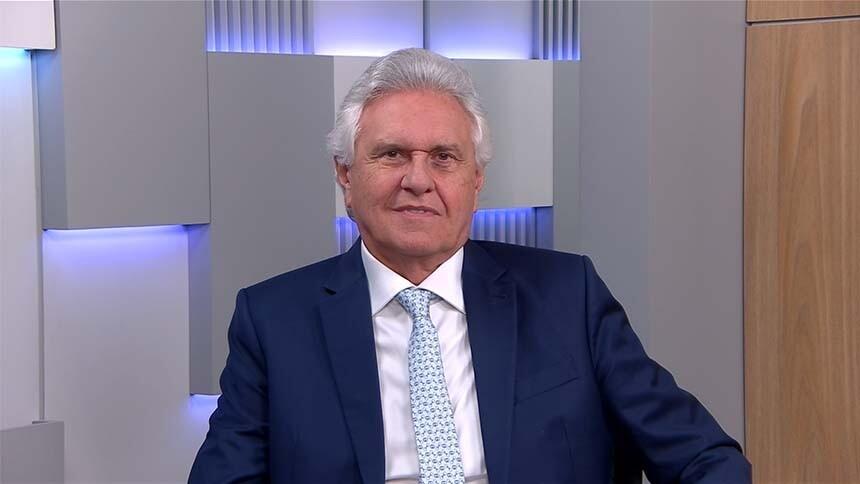
Former governor of Goiás, Ronaldo Caiado, enters the presidential race representing the PSD party, contrasting two statistics. On one hand, he achieved an 88% approval rating for his administration of the state of Goiás, according to a Quaest institute survey from August of last year, making him the highest-rated governor in Brazil. On the other hand, he scores only 3% in presidential voting intention polls, far behind Senator Flávio Bolsonaro (PL), the main representative of the right wing at this moment.
In an interview with the program Eleições 2026 , on NeoFeed , Caiado put another number on the table that could work in his favor: "50% of the population still doesn't know me," he says, eager for the official start of the election campaign in August, when the debates will begin.
Caiado wants to oppose President Lula, the biggest rival in the political field he represents. "He doesn't have a structural project," he states, having picked a fight with the federal government by opening negotiations to secure a memorandum of understanding with the United States for the sale of a rare earth mine in Goiás.
While emphatic in his attacks on the Workers' Party candidate ("If he wins, the dollar will rise in two minutes... we'll have Dilma 2"), Caiado remains calm when speaking about Flávio Bolsonaro, although he believes that Bolsonaro lost his chance to win the election due to the repercussions of the Master case .
A five-time congressman, one-time senator, and re-elected governor in the first round in 2022, the pre-candidate is confident in the results he has achieved in his state. There has been a reduction in crime rates and an improvement in the state's scores on the Basic Education Development Index (Ideb), in addition to investment in the Center of Excellence in AI (CEIA), created in 2019. "I'm not going to say anything that can't be researched by everyone," he assures.
This is not his first time running for president. In 1989, at just 39 years old and then leader of the Rural Democratic Union, he garnered only 0.6% of the vote in that election. "I lacked experience and gray hair," he acknowledged in this interview.
Below are the main excerpts. You can watch the full interview in the video above.
Right-wing alliance and Flávio Bolsonaro
"I think it's normal in an election campaign to have a first round where parties launch candidates, within the projection of a two-round system. You could say: Lula is in a privileged position this time because no one is competing against him. That's true. However, we also don't have any candidate in the first round who has Lula's name recognition , right? He's been in every presidential election and has already been elected. We need to have the largest number of candidates possible to also be known in certain regions."
In my case, 50% of the population doesn't know me. I understand that you have to analyze the candidate who performs well in the first round. But the fundamental point is to see what the safe path is to defeat the PT, which is Brazil's only adversary. What path is capable of reaching the second round and winning the elections? Interpreting what the polls are showing, if I go to the second round, I am the person who all the polls place closest to Lula.
This series of polls has made it very clear that Flávio has lost his chance to win this election. In the second round, he will distance himself from Lula. If the goal is to win the PT election, my candidacy, at this moment, has a much more suitable profile to face Lula in the second round."
"In my case, 50% of the population doesn't know me."
Revenge in politics
"Something has been created in the country that is not a characteristic of Brazilian politics. The PT and the PL have managed to create a political situation where one feeds off the other. It's like a championship, a rematch. One won, then the PL, then the PT. An election is a game that has to show who has the best conditions, who has the qualifications to assume the Presidency of the Republic."
I'm not going to learn how to govern in the Presidency of the Republic. I come from experience. I'm a seasoned politician, currently with five terms as a federal deputy, senator, and two state governorships. I left office with an 88% approval rating. I governed by pacifying, not fomenting discord. If I was elected with 52% of the vote in the first round, how can I leave with 88% approval in the state? Those who didn't vote for me said: he delivered even more than I expected.
I believe that by October 4th, we will be able to show people that what the country needs is a president with moral authority, who knows how to behave in the face of this institutional disorder that has taken hold in Brazil. The branches of government have completely lost prestige with the people. This disenchantment, this discredit, instead of being analyzed as the main point, remains anesthetized, in that thesis of a revenge in 2018, 2022. It remains about amnesty or not amnesty, sentencing or not, and there is no debate about health, education, security."
20 years of PT in power
"I participated in the election in 1989. The first election held in Brazil after the country's redemocratization period. So, 37 years have passed since then, and the PT has been in government for 20 years. There's no clear development plan for the country."
People don't want to see the importance of this election. And that's why I have to participate in several debates. What if the PT wins again? With interest rates, with violence, corruption, with drug trafficking, with the low efficiency of work results, with the current situation that makes the entire productive sector in the country unviable due to household debt."
Gilberto Kassab vice
"He [Kassab] is an important politician on the national stage. We have already scheduled our national convention for July 26th. Until then, this process will be discussed and debated among us. An opposition candidate never burns their name like this right from the start. I think we have to be very honest here with everyone who is listening. It will be a difficult time that the country will go through. But Brazil's wealth today is so great that its capacity for growth is enormous. I am in a state that was bankrupt when I took office and I am handing it over with R$ 9.8 billion in cash."
Presidentialism and "amendment brokers"
"Work is done within the framework that the people will choose as the government program. If they support my project, my project will be implemented. I am in a presidential system. I don't know of any other system of government where there are 594 projects for the country, from 513 deputies, plus 81 senators. You have one government project. It belongs to whoever won the election. Deputies and senators cannot be mere intermediaries for amendments."
I know Congress; I've always been an active member of parliament. Today, you're voting on amendments to the Brazilian Constitution using virtual voting. You no longer go to Brasília, you don't debate in committees. Issues are brought up on the eve of elections, in an irresponsible populist process, without any consequences for fiscal balance.
"Any ruler who lacks the capacity and courage to govern is always a prisoner of some problem or scandal. Is there going to be a parliamentary inquiry into him? Then release more... it's the mandatory personal amendment, the caucus amendment, and the committee amendment. It's not a small amount. What is discretionary for the government is 100% contingent. So, what is a Minister of State worth? Worthless! I respect parliamentarians, but each one in their role."
"Deputies and senators cannot be amendment intermediaries."
Fiscal adjustment
"If Lula wins, the dollar will skyrocket in two minutes. Nobody will invest in Brazil because there's no legal security whatsoever. He'll continue spending more. Brazil will go through a Dilma 2. The bomb is already exploding in Lula's lap. My plan in the face of this collapse from a budgetary point of view is this: Nobody performs miracles. The president-elect must have the moral authority to call all the business leaders in Brazil, the people who actually govern the states, the representatives of all the workers and unions and say: 'I'm not going to perform miracles, I'm going to do what I did before.' I called all the branches of government and said: 'Tomorrow I'm going to cut 25% of the monthly allocation [transfer from the governor to the state assemblies and legislative chambers].' There was no way to pay the payroll."
I'm going to have to make this drastic cut, and when I do, the businessman will say: "At least I know he won't irresponsibly spend the trillion reais that were spent in three and a half years." Lula simply threw money around and didn't get results in terms of productivity or GDP growth.
I have absolutely no fear of assuming the Presidency of the Republic because I don't have a secret box. The truth will be reflected in my budget. This point is very important for whoever is sitting in the chair. The business community will know. First of all, I will make tough cuts to set a good example, and then I will reduce spending. Probably, among the many incentives that exist, there will be an increasing demand for qualified public servants. And we will advance in areas where we are a benchmark."
"I'm going to have to make this drastic cut, and when I do, the businessman will say: 'At least I know he won't irresponsibly spend the trillion reais that were spent in three and a half years.'"
Who will run the economy?
"I will seek out the best people, you can be sure of that. I governed with each secretary being better than me in their respective areas. Because I like to question people. I like to hold them accountable every day, every hour. I'm the one who speaks about partisan politics. A Minister of State does their homework. Did they manage it? Great. Didn't manage it? I replace them. That's the policy I pursued, and I left with 88% approval. We are talking to everyone."
Fiscal framework
"How many times has the fiscal framework been defrauded? It's included in government policies, and then a condition is created that shouldn't be within the fiscal framework. It has never met any of its goals. A government that will exceed 80% of its debt, GDP with a real interest rate of 10%, a situation of indebtedness for all families. The industrial sector, commerce, rural producers—areas I know well—everyone is indebted. And you see India, China, Asian countries growing. I [Brazil] don't have earthquakes, volcanoes, or climate problems. I have all this potential, but I haven't had a president for 20 years, which is how long they've been in power. Isn't Lula the best president Paraguay has ever had? Thousands of jobs are going there."
Rare earths and exporter of brazilwood.
"The state [state government] does not have the power to grant mining concessions. The concession belongs to the federal government. I know my limits. The exploration concession was granted by the federal government [to the Serra Verde mining company, from Minaçu, in northern Goiás, which belongs to an American fund, and joined forces with the Rare Earth company this year with an investment of US$ 2.8 billion]. Then the company arrived. It needed environmental authorization. I expedited the process as much as possible, within the rules, but I authorized it."
Then, at the beginning of 2024, she started producing. That's when I started to get a handle on things. What's happening? She's selling the [rare earth] concentrate. She sells a ton for US$70. That's just two elements, only two, out of 17. Let's take the most valuable ones, which are dysprosium and terbium. If you go to buy them, they cost US$1,000 per kilo. I'm selling them for US$70 a ton, that is, a thousand kilos. We continue to be simply an exporter of brazilwood. Just like in colonial times.
What is the most important piece of the crown jewels in the world today? Precisely these two minerals, dysprosium and terbium. There's China and there's us. The federal government still hasn't produced any report on Brazil's mineral potential. It doesn't know the richness of our subsoil.
"We remain simply an exporter of brazilwood. Just like in colonial times."
Memorandum with the USA
"I went to Japan and the United States and we signed memoranda that explicitly state the transfer of technology to us. Instead of selling it [rare earth] in its raw form, we sell it separately. Look, our ambition is still far from ideal, because what we really wanted was for Brazil to have invested in technology, in innovation. If it weren't an analog country, like Lula's government, we would already be in a position to produce batteries, semiconductor cables, medical devices, sophisticated weapons. We have two minerals in Brazil, potassium mines and phosphorus, which are not being exploited. And they are fundamental to agriculture today."
Riches beyond our capacity
"In Minas Gerais and Goiás, you have more than 80% of the world's niobium. I'm going to reconsider Brazil's positions abroad. Look, we have mineral wealth, in addition to our agricultural capacity. It's true that in terms of manufactured goods, we lag far behind other countries. I'm proposing that we don't just take raw land and send it abroad. A structuring project with industries, regardless of capital. It could be American, Japanese, Chinese. As long as it stays here, of course. With research, with a vision of knowledge, or we won't get anywhere. To sit at the negotiating table here under different conditions."
Artificial intelligence
"The government never intervened to stimulate artificial intelligence. When I arrived in Goiás, we held a selection process among professors at the Federal University of Goiás to create an Artificial Intelligence course. That university surpassed medical school in the cut-off score."
We produce biomethane in Goiás today, something that wasn't possible before. We have artificial intelligence, we have the development of rare earth elements, regionalization of health and education.
But what about the congressmen [when I govern]? I know how to call congressmen and senators and talk to them. Political disagreements will always exist. Now, this has never prevented me from taking more advanced steps in Brazil."
Public safety
"What is the biggest demand from the surveys conducted by citizens? Public safety. And there in Goiás, there was this idea that you shouldn't interfere in a fight between husband and wife. I use handcuffs. I was the first to put ankle monitors [on aggressors against women, by law enacted this year in the State]. Goiás is the state with the lowest percentage of homicides in Brazil today [Goiás was the 19th state in intentional violent deaths in 2024, and the seventh in femicides, in proportion to 100,000 inhabitants, according to the 2025 Brazilian Public Security Yearbook]."
Objectively, security will be the first topic. After the World Cup, I will present my government plan. I will implement the terrorism system [Caiado wants to classify the factions as terrorists] for one reason only. Because then I will have the entire structure of the Armed Forces to carry out an integrated operation with the countries that want to make an agreement. I will seek out all ten countries bordering Brazil, seeking a cooperation agreement, just as we did in the Midwest.
"During my years in office in Goiás, I spent R$ 17 billion on public security. I received R$ 980 million from the federal government, 5% of what I spent in seven years and three months. This shows you that security has never been a priority for the federal government."