







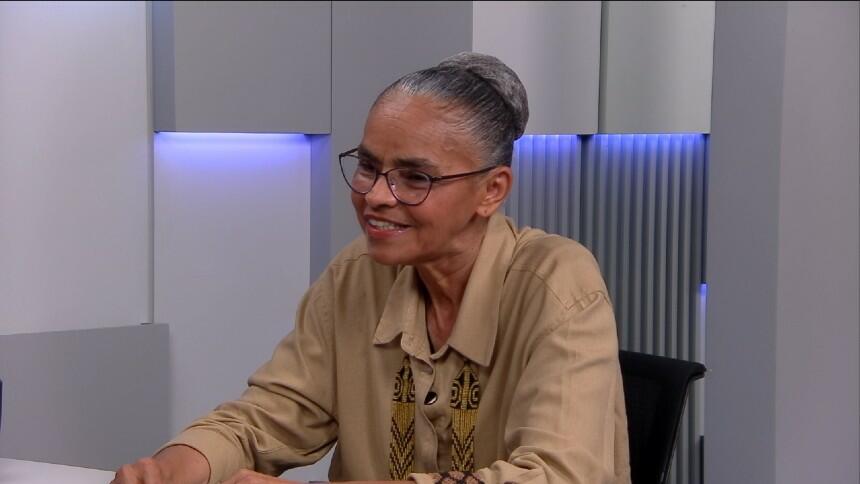
Marina Silva, pre-candidate for the Senate in São Paulo for the PSOL-Rede federation, is not intimidated to talk about the economy and the challenges of prosperity for the state and Brazil, even though her image is linked solely to the environment, since her days as a rubber tapper in Acre.
She knows that many executives see her as an obstacle to development, even though she is often the one who breaks the deadlock in international negotiations that secure investments for Brazil and require environmental approval.
Marina became known worldwide for her role as Minister of the Environment, a position she held three times during President Lula's administrations, including the current one.
She left her post to run for the Senate, satisfied with the reduction in deforestation in the Amazon and Cerrado biomes, which had reached peak levels of degradation during the previous administration.
“Agribusiness grew 2% [in the first quarter of this year] and deforestation fell 50% [in the last three years],” says Marina in an interview with the NeoFeed program Elections 2026 , highlighting her focus on the debate that stands out most when the topic is economic development.
“We don’t associate being an agricultural powerhouse with destroying our biomes,” she adds, understanding the environmental agenda as “pure economics.”
Ironically, the Donald Trump administration adopted data from the previous administration as one of the arguments to justify the new 25% tariff on Brazilian products. At the time, the Minister of the Environment was Ricardo Salles (Novo-SP), who is competing with Marina for one of the Senate seats.
The now former minister, with a vast political career, including three presidential runs, makes no secret of her willingness to become a senator for the state, where she was elected federal deputy in 2022 with 237,500 votes – she even took office in February 2023, but accepted the position of minister.
“I was elected in 2022, the same year that Tarcísio [de Freitas] came here from Rio de Janeiro and was elected governor,” she said ironically after being criticized by the governor for not having started her political career in the state.
"I know the ropes for many important, strategic investments so that São Paulo doesn't fall behind," says the woman who received the title of honorary citizen of São Paulo in the 1990s.
But Marina faces a challenging campaign. On trips to the interior, she had meetings with leaders who asked for photos with her, but did not make them public. "In a democracy, someone who holds a mayoral mandate is afraid to say they spoke with someone for fear of retaliation," she says, regarding the competitive atmosphere.
Read below the main excerpts from the interview, which is available in full in the video above.
Trump's new tariff hike and deforestation.
"It's almost funny that President Trump, who withdrew from the Paris Agreement and doesn't advocate for sustainable development, is now concerned about deforestation. But the deforestation he's referring to happened during the Bolsonaro administration, which is his closest ally, and also during Flávio Bolsonaro's administration. In fact, the peak he's referring to in 2021 was during the period when they were 'letting the cattle run wild'."
We have resumed and updated policies, created new instruments, and the result is that this year we may have the lowest deforestation rate since it began to be measured in 1985. This is public policy with a capital P, where you combine command and control instruments with economic instruments. Because it's not enough to say what can't be done. It's necessary to establish the correct way to do it.
"This year we could have the lowest rate of deforestation since it began being measured in 1985."
I've been saying this since 2003, when I was 45 years old and became a minister for the first time, and we started working on the environmental agenda based on guidelines. Environmental policy is cross-cutting. It has to be present in transportation, agriculture, energy, in all sectors that strengthen the National Environmental System. There's no way to establish what's right if those who are going to do the right thing are competing with those who are going to do the wrong thing.
"Is someone who practices sustainable forest management, who carries out logging in a way that allows the forest to regenerate, going to compete with someone who is stealing timber within indigenous lands, conservation units, or even on a neighbor's farm?"
Energy transition, bioeconomy
"The main hallmark of this administration was creating the economic instruments to bring about Brazil's ecological transformation. Investing in low-carbon agriculture, in the green reindustrialization of Brazil, especially in the energy transition to address climate change. New investments in the areas of bioeconomy, circular economy, and resilient infrastructure. Addressing climate change. I think we are on the right track, integrating the economy and ecology into a single equation."
Rare earths, AI and the environment
"As a minister, I greatly helped the government to consider what the appropriate rules would be to explore this potential that Brazil has. People say that we are the second largest [global land market], we have exploration possibilities that we don't have the in-depth knowledge of that we would like. Rare earth elements are very complex to explore."
As a minister, I've been helping to think about what these regulations would look like. We need to add value to our products, use them to develop domestic technology, and create material products that are relevant to our own economy and environmental regulations.
In the environmental area, we already have consolidated legislation that deals with oil and mineral exploration, as well as timber. The problem was this change made in the National Congress to the Licensing Law, which established that each state can now make its own rules. Imagine what that will be like? This will lead to litigation.
"In the case of rare earths, as with any undertaking, you have to have economic, social, and environmental viability."
In the case of rare earths, as with any undertaking, you have to have economic, social, and environmental viability. When this equation is balanced, Ibama grants the license.
In a republican government, nobody functions under political pressure. You have rules that are followed by the technicians. We have to establish the correct way to do things. It's a great opportunity for Brazil. "Ah, but what if it's on indigenous land?" It can't be on indigenous land; the Constitution says so. Now, not all rare earth elements will be within these indigenous areas.
Interest of the United States and China
"We have no prejudice against investors. We have rules to combat bad investors, those who want to default on their investments in Brazil. I think Brazilian society should create mechanisms to stop those who sell out the country, because this debate about rare earth elements is related to a view that believes developing countries, in this case Latin America and the Caribbean, are the backyard of the United States, and we are not."
We need to have a sense of patriotism. It's not about those who give, but about those who manage wisely and create opportunities for employment, income, wealth, and technological advancement for their own country. And in that sense, I think we need to make a distinction. Agribusiness, industry, regardless of ideology, must defend the interests, jobs, and investments of Brazil and not be held hostage by those with a subservient vision.
We are not going to distort the criticisms we have. We will make them, but we will not take advantage of them to harm an investment and business opportunity that was presented to Brazil. I learned this from my grandmother. A simple, illiterate woman, she used to say that dirty laundry should be washed at home. And I learned this from diplomacy.
"The environmental agenda is pure economics. When the G7 meeting was in 2024, who was invited to speak about biofuels at the G7 meeting in Italy? It was me. Because part of the restrictions on our biofuels is the argument that it will harm food security and destroy Brazilian biomes."
"The environmental agenda is pure economics."
Agribusiness, fuels and deforestation
GDP grew 1% in the first quarter of 2026. Agribusiness grew 2% and deforestation fell 50% [in the last three years]. We don't associate being an agricultural powerhouse with destroying our biomes. When we have this discussion within the G20, it's a complex discussion about biofuels being treated as a transitional fuel, as a nature-based solution.
This discussion isn't easy because the debate isn't about whether or not it was a transitional fuel. Of course it is. People say it isn't because they don't want the flow of money coming our way. But then you run out of arguments.
I was at a meeting with Mercosur and I showed that those who oppose compliance with environmental legislation represent about 1%. But it's a noisy 1%; 99% of farmers have production through productivity gains, technology, and innovation.
But they are not vocal. And that 1% vocal tarnishes the image of Brazil and agribusiness. And we go there and show the data. I created a deforestation control system in 2004, in real time. We opened more than 500 markets for Brazilian agribusiness. I always say that the agenda I work with is an economic agenda."
"We opened more than 500 markets for Brazilian agribusiness. I always say that the agenda I work with is an economic agenda."
Perception of environmental obstacles
"Generally, what is voiced is the action of command and control. Did you know that we managed to secure R$ 350 billion to invest in restoration for agriculture, energy transition, sustainable forest management, generating jobs and income in the Amazon regions, which were previously all illegal exploitation? Nobody knows that."
And I talk about this all the time, but only one side ends up getting emphasis. Perception is bad when you're doing something positive, and perception isn't always aligned with that.
Me and [former Finance Minister Fernando] Haddad went to launch a platform on the Stock Exchange in New York. We were going to raise something around US$2 billion with green bonds. Look, my grandmother had a saying: It was like butter on a cat's nose.
From there, we created a series of possibilities. I think it was something around US$350 billion [R$370 billion since 2023 from various funds]. It's not fictitious money flying around. There are some modalities of these investments where the government puts in R$1 and raises R$3, from the private sector and the financial sector.
We created a global fund to protect the rainforest, using the very logic of the market. Instead of cutting down the forest and then it becoming a problem for you – with water shortages, heat waves, droughts – you will profit from your forest.
Michelle Bolsonaro and evangelical female voters
"Since 2010, evangelical women and men have been increasingly asserting their legitimate role in political participation. Millions of human beings have the right to vote and to be elected."
I am an evangelical member of the Assembly of God, and I believe there was a repressed demand for participation in the political sphere. When I ran for president, both in 2010 and 2014, I received a very significant number of votes from evangelical people. In 2018, it was something out of the ordinary. That's when this instrumentalization of faith began, and through two biases that I consider very dangerous for a democracy: political fundamentalism combined with religious fundamentalism.
You can't instrumentalize politics for faith, nor faith for politics, because the State is secular. And it's necessary to know how to separate these things.
"You can neither instrumentalize politics for faith nor faith for politics, because the State is secular."
Women, across all political spectrums, are underrepresented. Of the 513 seats in the Chamber of Deputies and 81 senators, only 18% are women. That's why Simone [Tebet, PSB-SP] and I decided to help close this gap, in a context where violence against women has reached absurd levels.
And there are a number of explanations for why it's increasing, including the misogynistic discourse of far-right individuals who even question our vote. There is a difference between being conservative and being reactionary.
Those who are rising up are right. They are even denouncing the fact that this sexist view of women, this hateful view, has no basis whatsoever.
Prosperous society and strategic elite
"A society that is merely rich is not enough. A country has to be prosperous, because you can have half a dozen rich people. Now, a prosperous country will have rich people, but it will be similar to Japan. More than 90% of the people there are middle class."
"That's what we want for our country, a new cycle of prosperity. And São Paulo is the lever for this new cycle of prosperity."
Tiredness with the PT (Workers' Party), anti-Lula sentiment, and a divided society.
"This is a reality worldwide. We have a crisis of democracies. We have to provide answers for people's lives, showing that democracy is the best way to provide those answers."
"Now, you say you're tired of President Lula, but it was with this president that society identified a way to avoid another four years of Bolsonaro, because otherwise it would be the end."
Elite and strategic thinking
"We are speaking to a highly informed audience that understands all the consequences of having a country like Brazil, the power that we are, in the hands of those who lack strategic vision."
No country has problems because of an elite. A country has problems because of a lack of one. The elite are not those who have money. The elite are those who have strategic thinking.
"No country has problems because of the elite. The elite are not those who have money. The elite are those who have strategic thinking."
Look at the contradictions in the world. What has the mecca of liberalism and freedom of expression become, now intervening unjustly? We must reject any possibility of Brazil regressing. People with strategic thinking must work in that direction.
Oil on the Equatorial Margin
"The decision-maker is not the Ministry of the Environment, but the Energy Policy Council, which includes representatives from various ministries, academia, and so on."
"The world is changing very rapidly. The race for third and fourth generation fuels is in full swing. A lot can happen."
The Ministry of the Environment, through IBAMA, which is the agency responsible for licensing, does not act based on political influence. When all regulations are met, it grants the license. The technical decision prevails. And that was the case with the Equatorial Margin.
While the Campos Basin is perhaps the best known, the mouth of the Amazon River is the least known, and you can't explore for oil without knowing the basin. It's only for prospecting. That takes at least three to five years. I suggested that an environmental assessment be carried out for the sedimentary area during that period.
But there's a problem. The world is changing very rapidly. The race for third and fourth generation fuels is in full swing. A lot can happen. That's why President Lula, strategically at COP, proposed a roadmap to move away from dependence on fossil fuels.
Next comes the war [in Iran]. And now the Strait of Hormuz has created all this problem for all of us. We have to think strategically. Rich countries already have their maps to escape dependence. Brazil is finalizing the guidelines to create our roadmap, to make a medium- and long-term plan for new technological trajectories. And what if things change? The planet is warming. And if we have to stop abruptly, what routes do we have?"



