






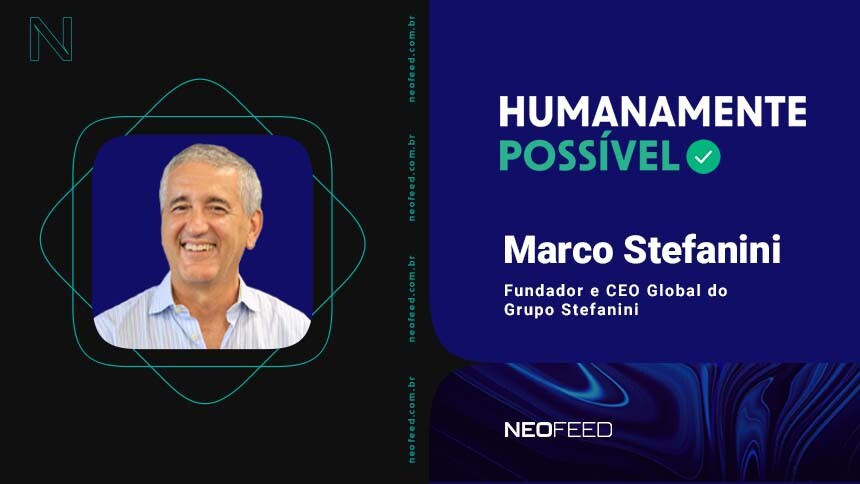







For Marco Stefanini, leadership has never been about centralizing power, but about knowing where not to be. Founder and CEO of the Stefanini Group, he built a Brazilian multinational technology company by betting on a principle that often goes against the instincts of many executives: relinquishing operational control to gain adaptability and scale.
This vision was detailed in the last episode of the first season of Humanamente Possível , a NeoFeed program presented by Leonel Andrade.
Stefanini explained that his company, which is expected to generate R$ 8.4 billion in revenue this year and has a projected growth of 15% in 2026, started with only him and his wife as employees. Much of the growth came from approximately 40 acquisitions, but with a unique strategy.
Aware that mergers and acquisitions are among the most complex operations in the corporate world, especially in technology, where the main assets are people and knowledge, the entrepreneur decided to build a decentralized organizational model, structured in cells that function as small businesses within the group.
Since its first acquisitions, the company has bought majority stakes in businesses where it sees potential, but keeps the founders at the helm of operations, responsible for management and results.
Each unit controls revenue, costs, and margins, reinforcing direct accountability and speed of decision-making. "Autonomy is not the absence of accountability. It's clarity of responsibility," says Stefanini.
Another lesson from his career path is discipline. Today, Stefanini has a physical presence in 46 countries and serves clients in more than 100 markets, but the group grew without external investors and without debt. "We never had an investor," he says. "I've always been very conservative from a financial point of view."
According to Stefanini, this choice directly shaped the type of leadership possible within the company. Without abundant capital, each decision needed to be sustainable over time, which reduced impulsive bets and increased the focus on efficiency, governance, and cash generation.
In times of crisis — from the Collor Plan in Brazil to the successive economic shocks in Argentina — this discipline has functioned as a survival mechanism. In the new technological cycle, marked by artificial intelligence, this logic gains even more relevance.
In the businessman's view, the main challenge for companies is no longer access to technology, but rather how they are led. "Creating technology today is not the problem. The problem is people's mindset ," he states.
In an environment where AI accelerates decision-making, reduces technical barriers, and shortens market cycles, overly centralized leadership tends to become a bottleneck. According to Stefanini, the competitive advantage lies in building organizations capable of learning quickly, delegating responsibly, and adjusting course without depending on orders from the top.