








Defining what constitutes the core business and what can be treated as a commodity has become one of Itaú Unibanco 's most sensitive decisions in adopting artificial intelligence.
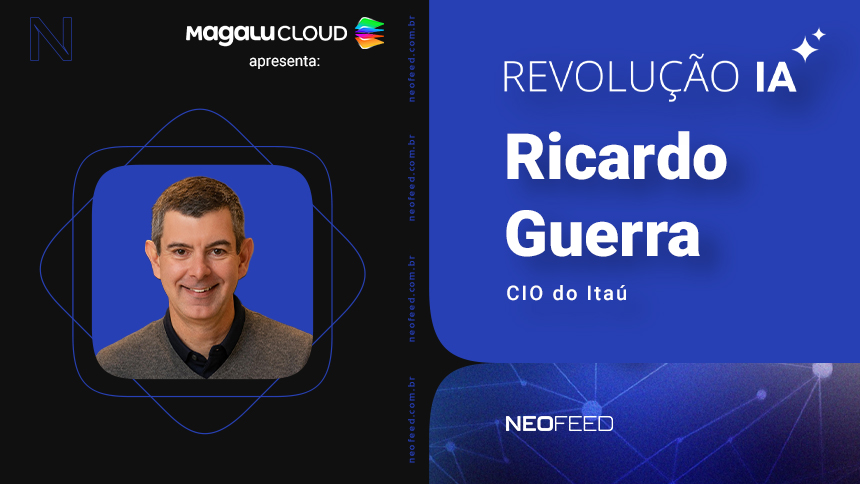
It is in this context that Ricardo Guerra, CIO of the institution, establishes a clear limit for the use of external solutions. "If I outsource everything, I would be outsourcing Itaú's activity at the end of the day," he states in an interview with Revolução IA , a NeoFeed program supported by Magalu Cloud.
For him, the boundary between what should be developed internally and what can be purchased externally defines where artificial intelligence generates a competitive advantage and where it merely replicates capabilities available on the market.
In practice, this translates into objective choices. Solutions seen as standardized can be acquired on the market, as long as they don't create dependencies or limit product evolution. However, anything that involves in-depth knowledge of the customer, decision-making, and the bank's logic needs to remain in-house.
The advance of automation, however, reignites the debate about the future of junior professionals in increasingly technological teams. Guerra rejects the idea of replacing young developers with AI. For him, entry-level roles will change, but abandoning the training of new talent would compromise the sustainability of the teams.
“You don’t become a senior if you weren’t a junior one day,” he says. “The role of the junior will be different from what we know today, but it needs to exist.”
In software development, the challenges become even more complex. Although AI tools already accelerate code generation, Guerra believes that localized gains do not solve structural bottlenecks.
“You can accelerate an engineer, but if the rest of the cycle doesn’t keep up, you only increase the waiting time,” he says. The real impact, according to him, only appears when the technology permeates the entire process. “It’s not just about using AI to write code; it’s about using AI to run the company on a daily basis.”
This logic also guides applications already in operation, such as investment recommendations based on artificial intelligence, which combines internal data, rules, and the reasoning of human advisors.
“We interview those who make investment decisions and transform that into something consumable by artificial intelligence,” he says, pointing out that the goal is to create a system in which humans and algorithms learn together, expanding personalization and decision-making capabilities.