

Miami - There is a consensus among economists and managers. The so-called "tourist investor," who buys passive indices but waits for the highest and best return, risks being left without a seat at the table in 2026.
The era of active management and private capital is no longer an option. It is the only possible map to navigate in a world that has stopped seeking the lowest price and prioritizes survival.
While the average investor still struggles with the volatility of daily stock prices, the world's leading allocators, such as BlackRock, JP Morgan, Morgan Stanley, BlueOwl, and others, show that big money is seeking refuge where the chart doesn't fluctuate hourly.
Read below the main highlights of private fixed income and alternative investments that occupied the afternoon of the first XP Global Conference outside of Brazil:
"Single B" strategy
To discuss global fixed income, Marcello Pasquatti, responsible for product distribution at Pimco in Latin America, moderated the panel with Mark Benbow, portfolio manager at Aegon Asset Management, and Peter Vecchio, fund manager at BNP Paribas.
Contrary to the common intuition that higher quality (AAA) bonds are always safer, there has been an argument that the current "safe haven" is medium-quality credit with a short maturity.
The "sweet spot" is short-term, single-B rated bonds. They are seen as more defensive than long-term investment-grade bonds (triple A or B). The reason is what you pay to wait in an uncertain environment.
Right now, the strategy is to focus on the coupon and not on the appreciation of the bond price. "You get paid to wait while the volatility passes," says Vecchio of BNP.
Recovery versus compensation
The panel also criticized the slow pace of credit rating agencies – Standard & Poor's, Moody's, and Fitch – which are lagging behind the needs of fund managers. The market prices in an improvement or decline in a company's rating long before the agency changes it.
While companies focus heavily on "recovery," meaning how much is left if the company goes bankrupt, managers seek "compensation," the ability to generate cash to avoid bankruptcy.
Benbow, from Aegon, says that about 25% of the high-yield market in the US today is made up of unrated companies, which shows a maturity of the market where large corporations prefer not to pay for the ratings of the agencies.
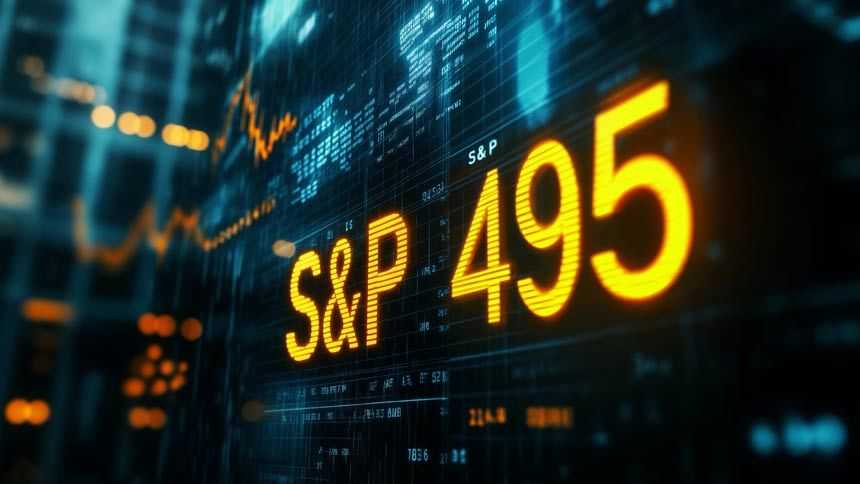
"S&P 495" awakening
Nathan Chiinsky of BlackRock and Nick Angelo of JP Morgan opened a debate between the "east coast" – investors impatient for returns – and the "west coast," of inventors who spend billions of dollars, in the panel on variable income.
For them, the market concentration in the five largest companies (which together account for 30% of the index) is creating opportunities that are going unnoticed.
The expectation is that profit growth will begin to accelerate in the coming quarters for the other 495 companies in the S&P 500.
Chinsky describes the current moment as "fantastic for generating alpha," as the volatility and dispersion allow for the identification of winners outside the mega-cap bloc—companies with a market capitalization of over $200 billion, such as Nvidia, Microsoft, Apple, Alphabet, and Amazon.
From US "Only" to US "Plus"
Although the US maintains its leadership in innovation, the recommendation from managers at BlackRock and JP Morgan is for geographic diversification.
Since 2009, American companies have delivered profit growth far exceeding that of the rest of the world. Now, outside the US, growth is slower, but valuations are much cheaper.
According to Angelo, the strategy evolved from "only US" to "plus US," including Japan and emerging markets to diversify technological exposure.
AI's "Apollo program"
The current scale of investment in AI is unprecedented in history. The Apollo space program cost approximately US$250 billion (adjusted for inflation) in the 1970s. Today, the world spends the equivalent of two Apollo programs per year on AI infrastructure alone.
Angelo says that while it took the PC 15 years to reach 50% of the population and the internet 10 years, AI is breaking all adoption speed records.
For Chisky, AI is not a bubble. It represents a structural change in the real economy, with massive investments in data centers, GPUs, and storage.
Choosing the cherries
The alternative investment market, which was once exclusive to institutional investors, is changing its face and creating opportunities for wealth management.
While institutional investors have robust allocations, retail and "intermediary" investors still have very small exposures, around 5% of their portfolio.
Nicole Drapkin, senior managing director at Blue Owl, highlighted that the successful model now is to offer the exact same portfolio to institutional and retail investors, without "picking different cherries" for each channel.