

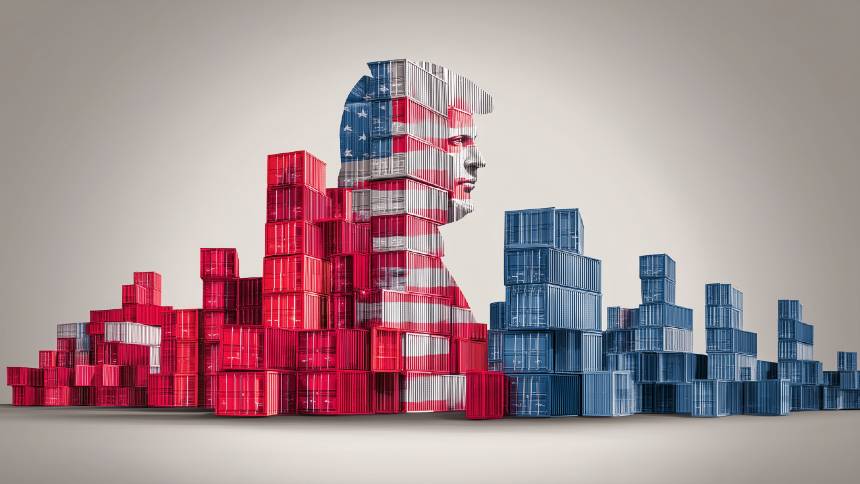
In his biggest defeat since the start of his second term, US President Donald Trump watched as the US Supreme Court, by a 6-3 vote on Friday, February 20, struck down the massive import tariffs imposed by the White House last year, which had created chaos in global trade.
According to the decision of US judges, Trump cannot use the International Emergency Economic Powers Act (IEEPA) to impose tariffs. The Court ruled that the power to establish and collect taxes belongs to Congress, not the president.
The judges' decision affects the so-called "reciprocal tariffs," imposed by Trump on April 2nd of last year, on the so-called "Liberation Day." However, additional charges, such as those levied on steel and aluminum, remain in effect.
Shortly after the announcement, Trump stated that the decision was "terrible" and said he was "ashamed of certain members of the Supreme Court, absolutely ashamed, for not having the courage to do what is right for our country."
Subsequently, he retaliated and announced a new global tariff of 10%, which he later increased to 15%, based on a trade law known as Section 122, which allows the president to impose extra tariffs for up to 150 days to correct imbalances in the American trade balance.
The question that remains – at least unanswered for now – is what the stance will be regarding the fees that companies from various parts of the world have already paid to ship their products to the United States.
The dispute will revolve around the more than $133 billion in tariffs that were collected by the United States government and have now been annulled. This amount was calculated up to mid-December by U.S. Customs and Border Protection.
These fees represented approximately 67% of the total revenue collected in fiscal year 2025, which ends in September, and 57% of the fees collected between the end of September and December 14.
In total, including a series of miscellaneous fees unrelated to the president's trade measures, customs collected approximately $202 billion in fees in fiscal year 2025, about 2.4 times the total amount collected in the previous year.
Even after the decision, the Supreme Court has not yet provided guidance on whether the fees would be reimbursed, which will lead to judgments being made by lower courts. Still, lawyers specializing in international trade say that hundreds of companies have already filed lawsuits to increase their chances of recovering the money.
The amount includes the imbalance caused in Brazilian exports, impacted in two phases by Trump's measures. According to estimates from the US government, between April and December 2025, Brazilian companies paid almost US$1 billion in revoked reciprocal tariffs.
China and Hong Kong lead this ranking, with expenditures of around US$37 billion each. In Mexico, the cost of the tariffs reached nearly US$7 billion. Canada reached US$2.42 billion, Japan was taxed at US$2 billion, and India, US$1.99 billion.
During a trip to India, President Luiz Inácio Lula da Silva, who had been trying to finalize agreements to eliminate tariffs on Brazilian products once and for all, stated that he intends to speak with Trump "in a sovereign manner" to discuss various issues involving both countries, including rare earth elements and critical minerals.
Nevertheless, Lula said that Trump “is a marketing expert and acts as if he were on a TV show.” The view of Brazilian authorities, who are in New Delhi, is that it is still too early to form any position on the Supreme Court's decision. The topic is expected to be discussed at the meeting between Lula and Trump at the White House, scheduled for March.
Research shows, however, that American consumers and businesses bore the brunt of the tariffs. Recent studies by the Fed and the Kiel Institute for the World Economy (IfW), a German economic think tank , have shown that the United States absorbed about 90% of last year's tariff increases.
So far, tariffs have had a moderate impact on inflation, largely because companies have tried to absorb the costs over the past year rather than passing them directly on to consumers.
Morgan Stanley estimates that an 80% refund of tariffs could lead to a relatively small increase of 17 basis points in US GDP in 2026, while a more limited refund of 40% could lead to an even smaller increase of eight basis points in 2027.
“It’s nothing spectacular or devastating,” said Scott Lincicome, vice president of economics and commerce at the Cato Institute. “Even if there’s an immediate full refund, we’re talking about only $150 billion injected into a $30 trillion economy.”
Goldman Sachs estimated that the government collected between $115 billion and $145 billion in IEEPA tariffs up to the date of the court ruling. These tariffs represented approximately 7 percentage points of the 10 percentage point increase in the total effective tariff rate in effect before the ruling.
Now, the trend is that much of this money will start returning to the pockets of the companies that bore this extra cost, following Donald Trump's decision on "Liberation Day".