

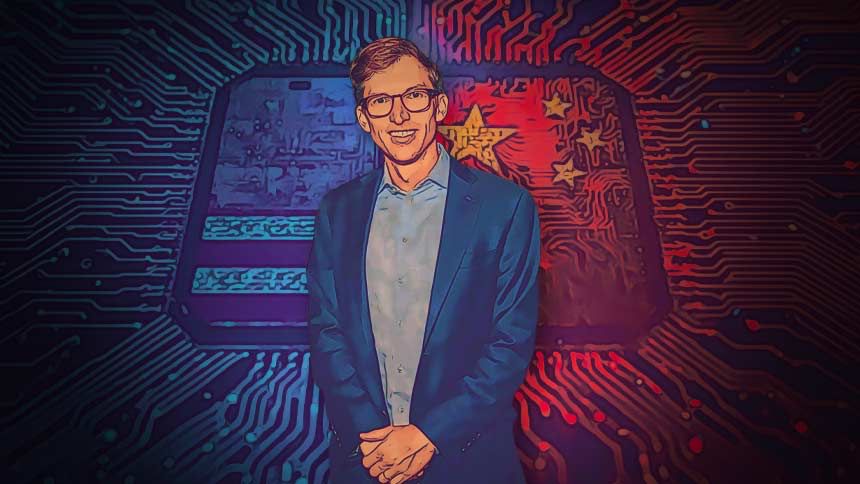
When American historian Chris Miller published the book Chip War in October 2022, artificial intelligence was still in its infancy—and the book's impact was ultimately overshadowed by the emergence of ChatGPT the following month.
The book shows how semiconductors have become the central strategic resource of the 21st century and how their production depends on a highly specialized global supply chain, dominated by a few countries, such as the United States, Taiwan, Japan, and South Korea.
In an interview with NeoFeed , Miller admits that the biggest change since the book's release has been the investment in artificial intelligence (AI) infrastructure, which has grown disproportionately in the last two years, increasingly distancing the countries that produce this infrastructure from the others.
However, this does not prevent emerging countries, such as Brazil, from being left out of the technological leap. This is because, Miller argues, access to chips and AI models will not be a problem, with open and free models. The challenge is how to take advantage of the technological innovation they bring.
“Implementing and using AI requires changing the way companies, organizations, and governments do business,” says Miller, a professor of international history at Tufts University in Massachusetts. “This change tends to happen slowly, but that’s where, ultimately, productivity gains will come from, and we’ll see new products and new markets emerge in the process.”
The technological dispute between the US and China , the central theme of the book, remains relevant. But, according to Miller, in addition to chips, energy and critical minerals form the tripod of the next global hegemony—and China lags behind precisely in semiconductors, especially in relation to Taiwan .
He notes that TSMC , the Taiwanese semiconductor giant, is expected to produce AI chips this year on a scale 30 times greater than the entire Chinese industry. “Taiwan has shown that there is a competitive model to the Chinese one, capable of producing the most advanced technology—something China cannot do alone—and still guarantee a better standard of living. This is embarrassing for China,” says the historian, who fears a future Chinese military advance on the island.
Miller also highlights that current military advancements focus on the increasing use of autonomous systems and AI on the battlefield, such as the massive deployment of drones in the Russia-Ukraine war, many of which are already capable of making basic decisions without human intervention.
Another area of focus is the use of AI for intelligence analysis, such as the automatic identification of targets in spy satellite images. "These developments show that automation and advanced analytics are already transforming warfare, not as science fiction, but as operational reality," he states.
The historian was in Brazil last week at the invitation of the FS Group , which operates in digital infrastructure and cybersecurity, will invest R$ 1.8 billion in the implementation of three data center parks in Brazil, and controls EXA, a cybersecurity company.
Read below excerpts from Miller's interview with NeoFeed , given in São Paulo after speaking in Rio and the São Paulo capital:
Since the release of Chip War in 2022, we've seen the emergence of ChatGPT, DeepSeek, and even Moltbook—new tools that promise to make edge computing cheaper and faster. To what extent has this technological advancement made your book outdated?
The biggest change is that there has been a huge increase in investment in AI infrastructure. In 2022, when I published the book, it was already becoming clear that better AI would require better chips. But I admit my surprise at the scale of the investment that has been made in the last two years. It's clear that this is the most important factor in a possible current re-edition of the book.
Do these new tools represent merely an evolution or a leap capable of reshaping the global economy? Do they carry inherent risks that we are not yet seeing?
There are risks in moving too quickly to deploy AI in many different areas, but also in moving too slowly because, in that case, we will miss out on the new capabilities that AI enables, such as technological advancements, scientific discoveries, and the new efficiencies that come from AI. In other words, I am more concerned about losing these advantages than about deploying potentially risky forms of AI.
"I'm more concerned about moving forward slowly and losing the new capabilities that AI makes possible than deploying risky AI models."
In this sense, do these new tools reduce or increase the vulnerability of the high-tech supply chain?
It's a mix of both. The biggest vulnerability is that not every country will have trillions of dollars in AI infrastructure or to train leading models. The good news is that there are many open models available, and they differ from each other. Some are already free, others are paid – but there's no shortage of available models. So, the first question arises: is it possible to gain access? Yes. And the second question: is it possible to find a good way to use them? That's the challenge.
The development of chips and AI requires extremely high investments. What can countries like Brazil do to avoid being structurally excluded from the technological frontier?
The key will be the availability of AI chips and models. The challenge, for countries like Brazil, is how to use this technology. And that's no easy task: deploying and using AI requires changing the way companies, organizations, and governments do business. This will ultimately require people to change how they operate – which means that this will inevitably happen.
Will this change take a long time to be implemented?
It tends to happen slowly because it will require organizations to change, but that's where, ultimately, productivity gains will emerge, and we'll see new capabilities, new products, and new markets arise in this process. That's why we should focus as much, or even more, on the implementation of AI as we do on the infrastructure and the models themselves.
What will ultimately be the deciding factor of the next decade — chips, AI, data, energy, or strategic minerals?
I believe that chips will be the fundamental ingredient that very few countries will be able to produce, without which it will be impossible to build the most advanced AI systems. But I also believe that most of the money, most of the economic value, will not come from the chips themselves, but from the applications built on top of them. Therefore, chips are a necessary foundation. The new businesses that will emerge will be from companies that leverage what these chips can offer and develop new capabilities with active computing power.
"The new businesses will be from companies that will take advantage of what these chips have to offer and develop new capabilities with active computing power."
In this sense, how can Brazil transform the advantage of attracting AI data centers—thanks to cheap energy—into its own technological capacity, and not just infrastructure for third parties?
To transform this advantage into real capacity, the country also needs to attract research and development, train the workforce, and bring in operations that go beyond mere hosting—because the value of data centers lies with those who use them, not just those who house them.
There is increasing competition between the US and China for essential minerals. What do the US need to do to maintain access to these essential metals, whose processing is concentrated in China?
Over the past 18 months, the US, Europe, Japan, and South Korea have begun to view their dependence on China for the processing of critical minerals differently. This concentration is not due to a lack of resources in other countries, but because China has a much lower cost of capital—a result of more flexible environmental regulations—giving it a decisive advantage in this processing.
How can Western countries reverse this Chinese advantage?
Japan, the US, and other countries have already begun funding mining projects outside of China. With new operations coming online, China's dominant position—currently, in some cases, that of sole supplier—is expected to shrink significantly in the coming years. And I think Brazil is in an interesting position because many of the minerals in question are present in Brazil.
In what areas is China eroding the significant advantage of the US, the sole global superpower?
China has a very clear advantage when it comes to energy. Its growth rate in energy production is far exceeding that of the United States. China has gained an advantage in critical minerals because it has secured the supply of certain minerals, such as gallium and germanium, and others that are used in the chip manufacturing process. China has also made great progress in building a very large and capable base of engineers specializing in artificial intelligence – although it is still true that many of China's smartest and most capable engineers end up working in the US.
Despite China's advancements in green and digital technologies, AI has not yet become a central driver of the country's economic growth. What explains this gap between ambition and real impact?
The challenge has been twofold. First, it's clear that the US pioneered AI, and China has been catching up over the last 18 months. This means that globally, the leading AI companies, in terms of market share or revenue, are American, such as Anthropic, OpenAI, or Google. Therefore, it's difficult to catch up, given that these companies have already taken a substantial lead.
And what is the second challenge for China?
The limitation lies in the construction of advanced data centers in the country, since the US does not allow the sale of the most advanced chips to China, and the Chinese are unable to produce them internally. Currently, there is a substantial gap between the number of AI chips capable of generating data outside of China and the number of chips produced in the Asian country. AI chips will be produced in Taiwan this year on a scale 30 times greater than in China.
With the diversification of advanced chip production to the US, Japan, and Europe, what will be the 'new Taiwan' of the next decade—the next critical bottleneck in the global supply chain?
The new Taiwan will be today's Taiwan... TSMC, from Taiwan, is producing semiconductors, and that's not going to change anytime soon. In Europe, TSMC is building a relatively small chip factory with mid-level technology. In Japan, they just announced plans to build an advanced facility, but it won't be at the forefront of technology. In fact, TSMC will only have its advanced capabilities in Taiwan and the US, but most of those capabilities will still be in Taiwan. In other words, in the next decade, Taiwan will be an absolute and irreplaceable hub.
Will the biggest high-tech bottleneck of the next decade be physical, technological, or political?
I hope the next bottleneck isn't political, but I think we should be concerned about the threats China makes to Taiwan, because it seems to me that they increase in scale and credibility each year as China's military power grows. There will likely also be physical bottlenecks as long as there is demand for powerful AI chips because it's proving very difficult for the world's leading companies to acquire all the critical materials, energy, and minerals needed to manufacture them. And if our consumption continues to grow, these challenges will only increase.
American foreign policy under Donald Trump has adopted increasingly assertive positions. What kind of decision in the area of chips and AI could precipitate a serious crisis with China in the coming years?
I think the biggest question hanging over the chip industry and the AI industry is whether Taiwan will be able to continue supplying chips. Because, of course, China is unhappy with the status quo where Taiwan is, in effect, a separate country. China has wanted to take control of Taiwan for 70 years. The fact that TSMC is now valued more than any other company within China, from the perspective of Chinese leaders, only exacerbates their discontent with not controlling Taiwan.
So, is Taiwan winning this technological war against China?
Taiwan has managed to demonstrate that a competitive model exists in relation to what China has done, a model capable of developing the most advanced technology, technology that China cannot develop alone, while simultaneously providing a higher standard of living for its citizens. This is embarrassing for China, which wants to see itself and be seen as a technological leader, when, in reality, the true technological leader is an island across the strait that China considers its own, but which it cannot control.
"The true technological leader is an island (Taiwan) that China considers its own, but cannot control."
Where could this lead?
The concern should be that, as China's military power grows, the Chinese leadership will not limit itself to exerting diplomatic or economic pressure on Taiwan, but will increasingly resort to military pressure. And I believe we have seen, in recent years, a series of military exercises designed to demonstrate that China could, if it wanted to, impose a blockade on Taiwan. Therefore, I am very concerned about China's intentions.
Is it possible to imagine unprecedented weaponry becoming possible with cutting-edge chips and advanced AI, a military revolution comparable to the invention of the guided missile?
If we pay attention, military and intelligence officials from all major powers are already talking about deploying AI. This is the case in the war between Russia and Ukraine, in which both sides are deploying thousands of drones, and many of these drones increasingly rely not only on guidance but also on the drone itself to make decisions about where to fly and in which direction to go. And, as time goes on, these decision-making capabilities will become more advanced.
Will this be the great military technological breakthrough?
All major world armed forces are investing in comparable capabilities: drones that increasingly fly autonomously. Therefore, autonomous systems are one of the key areas. The second sphere is intelligence and analysis. For example, some governments are already using images captured by their spy satellites and employing AI to identify what is a truck or a tank, for instance. These are just two examples of how autonomous systems and artificial intelligence can be applied; it's not science fiction, it's already a reality.
Are we entering an era of stability or permanent technological instability?
I think we should expect many technological changes, and I'm sure this will be destabilizing, for better or for worse. I believe that many dynamics in the current world will be enhanced by technology. We will have faster scientific discoveries and improvements in healthcare, for example. But I also think it's inevitable that when drastic technological changes occur, they cause economic, social, and political transformations. That's what we need to be prepared for.