

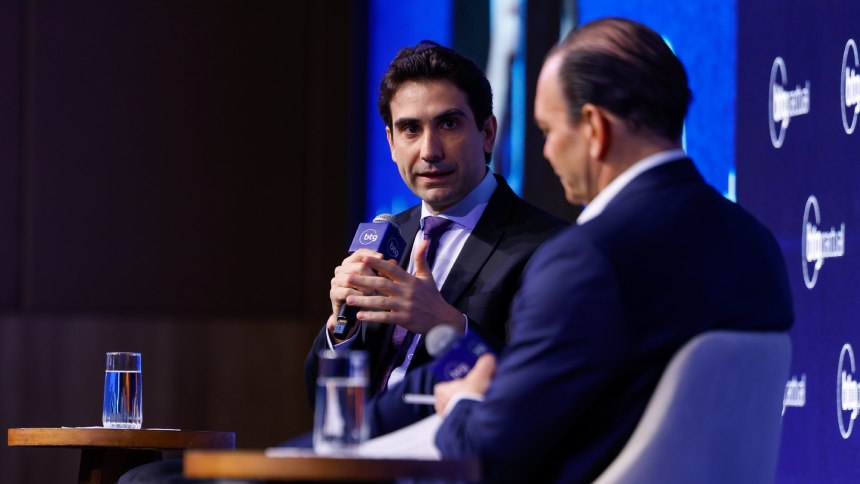
In a year that is expected to be marked by uncertainties in the financial market, mainly due to the Brazilian electoral scenario, the president of the Central Bank, Gabriel Galípolo, stated that the monetary authority needs to be, at this moment, more like an ocean liner, which moves slowly and more safely, than a jet ski, which moves at speed.
The statement, made on the morning of Wednesday, February 11th, during a panel at the CEO Conference Brazil 2026, promoted by BTG Pactual, indicates that the Central Bank should begin the new cycle of interest rate cuts, scheduled for March, in a very gradual way, based on a broader analysis of macroeconomic indicators, without causing a major impact on the Faria Lima environment.
“We need to remain calm. The Central Bank is more like an ocean liner than a jet ski. It can't make big moves and changes. It moves in a more measured and safe way,” he said. “Therefore, we need to separate the noise from the signal.”
In his assessment, there needs to be "more confidence" so that the decision to reduce the Selic rate, currently at 15% per year, has a stronger basis for support. Therefore, according to Galípolo, it is important that the move be more cautious.
“Especially in years like this, when the Central Bank can help reduce market uncertainty, that’s healthy. When there are any surprises and a need to reverse signals, it brings more uncertainty. The cost becomes higher. And we don’t want that,” he stated.
In the panel, moderated by Roberto Sallouti, CEO of BTG, the president of the Central Bank said that it is inevitable that there will be an impact on the economy due to the proximity of the presidential election in Brazil in October.
“There is a source of uncertainty inherent in an election year. Even though monetary policy has managed to bring inflation to a lower level, there is still a correlation between the variables that makes it difficult to draw a clearer trend for the future.”
According to the president of the monetary authority, the Central Bank's move also takes into account the equation of the labor market and productivity. "This won't happen overnight, but it's a central issue."
“These are structural problems. Our economy is seeing little productivity gain, and this is a central issue for the country. We need to collaborate to create a more friendly environment so that investment occurs and produces in a more sustainable way,” he said. “This won’t happen overnight, but it’s a central issue.”
In any case, as he did on Monday at an event of the Brazilian Association of Banks (ABBC) , Galípolo praised the Minister of Finance, Fernando Haddad, for his handling of structural policies from an economic point of view.
"Brazil has competitive advantages to present itself to the world as a hub for attracting investments and offering productivity gains. This depends on us. And the minister has been advocating for this since the beginning of his administration," he stated.
In addition to the impact of local politics, the head of the monetary authority explained that the turbulence in the United States economy, mainly caused by the tariff increases imposed by President Donald Trump, is also an important variable in the calculation of the interest rate cut.
In his assessment, however, Brazil ended up being favored precisely because it had less dependence on the American economy. "Being less tied to the United States became a line of defense, and being an exporter of commodities became something well-regarded. This ended up benefiting Brazil."
At the BTG event, Galípolo also spoke about the case of Banco Master, liquidated by the Central Bank in November following the discovery of fraud in financial operations. He also mentioned that changes are being studied for the Credit Guarantee Fund (FGC) to protect the financial system from similar incidents.
In addition to mentioning the support Haddad received, Galípolo also acknowledged the Federal Police's role in the case, which involved operations to curb and investigate the illegal activities committed by Daniel Vorcaro's bank.
"The financial market owes a great debt to the Federal Police, which is doing a great job. And we have received a lot of support from the financial market in this episode. We are making regulatory changes, which depend on joint work."