

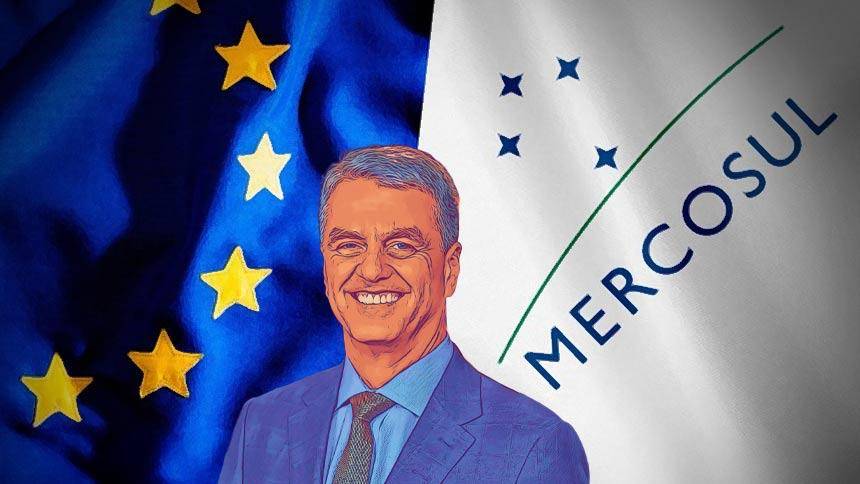
The safeguards to limit exports of agricultural products from Mercosur , included in the trade agreement with the South American bloc finally approved by the European Union this Friday, January 9th, after 26 years of negotiations, may even cause turbulence further down the line.
However, these losses tend to be offset by the gains resulting from the opening of the European market, which tends to absorb more advanced products with higher added value, both from Brazil and from Mercosur countries – which will give a boost to the national industry.
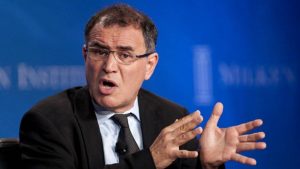
This is according to Brazilian diplomat Roberto Azevêdo , who closely followed years of negotiations between the two blocs, both at the Ministry of Foreign Affairs and as Director-General of the World Trade Organization (WTO), a position he held between 2013 and 2020.
“We are talking about the largest trade agreement in the world, which should give a major economic boost to both the European bloc and the Mercosur countries,” says Azevêdo, in this interview with NeoFeed .
“And, in a way, it somewhat compensates for all these trade unpredictabilities that we are seeing around the world,” he adds, referring to the protectionist trade policies of the United States and the threats to multilateralism carried out by President Donald Trump .
Azevêdo prefers to see the glass half full and believes that the format of the agreement – which provides for an adaptation period for the most vulnerable sectors to prepare for competition, as is the case with Brazilian industry – brings advantages.
“As the two blocs are able to better integrate their value chains, niches will emerge,” he says. “In sectors where the European Union may not be very competitive, Brazilian products could enter, and it’s time for our industry to seek the external market.”
The gains are visible for both blocs. The agreement creates a free trade area with more than 700 million people and a combined GDP of US$22 trillion, expanding trade between the countries of the two blocs, which currently amounts to around €111 billion per year.
For Mercosur countries, the agreement opens access to a market of approximately 450 million consumers in the 27 EU countries, representing 15% of the global economy. The EU economy, in turn, will be able to tap into a market of 280 million consumers in the Latin American Mercosur countries – Brazil, Argentina, Uruguay, and Paraguay – where around 30,000 EU companies already operate.
EU exports are dominated by machinery, chemicals, pharmaceuticals, and automotive products, while Mercosur exports focus on agricultural products, minerals, pulp, and paper.
The two blocs commit to eliminating tariffs on more than 90% of bilateral trade. For the EU, this means removing €4 billion in taxes on its exports, which are expected to grow by €84 billion, generating approximately 756,000 new jobs. Mercosur countries have high tariffs, such as 35% on car parts, 28% on dairy products, and 27% on wines.
This result was possible because Italy finally voted in favor after concessions made in recent days by the European Commission. France, Poland, Austria, Hungary, and Ireland, on the other hand, remain opposed. Belgium abstained.
This secured the necessary qualified majority (55% of the countries representing at least 65% of the EU population) for the President of the European Commission, Ursula von der Leyen, and the President of the European Council, António Costa, to travel to South America next week for the formal signing of the agreement.
To win over the skeptics, the European Commission implemented safeguards that could suspend imports of sensitive agricultural products. It strengthened import controls, particularly regarding pesticide residues, created a crisis fund, accelerated support for farmers totaling €45 billion, and committed to reducing import tariffs on fertilizers.
These safeguards stipulate that if distortions are detected in the domestic market—such as a 5% increase in imports above the average of the last three years or a 10% drop in prices—investigations will be opened, which may lead to provisional measures to mitigate the effects, such as the reinstatement of tariffs on the affected products.
“It needs to be made very clear that the level of ambition, in terms of opening the European market to commodities, is very low: the quotas are limited and will not allow for a significant increase in Mercosur exports,” warns Azevêdo. “But, from Brazil’s point of view, the agreement must be seen in a broader way and not just in terms of access to the commodities market.”
Read below the main excerpts from the interview:
How should we assess this agreement in terms of its strategic importance for each bloc, at a time of great threat to multilateralism and protectionist pressures from the US?
The timing for finalizing this agreement couldn't be more opportune, precisely for the reasons mentioned. From a technical standpoint, the agreement has been mature for a long time – 26 years of negotiations. And we're talking about the largest trade agreement in the world, which should give a major economic boost to both the European bloc and the Mercosur countries. And, in some way, it somewhat compensates for all the uncertainties and unpredictability in trade that we are seeing around the world. Now, we need to be clear that all of this is still subject to turbulence.
In what sense?
The Europeans also voted on these safeguards for agricultural products, including a mirror clause. Although these were unilateral measures by the Europeans and were not negotiated with Mercosur, they may cause some friction later on. In any case, the timing couldn't have been better to finalize this agreement.
Could the fact that Mercosur exports are concentrated in agricultural products make the European market less attractive precisely because of the clauses and concessions to European farmers?
It is important to make it very clear that the level of ambition, in terms of opening the European market to commodities, is very low. The quotas are limited and will not allow for a significant increase in Mercosur exports. But, from Brazil's point of view, the agreement must be seen in a broader way and not just in terms of access to the commodities market.
"The level of ambition for opening the European market to commodities is very low."
Where can we see potential gains?
We need to take into account the fact that the market for more advanced products, with higher added value, is also opening up to Brazil. This will attract European investment to Brazil and give us access to more advanced technologies. All of this is part of the overall picture. And the European Union, in a way, tends to import products with a higher degree of processing than China, for example.
Could Mercosur perform better in exports to European countries than to China?
China focuses heavily on importing raw commodities. The European Union has a GDP per capita that is three times higher than China's, so it demands products with a slightly higher added value, more processed, in a way. This is good for our industry.
Brazilian industry, incidentally, has always benefited from government protection against foreign competition, with high import tariffs. Is it ready to absorb this competition from European manufactured goods?
The agreement foresees a phase-in , a staggered adoption. The sectors considered most vulnerable or sensitive in the Brazilian economy – and this was the subject of negotiations over these 26 years – have a longer implementation period. Therefore, there will be an adaptation period for these sectors to prepare for competition. This agreement, on the other hand, also opens the possibility of structurally changing the value chains themselves.
How would that happen?
As Mercosur and the European Union are able to better integrate their value chains, niches will emerge – sectors where the European Union may not be very competitive, for example, where Brazilian products could enter. Similarly, European products could enter a less competitive area of the Mercosur market. This integration of supply chains will take time to settle and develop during the implementation phase.
In other words, this integration of value chains isn't really an obstacle; it could open up new export markets for our industry?
It will by no means be an obstacle, quite the opposite. I also believe that it is high time for the Brazilian industrial sector to start looking at the external market as a target, and not as a sporadic market – that is, our products being exported only when we have a surplus, an overproduction locally.
What kind of trade agreement would be interesting for Mercosur to start pursuing going forward?
Mercosur needs to seek this type of agreement, as was done with the EU, with everyone... Obviously, the appetite for this type of agreement with some countries, such as China, is lower because of the competitiveness of Chinese industry. Therefore, we should seek advanced markets that have a production cost compatible with ours and a more or less similar level of development. We have to be open and look for these opportunities.
Is now a good time for Mercosur to finalize new agreements?
With the weakening of the multilateral system itself, these opportunities will generally arise through bilateral and regional agreements. Therefore, it must be a continuous pursuit.
To what extent are legislative elections taking place in Argentina and presidential elections in Brazil, the two main economies of Mercosur, likely to delay a large influx of European investment into the region?
Your approach should be different. When there are political fluctuations in Brazil and Argentina, which are, evidently, the two largest players in Mercosur in economic terms, it is often difficult to coordinate the political will for market opening or the pursuit of trade agreements. Often one of the two countries does not want these agreements, especially during periods of greater closure of the local market, of greater protectionism. It is difficult to have this political synchronization or political ambition for trade agreements on both sides.
"The agreement offers the type of predictability that investors like."
So, is it easier now?
With the agreement signed and in effect, we will eventually have to manage any differences in the pace of opening up, things of that nature. But that becomes an internal Mercosur matter. I think it's unlikely there will be a review of the signing of the agreement and the application of its provisions.
Could President Trump's protectionist policies, in addition to these threats against NATO and military intervention in other countries, create legal uncertainty for investors and hinder the opening of markets, as foreseen by the EU-Mercosur agreement?
I see it from the opposite perspective: the agreement provides precisely the kind of predictability that investors like and seek, and which is sometimes lacking in many other commercial relationships that Brazil has around the world. In addition to more stable rules and greater predictability, we have a dispute resolution mechanism, which is a form of political protection. So, if one of the sides, whether Mercosur or the European Union, is failing to comply with what was agreed upon, it is possible to activate the arbitration mechanism provided for in the agreement itself. This is a positive development for investors who are precisely seeking predictability and legal certainty in their investments.
As soon as President Trump implemented this protectionist policy, agreements between trade blocs began to spring up, partly as a reaction to the "closure" of the American market. Is it possible to expect a contrary reaction from Trump in the medium term regarding these agreements?
In the immediate future, I don't believe so. President Trump, at this moment, is more concerned with the presence of foreign products in the American market than with international trade flows or reciprocal preferences in which Americans are not a part. It is possible that some concern of this type may emerge in the future, but not in the immediate timeframe.
Are we at risk of seeing China, which has a strong economic presence in both blocs, flooding Europe and South America with cheaper products to counter the exemptions provided by the European Union-Mercosur agreement?
I don't see a direct relationship between the two things. China is competitive in both markets. Perhaps it might lose preferential market share on one product or another because of the agreement, which tends to eliminate tariffs between the two blocs. But Chinese competitiveness in the European Union and Mercosur is already present with full tariffs. I can't foresee situations where a product, whether from Mercosur or the European Union, would significantly displace Chinese exports.