

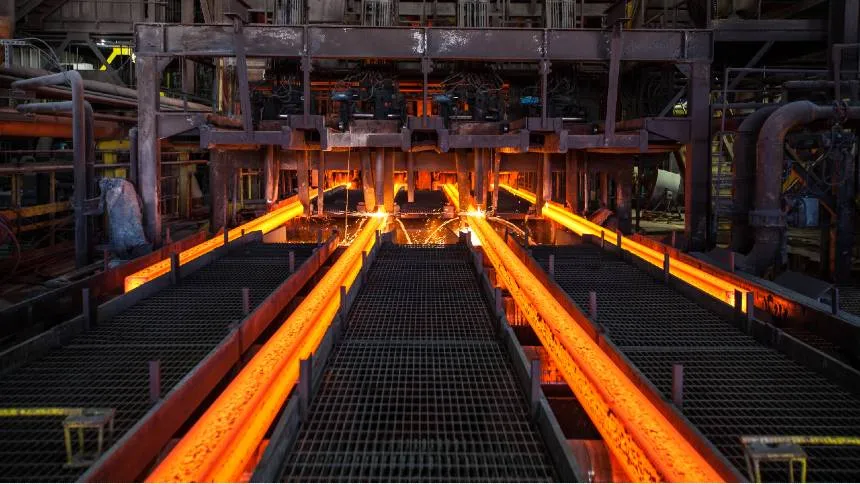

Gerdau , Brazil's largest steel producer, felt the direct impact of a recurring complaint from its CEO, Gustavo Werneck , in its 2025 results: the influx of imported steel, especially from China, into the domestic market negatively affected the company's numbers.
In its balance sheet for last year, Gerdau recorded EBITDA of R$ 10.1 billion, a 7% decrease compared to the previous year. Adjusted net profit fell 21%, reaching R$ 3.4 billion.
The negative impact of the situation was so significant on the company's results that even the company's strong financial performance in the United States could not offset the revenue losses.
“The proportion of EBITDA generated in North America compared to that generated in Brazil has grown. This means that things were worse here than we imagined, and better there than we anticipated. Today, Gerdau is experiencing two different realities,” said Werneck during a press conference on Tuesday, February 24th.
In the United States, according to the company, the operation generated R$ 1 billion more in revenue than was recorded in 2024, while in Brazil, it was R$ 1.5 billion less than what was generated in the previous year.
“Demand for steel remains strong. The problem isn't the economy, but rather this very intense penetration of imported steel. Brazil has always had this, but now we are seeing very unfair competition,” said the company's CEO, in response to a question from NeoFeed .
The executive's assessment is that the volume of this important product's presence in the national market is often far above what would be a healthy and acceptable scenario, which would be in the range of 10% to 11% market share.
But, according to Werneck, the level of presence of steel from outside the country today is 24% in the case of flat steels (in 2020 it was 10.9%). In total, the share of imported product in Brazil is 20.8%, compared to 9.3% recorded five years ago.
“It is a fact that the operation in North America was not enough to compensate for the difficulties faced in the Brazilian operation, which was heavily impacted by steel imports,” said Rafael Japur, CFO of Gerdau.
In any case, Werneck, who was very critical of the federal government throughout 2025, demanding trade defense solutions, believes that the worst-case scenario is over. And that the Ministry of Development, Industry, Trade and Services (MDIC) itself will block this open path.
"The ministry's technicians are already conducting studies and reaching the conclusion that there is unfair trade. It is very significant when these assessments progress and the government begins to prove that dumping has been occurring," he stated.
According to him, the federal administration has already detected this unfair practice by Chinese hot-rolled coil producers. The expectation, according to Gerdau's CEO, is now one of optimism, with the possibility of a definitive solution starting in the second half of the year.
"Our request is not to block or close Brazil's borders. But that this competition be brought to a fair level," said Werneck.
“It won’t transform the scenario in the short term, but it shows a very positive trend for us. That’s why I maintain my belief that, in 2026, we won’t need to close new production plants at this time,” he added.
In the executive's view, the arrival of the election period, which will be more intense precisely in the second half of the year, should not affect the commercial investigations carried out by the technicians of the ministry currently headed by Vice President Geraldo Alckmin .
Nevertheless, the reduction in revenue is also reflected in the decision to record an accounting write-down of R$ 2 billion, relating to losses due to the lack of asset recovery in the company's manufacturing units in the country.
Another major impact would be the reduction in the volume of investments planned for 2026, as the CEO of Gerdau warned would happen for much of last year if there were no signs of action from the federal government.
Therefore, the company is currently operating with a capital expenditure (capex) of R$ 6.1 billion, a 24% reduction compared to the R$ 4.7 billion projected for 2025. In practice, this represents R$ 1.4 billion less for new projects, based on a negative scenario that has been constructed.
“Today there is little room for maneuver to change this course in 2026, because a large part of these projects are already in the disbursement phase. But if we see that these trade defense measures are effective, we can review this scenario for 2027,” says Japur.
In the fourth quarter, profit fell 38.5% compared to the previous period, with R$ 670 million recorded. Volume fell 7.3%. "It was the second worst quarter in the last 10 years, only behind the fourth quarter of 2015, at the height of the political crisis, with impeachment and Lava Jato," said Japur.
Over the past 12 months, Gerdau's shares have appreciated by 30%. The company is valued at R$ 40.3 billion.