


June has 30 consecutive days and will seem short considering the number of events it will hold, events that are expected to mobilize politicians, magistrates, businesspeople, economists, and fans of the "sixth title" (referring to Brazil's sixth World Cup victory) ready to celebrate their saints. June will also be the prelude to the elections.
Between July and August, party conventions will choose the candidates who will face the polls in October. Demonstrations from both the left and right wings of the pre-candidates and their supporters will be prominent.
In this context, the XIV Lisbon Forum – known as “Gilmarpalooza” – an event that is causing a stir in Lisbon and having repercussions in Brazil, opens the agenda on Monday, June 1st, despite the strain on the Judiciary due to recent events involving the Supreme Court and/or ministers. The forum is organized by the Brazilian Institute of Teaching, Development and Research, the Lisbon Public Law Research Center of the Faculty of Law of the University of Lisbon, and FGV Justiça.
Led by Supreme Court Justice Gilmar Mendes , the “Gilmarpalooza” event will conclude on the 3rd and is expected to discuss the “New International Order, Technology and Sovereignty: Democratic, Economic and Social Challenges.” On stage or behind the scenes, elections in Brazil will be on the agenda.
This event is no small feat. In 2025, it had three thousand participants. This year, the attendance will be lower, but still estimated in the thousands, and has already confirmed the presence of Supreme Court Justices Flávio Dino and Alexandre de Moraes, members of the Superior Court of Justice (STJ), former presidents of Brazil, Colombia and Cape Verde, at least three ministers from Lula's government, governors, the president of the Chamber of Deputies Hugo Motta, two dozen parliamentarians and the president of the Central Bank Gabriel Galípolo.
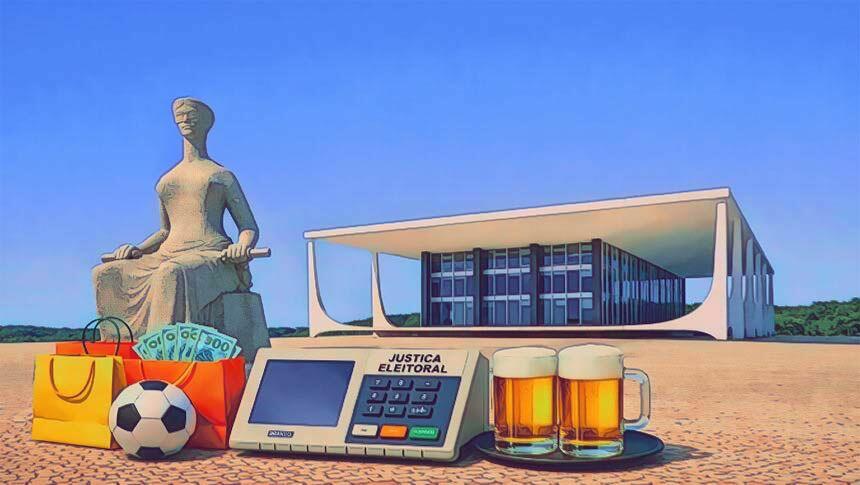
Corpus Christi, on Thursday the 4th, will be the fourth national holiday of the year to sponsor a long weekend, as it is adjacent to the optional holiday on Friday the 5th. And this extended weekend could be a "warm-up" for retail and services in a month conducive to consumption – not just of beer – in the wake of the World Cup .
Despite the endless expectation of credit restrictions, Brazilians maintain their intention to consume . And the start of the World Cup on Thursday, June 11th, boosts this disposition. After all, the tournament will be marked by its unprecedented nature as it will be played in three countries: the USA, Mexico, and Canada.
Brazil takes the field against Morocco on Saturday the 13th. This date coincides with the pilgrimage led by Saint Anthony, which opens the way for Saint John's Day on Wednesday the 24th, and Saint Peter's Day on Monday the 29th, concluding the June Festivals that shake up the North and Northeast. And empty Congress as parliamentarians return to their constituencies for the celebrations. And, this year, to garner votes for October.
Consumption and inflation
The progress of the ongoing "Desenrola 2" program for defaulters should stimulate consumption, and expectations are high for "Desenrola 3," dedicated to those who are up-to-date on their payments but pay very high interest rates, and which should focus on unsecured Direct Consumer Credit debts, Finance Minister Dario Durigan told Valor Econômico .
The exchange of more expensive credit for cheaper credit is a boost to demand – a lever for growth and inflation which, this year, should exceed the target ceiling of 4.5%. An IPCA (Brazilian consumer price index) of 5% is already priced into assets and is on the mind of the Central Bank, which will define the next Selic (benchmark interest rate) on June 17th.
The Family Consumption Intention Survey (ICF), conducted by the National Confederation of Commerce of Goods, Services and Tourism (CNC), revealed, in May, expansion for the seventh consecutive month and to the highest level in eleven years. The 1.6% increase in the month brought the indicator to 106.6 points – the best score since 2015.
The survey has seven components (Current Employment, Current Income, Current Consumption Level, Career Outlook, Consumption Outlook, Access to Credit, and Timing for Durable Goods Purchases). All of them rose in May for the first time this year. These increases were led by confidence in current employment and income, with positive monthly variations of 2% and 1.8%, respectively.
A revealing indicator of Brazilians' consumer drive comes from the "Moment for Durable Goods Purchases" index. On a year-on-year basis, this category declined persistently until last October, but not only reversed course but surged to 18.8% in April and 18.5% in May. To illustrate the significance of this data, in December 2025, the "Moment for Durable Goods Purchases" index registered a year-on-year expansion of 2.5%.
This indicator showed negative variations coinciding with the Selic rate hike cycle that began in September 2024. In June 2025, a year ago, the Selic rate reached 15%, where it remained until March 2026, before declining by a total of 0.5 percentage points in two consecutive Copom meetings. The Selic rate is currently at 14.5%.
The CNC (National Confederation of Commerce) warns that the surge in the "Moment for Buying Durable Goods" suggests an improvement in household expectations – and consumption intentions – in a context of lower perceived inflation regarding these goods. In April, the CNC cites, the price level of durable goods rose 0.45%, below the 0.67% of the overall IPCA (Broad Consumer Price Index). Over 12 months, the difference is more evident, with variations of 0.68% and 4.39%, respectively, in the overall index.
The information confirms the relevance of inflation to the population. The more inflation falls (and when it falls), the greater the effect will be on consumption, which is also very sensitive to falling interest rates. But the expansion of disposable income, which is increasing, also benefits the consumer.
Caixa (Brazilian bank) has brought forward the payment of R$ 8.5 billion to Monday, May 25th, for workers who opted for the FGTS (Brazilian employee severance fund) anniversary withdrawal. INSS (Brazilian National Social Security Institute) will continue, until June 8th, the advance payment of the 13th salary for retirees and pensioners. The first installment was deposited between April 24th and May 8th. In total, beneficiaries will receive R$ 78.2 billion. Half of it, therefore, is already circulating, flirting with the shop windows.