


Amid the declared war between liquefied petroleum gas (LPG) distributors and the National Agency of Petroleum, Natural Gas and Biofuels (ANP), which is scheduled to decide on Friday, May 29, whether to move forward with the proposal for cylinder fractionation and remote filling, a company operating in South Africa is closely watching the decision.
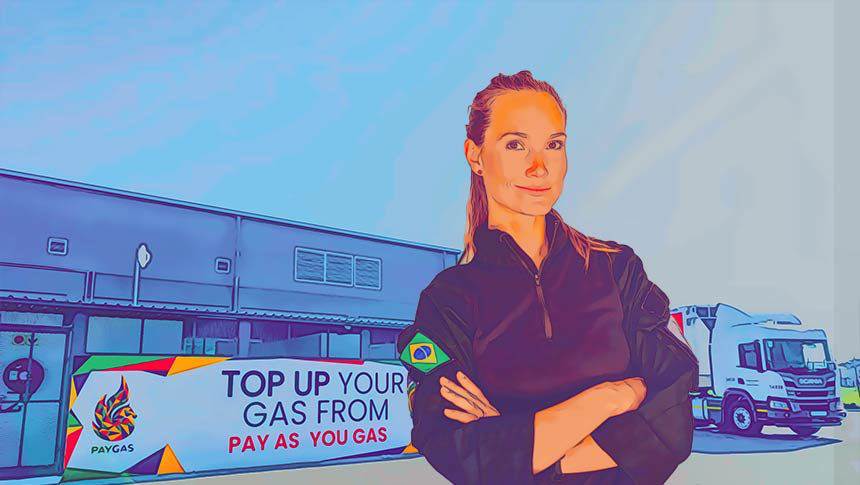
Created in 2019 in France by Brazilian Natália Giampietri and Frenchman Philippe Hoeblich, PayGas is present in Cape Town, South Africa, with refill stations in supermarkets – it is, literally, a “gas refueling station”.
The businesswoman, who is willing to challenge the major companies in the sector, says she is ready to begin operations in Brazil if the measure actually moves forward at the ANP (National Agency of Petroleum, Natural Gas and Biofuels), reaches the public hearings – which should take place in 45 days – and finally becomes legislation.
According to her, PayGas has the capacity to invest R$ 100 million per year to install 200 gas cylinder refill stations. Initially, these will be set up in the Baixada Fluminense and in the North and Northeast regions. The plan is to allocate R$ 1 billion in the country over a decade.
“It’s time to modernize the sector. Things can’t stay the same since 1938. What’s happening in Brazil is bizarre. Clearly, it’s an economic issue that’s generating all this complaint. The industry is structured for the current model. And when this is decentralized, companies will need to adapt,” says Giampietri, in an interview with NeoFeed .
She countered one of the most sensitive points raised by those opposed to the change, which is the real risk of organized crime entering a sector that is already regulated, and the lack of control and oversight. According to her, this problem already exists in the current model.
“Organized crime is already present in the LPG market. Territorial control has existed in the current market for years. What the new rules propose is to include traceability and know exactly who filled the cylinder, where it was, and the safety standards applied. And the filling process will be controlled, which doesn't happen today,” she states.
NeoFeed revealed on Monday, May 25th, that the Ministry of Mines and Energy had sent a strongly worded letter to the five directors of the ANP (National Agency of Petroleum, Natural Gas and Biofuels), criticizing the possibility of proceeding with the agenda regarding fractional bottling.
He argued, as the companies have already stated, that the changes will directly affect the operation of the Gás do Povo social program, which subsidizes gas cylinder refills for low-income populations.
But, according to Giampietri, allowing fractional sales will benefit the users of the social program, not the other way around. “I understand the People's Gas program as a great government initiative. But, with these new rules, it will be possible to better control what is sold through the program.”
Today, approximately 90% of the LPG sector belongs to the four largest distributors: Copa Energia (owner of Copagaz and Liquigás), Supergasbras, Ultragaz, and Nacional Gás.
Below are the main excerpts from the interview:
Why have the major distributors been opposed to the possibility of changes in the sector to allow for fractional packaging?
This has happened in several sectors that have undergone regulatory changes. It happened with the hotel industry when Airbnb arrived, and with taxis when Uber arrived. It's always a big controversy when a disruptive technology emerges. It's time to modernize the sector. We can't stay the same as we've been since 1938. Today, four gas cylinders are needed for a customer to have their own at home. It's a gigantic logistical undertaking and investment. In our model, only one is needed. What's happening in Brazil is bizarre. Clearly, it's an economic issue that generates all this complaint. The industry is structured for the current model. And when this is decentralized, companies will need to adapt.
"Organized crime is already present in the LPG market, in the current model (...) What the new rules propose is to include traceability and know exactly who filled the cylinder."
There are concerns about the potential entry of organized crime into a sector that is already regulated. Isn't there a chance this could happen with the practice of dividing the gas cylinders into smaller portions and allowing for remote filling?
Organized crime is already present in the LPG market, under the current model. Territorial control has existed for years and continues into the current market. There are territorial disputes and price increases. What the new rules propose is to include traceability and know exactly who filled the cylinder, where it was done, and the safety standards applied. We're not going to put these stations in someone's backyard. We're going to put them in a suitable location. These 'gas stations' will be in specific locations, like gas stations. And the filling will be controlled, which doesn't happen today.
Who will control it?
It could be done by the ANP itself or by the federal government. The idea is that the tracking system, whether it's the one or any other, will need to present mandatory information, such as which company was the last to fill the cylinder, the customer's name, and the cylinder's identification. All this data needs to be publicly available. When the ANP inspects, it will know who filled the cylinder. And today this inspection doesn't exist. This, for me, is a sine qua non condition for the opening of the market. It will be safer. And there's the issue of transparency.
Can you explain what this transparency would entail?
Today we don't know if there are really 13 kilos in the gas cylinder. That's up to the market. Some people say they have the impression that, in a month, the cylinder lasted less. And it's impossible to verify. In South Africa, we are required to report this information. We issue an invoice showing the initial weight of the cylinder, how much it was filled with, and its maximum capacity. All this information is public. What we want is precisely to avoid informality and bring more transparency. The truth is that the presence of organized crime is already happening.
In this new format, how does responsibility for any product safety risks stand?
Responsibility will fall to whoever last filled the gas cylinder. That's why tracking is so important. But we can't forget that ownership of the gas cylinder belongs to the consumer who purchased it.
The sector says the Brazilian market could become similar to Paraguay or Mexico, where there is no control. What is your assessment?
What if we use good examples? The legal basis of the South African market is rooted in British codes. Which is more rooted in United States regulation. There is remote filling in the United States and Canada. These are countries where this is already regulated, and we don't see criticism regarding the possible entry of organized crime. In South Africa, this doesn't exist. We need to look at good international examples.
"Remote stuffing exists in the United States and Canada. These are countries where it's already regulated, and we don't see any criticism regarding the potential entry of organized crime."
So why doesn't PayGas operate in the United States?
My market is geared more towards low-income people. That's why our focus was the African continent.
The Ministry of Mines and Energy sent a letter to the directors of the ANP (National Agency of Petroleum, Natural Gas and Biofuels) alleging that the change could affect the "People's Gas" program. Do you think this could happen?
On the contrary. I understand the People's Gas program as a great government initiative. However, with these new rules, it will be possible to better control what is sold through the program. There's an issue that nobody realizes, which is the issue of residual gas. When you buy a full cylinder, you lose 4% to 12% of the volume to the reseller, who delivers it to the distributor to recover this gas. So, of the R$100 that the beneficiary uses, they lose a portion. With transparency, it will be possible to ensure that the entire amount is effectively used by the people. It's possible to do more for the population.
But current legislation only allows for full load capacity. Will the ANP's rule change guarantee this change?
This is in a provisional measure and should only address the "People's Gas" program. Traceability needs to be included in the legislation. And these new laws are very recent, they were just established. This will also need to be discussed.
How does PayGas operate in South Africa?
We founded the company in France in 2018 and began operating in Cape Town, South Africa. Today, we have a partnership with a supermarket chain called ShopRite, which is a kind of wholesale store there, and they are also co-investors. People go to the supermarket, do their shopping, and fill their gas cylinders with the quantity they want. We set up remote filling stations, located near the population that needs them most, and following all the regulations.
Are there many of these stations?
These stations are located within a two-kilometer radius of each other and supply the monthly demand of approximately five thousand families. We have eight refill stations and already serve over 600,000 customers. And we are going to start licensing the technology. There, the average is 3.7 kilograms of LPG per refill. In other words, almost 70% of our customers only partially refill their cylinders.
How do you plan your entry into Brazil?
In 2024, I decided to launch PayGas in Brazil when I understood that these discussions were gaining momentum. I started seeking more information and realized that the Brazilian market could be very important for us, given the possibility of the end of this regulatory barrier. The company is ready to operate should the discussion move forward at the ANP (National Agency of Petroleum, Natural Gas and Biofuels).
What is the potential market for PayGas and the projected investment volume in Brazil?
The operation of the LPG stations will be ours. We will install and operate them. We can also license existing resellers in Brazil and operate within their facilities. We will invest R$ 1 billion over ten years. Just to set up a station, we estimate an investment of R$ 270,000. Annually, we will invest R$ 100 million to open approximately 200 stations per year. This amount also includes the investment in new gas cylinders. We will build 20 pilot stations in regions such as the Baixada Fluminense, as well as in the North and Northeast.
"Could the price of a gas cylinder become lower in Brazil? At least by R$20, because we could reduce the cost of the logistics chain."
But is your idea to buy LPG directly from Petrobras, like the distributors do?
In South Africa, I buy directly from distributors. Here, I should start by buying the product in bulk from smaller distributors, to become a mini-distributor. In this sense, I shouldn't buy directly from the four main distributors.
With this model you're advocating, how much cheaper could a gas cylinder become in Brazil?
At least R$20 cheaper, because we reduce the cost of the logistics chain. We eliminate the driver, the truck, the large number of exchanges, and reduce accidents. There's only one route. The empty cylinder goes to the station, you deliver it to the customer, and they take it home. And they'll take care of it.
If the measure moves forward, reaches public hearings, and is effectively approved, how soon could the company begin operating?
The company is already registered in Brazil, so it can begin operations as soon as the law is approved. Construction of the stations takes four weeks. License approval can take from six months to a year. Therefore, with the law in place, we can enter the market within a year, with our own stations and licensing models.
Have you spoken with any ANP directors about these potential changes in the sector?
No.
Will the proposal move forward at the ANP meeting?
I hope so. But we have no way of knowing. I hope that the work we are doing, to demonstrate the viability of the business, can help with that. I hope that democracy wins.