

With the domestic economy heading towards some slowdown, the Union Budget approved with a presidential veto on the increase in the Party Fund, but with the guarantee of R$ 61.2 billion in parliamentary amendments and the Tax Reform in "testing," 2026 really kicks off on Monday, January 12th. And the occupation of "temporary" leadership positions in two excellent bodies – the Ministry of Finance and the Supreme Federal Court – will mark the moment.
Minister Fernando Haddad returns from vacation in the final countdown to leaving his post, where he will be replaced, as he announced, by Executive Secretary Dario Durigan. Also on Monday the 12th, Supreme Court Justice Alexandre de Moraes assumes the presidency of the Court, alternating with current president Luiz Edson Fachin, who will be on recess during the second half of the month, while Justices André Mendonça, Gilmar Mendes, Dias Toffoli, and Flávio Dino will be on call for urgent decisions.
After a week focused on an unexpected foreign policy agenda centered on Venezuela and the act in defense of democracy alluding to the invasions of the Three Branches of Government on January 8, 2023 – and President Lula's veto of the proposal approved by Congress to reduce the sentences of those involved in the attacks and the coup plot – the Executive Branch is now engaging in the agenda that, for the Legislative Branch, will formally begin on February 2. From then on, the Three Branches of Government will be focused on the "legacy" of 2025 and the elections.
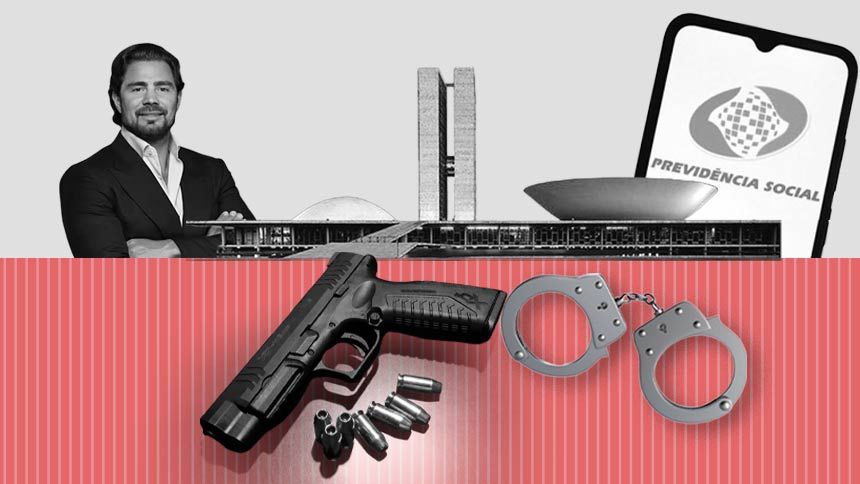
There's still a long way to go until October, and political decisions are necessary – notably regarding the Master case, INSS fraud, and Public Security – and will require concentrated effort because the second half of the year will be dedicated to another mega-election, with the selection of the next president and vice-president of the Republic, governors, senators, and federal and state deputies.
Beyond several proposals to create a CPI (Parliamentary Commission of Inquiry) on Master Bank in Congress, the initiative of Senator Alessandro Vieira (MDB-SE) to collect signatures for the opening of a CPI to investigate allegations involving Master Bank and the law firm of relatives of Alexandre de Moraes in a contract estimated at R$ 129 million promises to cause a stir. According to Vieira, this contract is "outside the standards of legal practice," including suspicions of "direct action by the magistrate" in favor of the financial institution.
A second event with a powerful media impact is the resumption of testimonies by the INSS Parliamentary Commission of Inquiry, which could bring Fábio Luís Lula da Silva, Lulinha, the president's son, into the spotlight for his alleged connection with businessman Antônio Carlos Camilo Antunes, the "Careca do INSS," considered a "facilitator" of the scheme to divert billions of dollars in funds from retirees and pensioners of the institute.
A third initiative spearheaded by the opposition targets an impeachment request against Alexandre de Moraes. The action was filed on December 29th based on the minister's alleged involvement in the Master case, stemming from conversations with Gabriel Galípolo – the Central Bank president responsible for the institution's extrajudicial liquidation due to a severe liquidity crisis, suspected fraud, and violation of prudential rules. The liquidation has already involved the Federal Court of Accounts (TCU), but it is not expected to be reversed, stated TCU president Vital do Rego, who believes reversing the operation is the responsibility of the Supreme Federal Court (STF).
Economy "downgraded" to the Second Division
With strong political tension, economic issues take a backseat. However, the market remains focused on the expectation that President Lula will nominate two directors to head the Central Bank. The names must be approved by a committee and in the Senate plenary – a process that could take place in February or March. Therefore, the first Copom meeting of 2026, scheduled for the 27th and 28th, will include votes from interim directors in the Economic Policy and Financial System Organization and Resolution directorates.
A similar process of ratification of Lula's nomination by parliamentarians will be applied to lawyer Otto Lobo for the presidency of the Securities and Exchange Commission (CVM). Congress will also have to question and approve or reject Lula's nominee for the Supreme Federal Court (STF), the Attorney General of the Union, Jorge Messias.
This combination of events with unpredictable consequences will be a "baptism of fire" for the negotiating power of the Lula government, which begins the year benefiting from a still positive economy, despite monetary tightening; from falling inflation; and from the validity of, for now, the president's main electoral promise: the exemption from income tax for those who earn up to R$ 5,000 per month.
The income tax exemption and free public transportation – currently under study and potentially enacted to the detriment of public finances – will be contenders in the "battle" for increased popularity for Lula and the government, who will defend the controversial end of the 6x1 work schedule before Congress.
At the beginning of 2026, the Tax Reform ceases to be a mirage for companies and the lowest-income population with the launch – also on Monday, January 12th – of the platform where this segment of taxpayers can check the effects of the decisions sealed by Congress. Brazilians registered in the CadÚnico (Single Registry for Social Programs) will be able to check the amount of cashback they will be entitled to on taxes paid on essential products and services. Companies, in turn, will be able to track tax credits and debits.
Despite his busy domestic schedule, Lula is ready to sign the Mercosur-European Union agreement, which was supposed to have happened in December while Brazil was still presiding over Mercosur, but was postponed. On December 20th, Brazil temporarily handed over the leadership of the bloc to Paraguay, but President Lula's firm defense of the agreement is already a "point" for Brazil.
This Friday, the 9th, EU member states will vote on the agreement and, despite resistance from France, which again faced protests from farmers on Thursday the 8th, the formalization of the agreement could take place on January 12th, according to the Council of the European Union.