

Numbed by the influx of R$ 53.4 billion from foreign investors into stocks on the B3 this year – the best quarterly result since 2022, when, according to the consulting firm Elos Ayta, R$ 65.3 billion was invested in the stock exchange – the market is watching Brazil's debut in a "new" calendar, starting on Sunday, April 5th.
Saturday, April 4th, is the deadline for future candidates to resign from their executive positions. Ministers, governors, mayors, and parliamentarians who have decided to change posts are already gearing up for the October election.
Triggered by President Lula at the ministerial meeting on Tuesday, March 31st, the rotation of key positions – now occupied by executive secretaries – goes largely unnoticed by the general public. However, it is being closely monitored by the financial market because the replacements are occurring at a unique moment in the economy, exposed to the effects of the war in the Middle East and through the most sensitive channel: the citizen's wallet.
The restructuring of the Executive branch with the replacement of 18 ministers was expected, but it is a point of concern given the Lula government's efforts to quickly implement two initiatives: containing the impact of oil and fertilizer prices , which could increase the cost of food for Brazilians, and facilitating debt renegotiation – a serious, but not recent, fracture in family budgets that affects the president's popularity. Debt-related income commitments have exceeded 29% since last October.
“The resignation of ministers is a 'break' in the calendar, but not a new phase of the Lula government. The replacements for ministers are technical experts and were aware of important ongoing guidelines. They agreed with the policies and worked alongside the incumbents,” says Leandro Consentino, PhD in Political Science and International Relations, and professor at Insper for over a decade.
When questioned by NeoFeed about the potential adoption of measures – populist or otherwise – by the government in the coming months to attract voters to Lula's reelection, Consentino says he does not foresee a "U-turn," or a 180-degree shift.
“Relevant action would only occur in an unexpected situation where the new appointees, now in control, might make course corrections. As a rule, replacements will follow the guidance of their predecessors, partly because they lack the political clout to justify major changes,” explains the professor.
Despite expectations that the government might launch more economic measures , the market remains numb under the flood of foreign capital which, although it has slowed down in recent weeks, is aiming for the historic record of R$ 100 billion reached in all of 2022.
In this comfortable context, banks and consultancies focus primarily on projections for inflation resulting from the war and any potential "delay" in interest rate cuts by the Central Bank.
"Flávio is not Jair, and the PT has the machine in its hands."
Revisions to economic scenarios between the first and second quarters raise estimates for the IPCA (Brazilian consumer price index) and, consequently, for the Selic (Brazilian benchmark interest rate). The inflation expected for this year by the three largest private banks in the country – Itaú, Bradesco, and Santander – increased from 3.70%-3.80% to 4.30%-4.50%. For 2027, they exceed 4%.
Regarding the Selic rate, projections rose by approximately 0.50 percentage points compared to indications prior to the war in the Middle East, now aggravated by Donald Trump 's frustrating address to the nation, indicating that the battle continues. The range of bets for the basic rate increased to 12.50% - 13% for 2026 and to 9.5% - 12% for 2027. For the exchange rate, the outlook from major banks remains stable between R$ 5.50 and R$ 5.60 for next December, and between R$ 5.60 and R$ 5.70 for the end of 2027.
For Gross Domestic Product (GDP), growth estimates remain unchanged and continue to be modest, between 1.5% and 1.9% for this year and 1% to 2% for 2027. The outlook for fiscal policy has also not undergone any significant adjustment. That is, the target of a 0.25% of GDP surplus this year should be met using the tolerance margin of 0.25 percentage points above or below the central point.
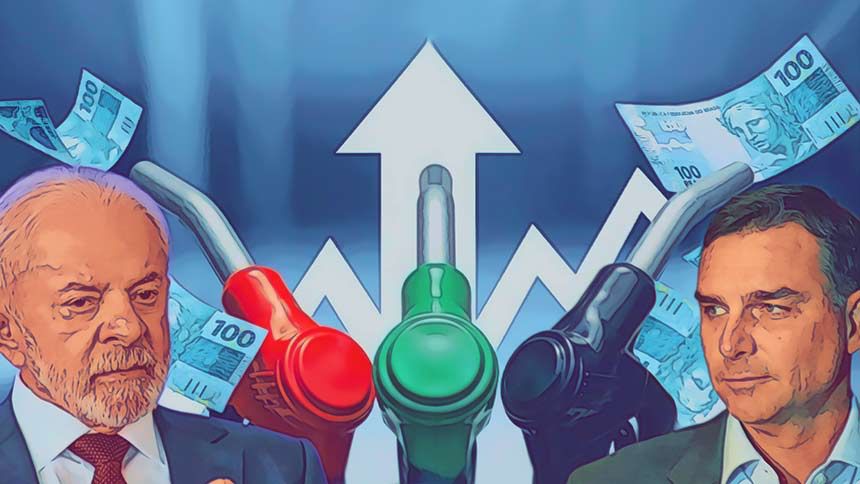
“These forecasts do not suggest that the country is under a red alert in the economy, even though inflation is a concern due to high oil prices. There is, however, a yellow light and a political undertone in the Planalto Palace because the contest between Lula and Flávio Bolsonaro seemed easier at the beginning of the year,” observes the Insper professor, who believes that, despite the prospect of a close race at the polls, the government has advantages.
“Flávio is not Jair Bolsonaro, he doesn’t have his father’s charisma, and he has a glass ceiling that will be exploited during the campaign. The Planalto Palace is prepared for this. But even more relevant is that the PT has the public machine in its hands and, in that condition, has never lost an election,” recalls Consentino, who warns of the need for the financial market to monitor the political bosses, the parties, and the interests of those who have just left executive positions.
"The voting is in October, but we are already in the election and heading towards the party conventions – between July 20th and August 5th – which will choose the actual candidates for the polls. This year, the conventions will take place in the wake of the World Cup," recalls the professor, who does not fail to consider the World Cup a point of distraction in the electoral scenario.
“For this very reason, daily events deserve attention because they highlight relevant issues,” Consentino emphasizes. “With Alckmin as Lula’s running mate and Haddad running for governor of São Paulo, who will form the front line in the Senate? Simone Tebet, Marina Silva, Gleisi Hoffmann? Signals like these are very important to understand what horizon is emerging for a possible next government.”