


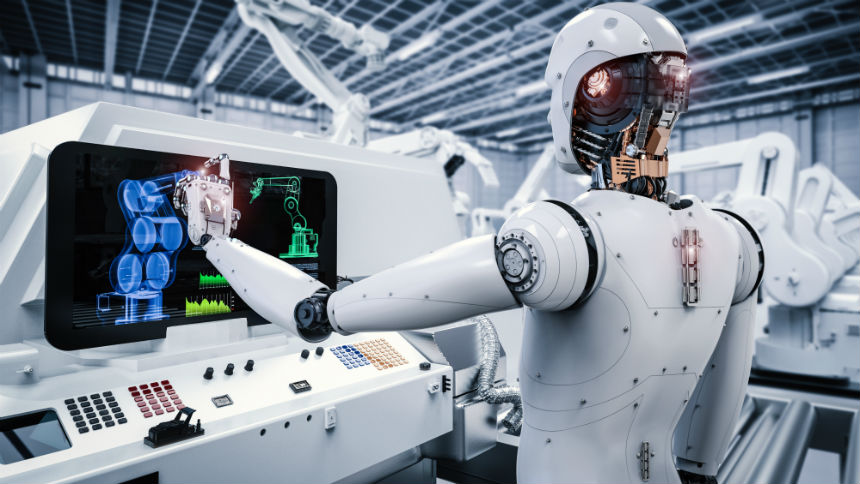
The impact of artificial intelligence (AI) on transforming society is slowly beginning to be understood. A minimal dose of intelligence applied to a process or object will elevate the effectiveness of any system to another level.
AI will be the primary force of competitiveness in the future. And indeed, we are already at the inflection point, where AI will accelerate exponentially and become the new electricity. The technology will give life to inert objects, just as electricity did more than a century ago. In the coming decades, we will cognify what we electrified in the past.
On the other hand, AI brings us new challenges. It will impact society as a whole, companies and their business models, professions, and of course, our lives. Changes have always happened in our society. What we are beginning to feel is that the pace of change is often much faster than what occurred with the industrial revolution. Instead of 200 years, the changes will occur in just a few decades.
Before the industrial revolution, more than 80% of the world's population lived off agriculture. By 2050, about 70% of the planet's population will be living in cities. Industry itself is transforming, with factory workers becoming rare, replaced by robots. Professions have changed; farmers have left the fields for factories and from there to offices. By the end of this century, more than 70% of current professions will have disappeared.
As AI technologies advance, the replacement of many functions currently performed by humans will be inevitable. Occupations consisting of well-defined tasks and procedures may be replaced by sophisticated algorithms. As the cost of computing consistently falls year after year, replacing people with machines becomes economically attractive. This process is accelerated by reindustrialization in wealthy countries, such as the US, which, after losing their factories to countries with cheap labor like China, are beginning to bring them back, but in a fully automated way.
The jobs in American manufacturing, lost due to factory closures, are not returning with them. Robots are taking over those roles. This process is also occurring in China, where several fully automated factories already exist, each employing at least ten times fewer people than traditional factories.
The jobs in American manufacturing, lost when factories closed, are not returning with them. Robots are taking over those roles.
Some studies estimate that about half of current jobs in the U.S. are at risk of being replaced or modified by the automation of a substantial portion of their tasks. These jobs include drivers of vehicles such as trucks and taxis, accountants, law interns, software developers, and computer systems administrators.
This is a significant difference that AI is causing. "Blue-collar" or blue-collar workers are already decreasing noticeably, impacted by robotics, but "white-collar" jobs, those in administrative tasks, previously immune, are now at risk. The replacement or transformation of work is inevitable, and reacting will not help at all. We need, instead, to understand the immense change that is unfolding and learn to navigate this new territory.
Reality is showing that several sectors, such as the music industry, travel agencies, newspapers, and now taxis, have transformed or are in the process of transforming. Solid and traditional sectors have simply collapsed and have had to find new business models to survive.
Let's exemplify the changes that will occur in a traditional profession: law. A thought-provoking question we can ask is: "Will there still be lawyers in the future?" The success rate of futuristic predictions is about the same as chimpanzees throwing darts and hitting the target, but we can debate some ideas and draw our own conclusions. Of course, provided we don't cling to beliefs and paradigms that limit our critical perspective.
Let's analyze the context. Lawyers' work practices haven't changed much in recent decades. I recommend an intriguing book, "The Future of the Professions: How Technology Will Transform the Work of Human Experts," by Richard and Daniel Suuskind, which shows the disruptive potential facing various professions as we know them today.
It shows that lawyers offer high-cost, personalized advice and that partners in prestigious firms preside over pyramid-shaped organizations, receiving high commissions, while battalions of junior lawyers do the hard work of finding precedents and drafting contracts. The high costs of these firms and their fees create an environment open to disruption.
The book makes a simple comparison with veteran London taxi drivers, who needed to memorize the geography of the streets to obtain their license. The service was therefore expensive. This was disrupted by Uber, which attracted hordes of drivers who charge low prices and navigate using GPS. Could this happen to lawyers?
Some studies suggest that a structural collapse of traditional law firms will occur within 15 years.
Some studies suggest that a structural collapse of traditional law firms will occur within 15 years, at least in some countries in Europe and the US. Some early examples indicate that this scenario may become a reality. Some law firms in the US are already using AI as a "digital associate," delegating to predictive algorithms the task of performing intelligent searches for documents, opinions, and case law related to the cases under analysis.
Interestingly, an analysis conducted in Europe and the US on the use of AI in law shows that, with rare exceptions, it is not traditional law firms, but new entrants investing in the concept. We see that the scenario of Uber, Airbnb, Skype, and WhatsApp is repeating itself. Established companies tend to be conservative and fight to preserve their business model.
Finally, we are facing significant changes in society, and virtually no function or business sector will be safe from these transformations. I recommend reading the text " The Great Disruption: How Machine Intelligence Will Transform the Role of Lawyers in the Delivery of Legal Services ." It shows which activities performed by lawyers are most subject to disruption (searching for documents, opinions, creating forms, texts and memos, and even predicting the outcomes of cases in court), how this disruption will affect the sector as a whole, and how law firms will likely use their talents to combat innovation.
Check out this interesting case, " An AI just beat top lawyers at their own game ," where an AI system, in analyzing NDA (Non-Disclosure Agreement) contracts, showed an average accuracy of 95% compared to 85% for humans. But the time difference is staggering. Lawyers took an average of 92 minutes for analysis, while the system took 26 seconds.
The turbulent scenario, like the context we see today involving Uber and taxi drivers, will certainly happen when law firms feel real threats to their current model. But some will understand that the process is irreversible, and the winners will be those who manage to strike the right mix between lawyers and technology.
The changes will affect the economic and social system as a whole. Initial studies already show that the middle class will be the most affected, as they occupy office jobs and are authors of intellectual works, such as lawyers and software developers, which will likely require far fewer positions than today.
New jobs will be created, but they will require specialized knowledge and high levels of education.
Of course, new jobs will be created, but they will require specialized knowledge and high levels of education. New careers and roles, which we don't yet know about, will be created, but it remains to be seen whether there will be enough of them to replace the jobs that will disappear. And whether the people whose jobs are affected will have the skills and qualifications to perform these new roles.
Our relationship with machines cannot be conflictual. There is room for everyone. There are jobs that machines can do better than humans, such as automated looms producing perfect fabrics at minimal cost, or an autopilot that navigates an airplane without deviations, optimizing fuel and making the flight extremely smooth.
There are also jobs that we don't do, but that machines can do. One example is the production of chips, which requires a precision, control, and attention that we are not capable of. Machines also perform tasks that we couldn't have imagined possible a few decades ago. An example of this is Google search, where billions of web pages are searched in a few seconds. It would be impossible for humans to do this. And there are jobs that only humans can still do, although this is not 100% guaranteed in the future.
AI will demand a new educational curriculum that abandons the memorization of facts and formulas to focus more on creativity and communication, things that Brazilian universities, for the most part, lack.
Although professionals such as lawyers, doctors, and accountants may find it tempting to believe in human exceptionalism, even their specialized knowledge, acquired through hard work, may be matched by machines in the near future. The truth is that most professional jobs can be broken down into sets of distinct tasks. Once broken down, many of these tasks can be performed by machines.
In short, this is a discussion that is only just beginning. But reality will come quickly, and ignoring the transformation happening in the world won't stop it from happening and reaching Brazil. We shouldn't race against the machines, but rather run with them. The more we learn to work together with technology and AI, the better our future will be. More than 90% of our colleagues will be invisible, AI software that will be integrated into all our tasks. Therefore, we need to decide as soon as possible how we want to live with them and how to prepare for it. This is a discussion that cannot be postponed.
* Cezar Taurion is a Partner and Head of Digital Transformation at Kick Corporate Ventures and president of i2a2 (Institute of Applied Artificial Intelligence). He is the author of nine books covering topics such as Digital Transformation, Innovation, Big Data, and Emerging Technologies. He is a guest professor at Fundação Dom Cabral. Previously, he was a professor in the MBA in Strategic IT Management at FGV-RJ and taught Internet Entrepreneurship in the MBI program at NCE/UFRJ.