

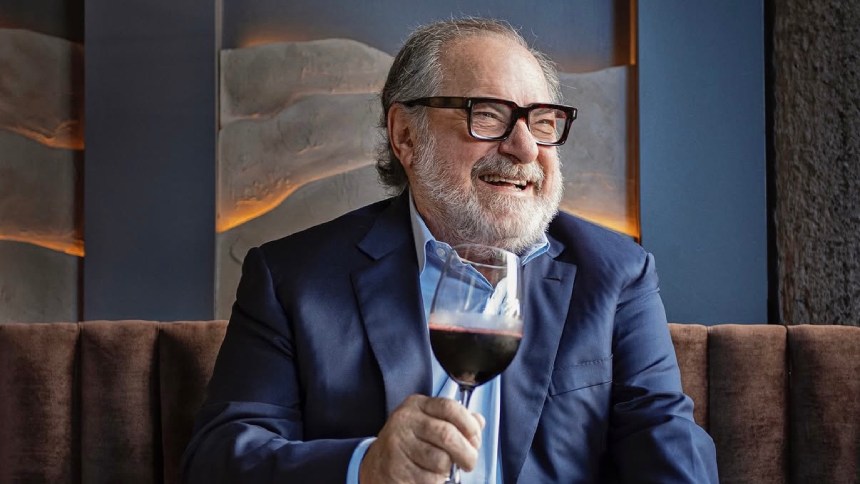
For more than half a century, Michel Rolland was synonymous with power in the world of wine. His name crossed borders, redefined styles, shaped markets, and divided opinions like few others in the history of oenology.
Consultant to hundreds of wineries, advocate for intense wines, and protagonist of debates that went beyond the glass, Rolland helped transform Bordeaux into a global brand and took his technical and aesthetic vision to every continent.
Admired by producers and criticized by traditionalists, he built a career as influential as it was controversial. This central figure in the wine industry has passed away, leaving behind a legacy that will continue to be discussed, tasted, and challenged for many years to come.
Rolland died in Bordeaux, France, on the morning of Friday, March 20th. At 78 years old, the man who coined the term "flying winemaker" suffered a heart attack at home, in the region where he was born, grew up, and to which he always returned after traveling the world providing consulting services.
He was one of the most influential professionals in the wine industry worldwide. In his 56-year career, he provided consulting services to over 600 wineries in 22 countries, including the Miolo Group in Brazil.
The winemaker enhanced Bordeaux's image worldwide. He influenced producers throughout France. He championed New World wines. Alongside the American critic Robert Parker, he was responsible for the style of wine that dominated the international market for decades: powerful, fruity reds aged in oak barrels. For this reason, many accuse him of standardizing global production, threatening the diversity of a millennia-old culture.
He was a controversial figure. Modesty was not his strong suit. He didn't hesitate to say that, before him, European wine was in the Middle Ages and that New World wine didn't exist. Not even Bordeaux escaped his biting observations.
"There were, for reasons unknown, some exceptionally good wines from certain vintages," he said during his last visit to São Paulo in 2025, for a vertical tasting of his Argentinian wine, Clos de los Siete, promoted by Wine.com.
“We can mention the Château Mouton Rothschild 1945, the Lafite-Rothschild 1959, the Latour 1961… There were no more than 20 labels. The proportion of bad wines was very high,” he added. Even those produced by his father were the target of criticism. “Why do you think I went to study oenology?” he said.
He was born in Libourne, on the right bank of the Gironde River, the less aristocratic side of Bordeaux. He was the third generation of producers at Château Le Bon Pasteur in Pomerol, an estate he inherited in 1979.
His family was friends with the owners of a then quite renowned château, whose wines had been served at the wedding of Queen Elizabeth II of England: Château Petrus. “It was the first great wine I ever drank,” Rolland recounted. “At my first communion, at age 11, 30 bottles of Petrus were opened.”
He attended the La Tour Blanche School of Viticulture and Oenology and later the Bordeaux Institute of Oenology, where he was a disciple of Émile Peynaud, the icon of oenology from the generation before his. There he met Dany, whom he married in 1972. A year later, the couple bought an oenological analysis laboratory in Libourne. With this, they began their first consultancies within Bordeaux.
In the late 1970s, they also took over the management of Château Le Bon Pasteur and showed the world what would be their concept of winemaking: constant care for the vineyards, meticulous hygiene in the cellar, and the replacement of very old barrels (which, according to them, were mostly contaminated) with new French oak barrels. In 1986, the couple bought Château Fontenil in Fronsac, also on the right bank.
His first consulting job abroad was for Simi Winery in Sonoma, California, in 1987. The following year, he visited Argentina for the first time, at the invitation of Arnaldo Etchart, from the San Pedro de Yacochuya winery in Salta. From then on, he began consulting everywhere. Rolland made wines in Croatia, Mexico, India (the most challenging, according to him), China, among others.
From the late 1990s to the mid-2010s, he was the most sought-after oenology consultant in the world. What was his secret? In the opinion of Jean-Charles Cazes, president of the renowned grand cru on the left bank, Château Lynch-Bages, his great talent was creating blends. "He was a master at composing the best wine from a variety of batches," the executive told NeoFeed .
Argentina was a passion. In the late 1990s, he convinced six other Bordeaux producers to divide a giant 850-hectare plot in Vista Flores, Mendoza, among themselves. Thus, Clos de los Siete was born. There, each would make their own wine and set aside part of the production for a shared wine. The Rollands' wine is Mariflor.
Bodega Rolland today also owns the Val de Flores brand, also from Mendoza, and Yacochuya, from Salta. The country has become its second home. "I loved the way you dressed as a gaucho to ride horses and have barbecue in Mendoza," wrote winemaker Laura Catena on her Instagram on Friday.
In Brazil, he provided consulting services to the Miolo Group between 2003 and 2013. "His presence helped accelerate the qualitative development of Brazilian wines," wrote Adriano Miolo, president of the group, on his profile.
In 2004, the documentary Mondovino , by American filmmaker and sommelier Jonathan Nossiter, portrayed Rolland as a manipulator who, through hunches made from afar, altered the character of wines in various parts of the world. The barrage of criticism was heavy.
“I’m still here,” Rolland said during his last visit to São Paulo. “I’m not saying I’m always right, but perhaps I’m less wrong than others.”
In his later years, Rolland saw wine critics, many sommeliers, and some avant-garde consumer groups turn to wines with a very different profile from his own: fresher, younger wines, without oak aging.
"You can make delicious wines without oak," he said. "But you don't make great wines. And consumers still prefer wine with oak."
On that same occasion, he mentioned that he was slowing down. At that time, he was providing consulting services "only" to about 100 wineries in 14 countries. "I have a team," he said. "I'm not always the one traveling. I'm nearing retirement."
He never actually stopped. Nor did he ever divorce Dany, but for some time he had been living with the writer and journalist Isabelle Bussinet. His partnership with his first wife, however, remained strong.
“Even after the separation, Michel, Dany, and their daughters continued working together in the laboratory,” says Brazilian journalist Alexandra Forbes, wife of winemaker Pierre Lurton of Château Cheval Blanc, a longtime friend of the Rolland family.
Rolland leaves behind his partner Isabelle, his daughters Stéphanie and Marie, and his first wife and business partner, Dany.