

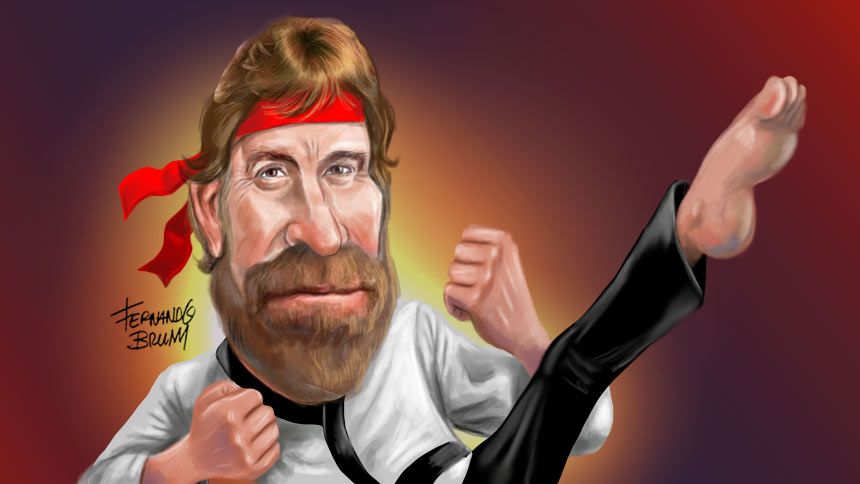
The New York Times once described him as "as expressionless as a statue." Time magazine characterized him as "a bland void." He may not have pleased the critics, but he drew crowds to theaters with his martial arts moves and reputation for invincibility.
On the morning of Thursday, March 19th, at the age of 86, death claimed Chuck Norris, who leaves behind the legacy of a star who transformed stage limitations into style, built a solid career on the fringes of intellectual prestige, and, against all expectations, became one of the most recognizable (and enduring) faces in pop culture.
Nine days before his death, on his birthday, Norris posted a video on Instagram showing him practicing some punches in the gardens of his home on the island of Kauai, Hawaii.
“Nothing like a little fun on a sunny day to make us feel young. I’m grateful for another year, for good health, and for the opportunity to continue doing what I love,” he wrote. “Thank you all for being the best fans in the world. Your support over the years has meant more to me than you could ever imagine.”
The artist's gentleness off-set and outside of competitions contrasted sharply with the image of the almost imperturbable, brutish hero who spoke little and solved everything by force. Thus, he became a legend of 1980s and 1990s action cinema. And, in the age of memes, the impassive demeanor of his characters has also made him an internet icon.
Starting in the early 2000s, a series of memes, the Chuck Norris Facts , began to go viral. With dry and hyperbolic humor, the jokes treat the actor as a practically supernatural being, capable of impossible feats.
They were jokes like: “Chuck Norris doesn’t do push-ups, he pushes the Earth,” “Chuck Norris counted to infinity. Twice,” or “Death had a near-death experience with Chuck Norris.” His favorite was: “They tried to carve Chuck Norris into Mount Rushmore, but the granite wasn’t strong enough for his beard.”
He not only joined in the fun and showed he had a knack for laughing at himself, but he also used his internet fame to star in advertising campaigns for the phone company T-Mobile, the game developer World of Warcraft, the Colombian brewery Cerveza Poker, and the car manufacturer Toyota, among others.
Gracie's tie
Before becoming an actor, Norris was, first and foremost, a professional mixed martial arts fighter. He started at age 24 in a small tournament in Salt Lake City. For the next four years, he lost more than he won.
In 1968, however, he suffered his tenth and final defeat. At the end of that year, he became world karate champion in the middleweight category. Throughout his career, he also trained and incorporated other martial arts, such as taekwondo and jiu-jitsu.
In 1990, he created his own system, Chun Kuk Do, a combination of techniques from Jiu-Jitsu, wrestling, Muay Thai, and Karate. In the early 2010s, during a visit to Brazil, Norris wanted to meet the Gracie family.
"I went to the ground with Rickson Gracie and it was like I'd never been to a class in my life," he said. "He told me, 'Chuck, punch me.' I replied that I wouldn't do that. The last thing I remember is reaching my hand behind me. Then I woke up, I had been strangled and I was unconscious."
McQueen's strength
With his fame in martial arts, Norris became sought after by various celebrities, such as Priscilla Presley, Donny Osmond, and Bob Barker. None of them, however, were as important as Steve McQueen, at that time one of the biggest action stars in Hollywood. He recognized the karate instructor's potential and encouraged him to try his hand at film. It worked.
In 1969, Norris made his screen debut in the action-spy comedy *Danger at Every Turn* , directed by Phil Karlson and starring Dean Martin. But it was * Enter the Dragon* , three years later, that introduced him to the world as an actor. In the film written, directed, and starring Bruce Lee, he played the henchman Colt. The fight between Norris and Lee in the Roman Colosseum is legendary.
Norris has appeared in about 40 films. Among the most famous is Braddock: Missing in Action , from 1984. In the film, Colonel James Braddock returns to Vietnam years after the end of the war to investigate reports that American soldiers are still being held as prisoners.
Upon realizing that, yes, there are Americans being held captive, he decides to act on his own. Braddock invades the Asian country, confronts Vietnamese soldiers, and carries out the rescue mission virtually single-handedly.
It's a typical 1980s action movie: straightforward, patriotic, and centered on a lone hero who resolves the situation through sheer strength and determination, obviously. It was a huge success—so much so that it became a franchise.
The film solidified the persona that would define Norris's career: that of the silent, solitary, and ruthless hero who operates outside the institutions to correct what the system cannot solve. With few dialogues, his character transforms physical efficiency into language.