

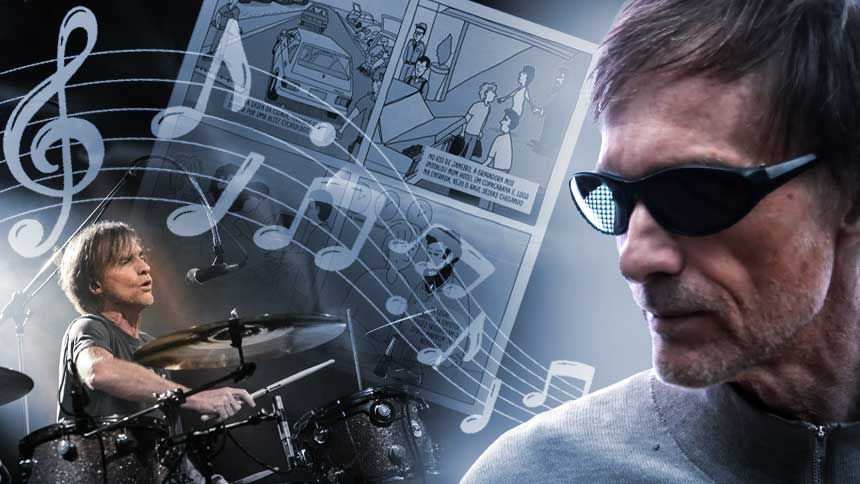
Like any child who grew up in the 1970s, São Paulo musician Marcelo Bonfá found constant companionship in comic books. He preferred Disney , Mauricio de Sousa , the Smurfs, and Hanna-Barbera, as well as Japanese TV heroes, to American superheroes from Marvel and DC. From this passion was born his love for graphic arts, which he preserved throughout his life.
As an adult, the drummer even honed his talent on the covers of two albums and in the liner notes of Legião Urbana, the band he founded in 1982 with Renato Russo and Dado Villas-Boas, which existed until 1996 when singer and songwriter Russo died. However, it was about ten years ago, in 2015, that Bonfá made an unusual decision: to write and illustrate, on his own, in comic book form, the story of the group from his point of view.
Bonfá points out that he had never had any experience with comics before and quickly discovered that this type of narrative is more difficult to create than it seems. He emphasizes that technology saved him.
“I learned by doing. It’s all complex, even more so when it’s autobiographical, because it involves other people and stories and how that’s expressed in the artwork,” he says in an exclusive interview with NeoFeed .
From this artistic adventure that lasted almost ten years came the book My Favorite Band of All Time, published by the Rio Grande do Sul-based publisher Braza. This deluxe edition can be considered a contender for one of the best releases of the year, as the author surprises with his mastery of comic book narrative and his ability to synthesize a unique story in Brazilian music.
Marcelo Augusto Bonfá was born in Itapira, in the interior of São Paulo state, where he lived until he was 12 years old. In 1977, he moved with his family to Brasília after his father, an employee of Banco do Brasil, was transferred. Adaptation to the capital was quick, and many of his new friends, several from Rio de Janeiro, shared an interest in music. From this group would emerge bands such as Plebe Rude, Capital Inicial, Metralhaz, and Blitx 64, among others.
In 1982, Renato Russo invited him to form Legião Urbana. Then Dado Villas-Boas joined. The rest is the story he wanted to tell.
After the band broke up, he pursued a solo career and released six albums. In 2015, he reunited with Dado to celebrate the 30th anniversary of Legião Urbana's first album, on a tour titled Legião Urbana XXX Anos, with André Frateschi on vocals. The success led to further tours in 2018 to celebrate the albums Dois and Que País é Este.
But not everything went smoothly for them. One story was left out of their graphic novel . Since 2013, Bonfá and Dado have faced a legal impasse against Giuliano Manfredini, son and heir of Renato Russo, who filed a lawsuit over the use of the Legião Urbana brand and legacy. In 2021, the case reached the Superior Court of Justice (STJ) in Brasília, where it remains unresolved.
The details of that fight, and especially his history in the Legion and the process of producing his book, are discussed in the following interview:
Did it take you a decade to make this comic book?
That's about it. This story began in 2015 when I bought an iPad Pro, which made my life easier since it allowed me to draw on the screen. I learned everything from scratch. While waiting in airports and hotels, I would draw.
From the beginning, did you decide that you would tell your story and the band's story?
Yes, the fans of Legião Urbana who are in contact with me know that I've owed them this project for many years. I kept saying I was going to do it, but nothing happened. But everything has its time. And mine was the invention of these technologies.
Did you follow a bit of intuition when making the comic?
Yes, I don't have the technique of scriptwriting. I think I did well with it, because I go through all those moments with Legião Urbana and also talk about my origins in the interior of São Paulo, the move to Brasília, how I started playing music. Since it had to be 200 pages long, I didn't use many of the drawings. At the same time, I fixed and improved the lines. In short, it was incredibly hard work, but also rewarding and fun.
"I've always enjoyed this whole storyboard thing, I did some for Legião Urbana songs, like 'Faroeste Caboclo'. But I only discovered non-children's comics when I started developing this work."
It's common for people to think about telling their story in a book. Why did you choose to do it in comic book format?
Because my thing is visual, right? My thing is drawing, more than writing. I mean, I have lyrics of my own. I've always enjoyed this storyboard thing, I did some for Legião Urbana songs, like "Faroeste Caboclo." But I discovered non-children's comics when I started developing this work, I sought to learn about some of the styles of these crazy French artists that I came to like.
You are sincere in several passages, but were you careful not to hurt people?
Yes, I wanted it to be a beautiful book, one that would sit on a shelf, on a table. But I couldn't avoid certain subjects. I took care to be respectful of people, like Negrete [Renato Rocha] and Renato [Russo], who aren't here to speak. It's complicated, I prefer not to have problems, you understand?
His story dedicates a long passage to the departure of the band's first bassist, Negrete. Was this an explanation he wanted to give fans, suggesting that Negrete had given them reasons to fire him from Legião Urbana?
I did it because he's involved in everything, because he was part of the band during a good period (on the first three albums), and because it directly involved my performance. In a rock band, the rhythm section is bass and drums, that's the foundation of everything. It so happened that Renato cut his wrists before recording the first album, and my world collapsed. I was 18 years old and had to find a bassist.
And then came the idea of calling her Negrete...
Exactly. He was in our group, but from a different faction; he liked hardcore, he wasn't into punk rock like us. I didn't know if that would impact our recordings. And he made all the difference in the world.
How?
He wasn't a concise guy with the notes like Renato. We started with a kind of mantra, and Negrete came along putting notes and his finger everywhere. That changed the groove of everything, and we only understood that day by day, in practice, until the point where we weren't composing together anymore, from the first to the second album.
"I found a way to avoid specifically addressing what types of drugs we were or weren't using. Otherwise, the entire book would be about that."
Did things go wrong with him there?
When we went to record the second album, we weren't in sync to do everything because Negrete wasn't keeping up. "I'll take the idea home and then I'll come back," he'd say. I insisted: "Play it, man, if you don't do it, what am I supposed to do? I'm the drummer, remember I need you?" Things went downhill, he stopped coming to rehearsals. Until the day he wasn't there, someone from the record label came to Renato and said: "Look, if the person isn't cooperating, goodbye." I thought it was great because I felt like only I was being harmed.
The only incident involving drugs was your meeting with Raul Seixas at your hotel?
Along the way, I found a way to avoid specifically addressing what types of drugs we were or weren't using. Otherwise, the whole book would be about that, even though we never went beyond a joint here, a little alcohol there, because we were never into excesses in that regard, everyone had common sense, nobody died from a drug overdose.
Why does your book only cover the first four albums and then jump straight to Renato Russo's death?
I wanted to focus on my most intense period with the band because, after those albums, Renato found out he was HIV positive and started having problems. At the same time, he was drinking too much at times. From then on, it was like that: more of the same in a kind of boring way. The next three albums are good because we would meet in the studio, exchange ideas. And I wasn't interested in going into that story anymore, in telling what everyone already knows.
Another point you left out was the legal battle with Renato's son. Why?
Because this is nonsense, I didn't think there was any point in getting involved. The guy is shooting himself in the foot, leave him alone. Our lawyers handled all of this very well, we won at every level, but it's not over. It was a complicated moment when I was faced with this situation, which exploded like a bomb.
You left out the legal battle with Renato's son. Why? "Because that's idiotic."
Was it all so sudden?
Strange things started happening. We wanted to play music, but we noticed we were being somewhat restricted; people who wanted to do projects with us were having difficulties. And we discovered that someone was blocking us. We had to enter a field, the legal one, which wasn't ours, where everything is very complex. I needed to understand this legal language to help. Explaining the obvious can be quite complicated, you know?
And it becomes surreal, even...
Yes, that's what happened to us, it's pure Kafka. Legião Urbana started as just another band, it could have been called anything. But the name took on another dimension after years of work, after we dedicated our lives to it. So, all the value that this brand has is due to what I, Renato, and Dado did. Otherwise, it wouldn't be worth anything. Someone's interest in it is because it has value, and that comes from what we built. It's crazy to want to exclude us from that.
Is Legion still a good business today?
Yes, the revenue comes from royalties, and our songs are still played a lot today. Thank God, our work has been revitalized. The number of children and teenagers I see today who are fans of the band is impressive. They discovered Legião Urbana because what we did is real, visceral, organic; they are people who realized that what's being done in music today is automatic, soulless, nothing special.
How much does the brand generate in revenue for you per year?
I don't know. I don't even stop to think about it, I haven't the slightest idea. I'm not a guy who lives on luxuries, but we live off royalties. There are divisions: artistic rights, related rights, performance rights. There are several. I'm a musician and composer, the lyrics are by Renato, and the rest is divided between the parties. In short, there are a lot of calculations to do.
What do you say when people tell you that you built something truly special, something that made all the difference for an era?
It's difficult to talk about this. We are the soundtrack of this country during very significant moments in its political, social, and economic history. And that soundtrack plays today, marking lives. The band always had great chemistry; we really gave ourselves over to it. I'm proud to be recognized for something I dedicated my life to. I believed in everything, in the lyrics, in the message. Of course, we didn't realize what was to come, but we always considered ourselves the best rock band in Brazil. We were above all others with a lyricist like Renato.
Did that make you try to outdo yourselves with each album?
Undoubtedly.