


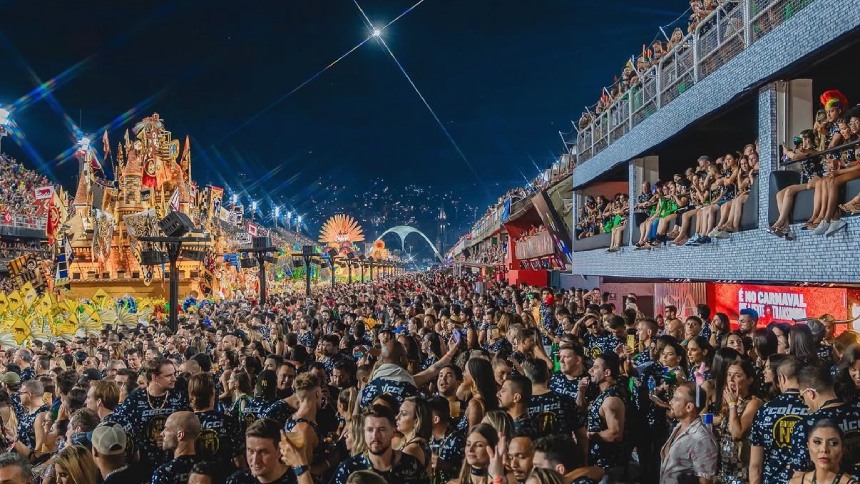
N1 was born in Sapucaí. In 1991, José Victor Oliva partnered with Ambev to create what was then called Camarote Brahma , which later became Camarote Nº1. Over the last few decades, the space has become one of the most sought-after spots on the samba runway, bringing together national and international celebrities such as Silvia Braz, Alok , Maradona, and Arnold Schwarzenegger . This year, the expectation is that the VIP area will host Ronaldo Fenômeno and Carlo Ancelotti .
It was Carnival that propelled the company and helped build the brand's prestige. But, to continue growing, N1 will have to depend less and less on the festival—and, above all, on the revenue that comes from the main samba parade route.
The Independent League of Samba Schools of Rio de Janeiro (Liesa), the main association that organizes the Rio de Janeiro carnival, has been redesigning the rules of the game, standardizing services, restricting activations, and creating new charges that tighten the operation of Camarote Nº1 precisely at a time when the sector is losing a significant cushion of profitability, the PERSE, a federal program that helped sustain the resumption of events in the post-pandemic period.
The assessment within Holding Clube (owner of the N1 brand and platform) is that Carnival remains a pillar, although it has become a "more difficult business to plan." This is because Liesa has started capturing part of the revenue and centralizing suppliers and contracts that were previously negotiated directly by the VIP boxes.
Three years ago, all ticket sales for Rio Carnaval were handled by a single ticketing company, Ticketmaster, with unified access control and a consolidated database, which led N1 to dissolve its partnership with Ticket360.
Then, the same thing happened with the Wi-Fi, previously operated in the VIP area by Claro . And the most recent move involves energy: instead of each VIP area setting up its own "island" of generators — with commercial agreements and even bartering with suppliers — now the VIP areas will have to contract the service through Liesa, at a fixed price.
“There were suppliers who would turn around and say, ‘I’ll do it for free in exchange for this.’ I no longer have that option,” says Márcio Esher, managing partner of Holding Clube.
The restrictions also affect sponsorships. In the case of betting, Camarote Nº1 can close deals as long as there is no visual exposure, such as t-shirts or billboards, being restricted to actions with influencers.
In practice, according to the group, this reduces commercial interest. In one of the recent cycles, it is estimated that the VIP box lost around R$ 5 million in sponsorship revenue due to the changes in the Sapucaí rules.
Today, the VIP area operates with an investment of around R$ 42 million for approximately R$ 50 million in revenue, and the group itself admits that, with the new environment, Carnival tends "not to grow much".
Still, N1 avoids portraying Liesa as the villain. There is explicit support for the league's repositioning as a "business hub" that increases revenue for the parade.
“We strongly support this movement because we know that this improvement for the schools is happening,” says Tatianna Oliva, CEO of Cross Networking, the group's partnership arm. “That was the main objective: to generate more money for the parade, for the schools. We understand that.”
Contacted by NeoFeed , Liesa confirmed that three years ago it implemented a new business model that concentrates all ticket sales, whether for VIP boxes or grandstands, in a single ticketing system, but did not respond regarding other changes implemented in services at the Sambadrome.
The league also said that it has a betting company among its sponsors, but that the VIP boxes "may have sponsorships from other betting companies, even though, as in other situations, there is no visibility to the parade area."
Dancing outside of Sapucaí
The fact is that, beyond this backdrop, the challenge increases in 2026, when Camarote N1 celebrates its 35th anniversary, with the end of PERSE (Emergency Program for the Recovery of the Events Sector), created by the government as one of the measures to save companies amidst the pandemic.
Seeing this scenario as structural, Holding Clube accelerated its diversification strategy. In 2025, Clube N1 — an umbrella group encompassing proprietary experiences and initiatives — generated approximately R$ 75 million in revenue. The projection for 2026 is to grow 15% on that base, with one key detail: a significant portion of this growth will come from outside of Carnival.
The first strategy is to keep the desire for the brand alive throughout the year, selling items developed through collaborations. During Carnival, the store located where shirts were customized has already shown strength even in expensive items: a line of bags priced at R$ 2,500 sold out at the event last year.
Now, the idea is that the special editions will continue to be available on partner marketplaces and at physical locations outside of the festival. For 2026, the plan includes 15 brands and approximately 20 SKUs in total. “It’s no longer about ‘I went there and bought a souvenir.’ It’s about engaging with that guest throughout the year,” says Tatianna.
The second growth area is the expansion of the proprietary events calendar, which allows for diluting the dependence on Carnival throughout the year and reaching audiences at different times and age groups. The logic is to use the strength of the N1 brand in Sapucaí as a showcase to create replicable experiences in other contexts.
For New Year's Eve, the group is betting on Arcanjos N1, held in Barra de São Miguel (AL), offering a premium beach festival experience and a younger audience. The event serves as a "gateway" for the brand, building relationships with a new generation that, in the future, is likely to migrate to Camarote Nº1 during Carnival.
During World Cup years, the company activates Torcida Nº1, a mega-event held at the Jockey Club in São Paulo, featuring a large screen, open bar, musical attractions, and brand experiences. For the company, it's like the "mid-year carnival," attracting high-profile sponsors and offering greater predictability in corporate revenue.
Internationally, N1 also brought its hospitality concept to Tomorrowland Brasil with the creation of Arena 1, a premium area within the festival. After its success, the project is confirmed to return in 2027 when the event comes back to the country. According to the group, the initiative accelerated the brand's global positioning, attracting foreign audiences to Carnival and strengthening N1 as a platform for premium experiences outside of the Sambadrome.
The third lever is the business ecosystem. Holding Clube was born in the events industry, but it created companies based on the demands of the market itself and today uses this structure to generate revenue outside of Sapucaí and gain resilience. Its portfolio includes Banco de Eventos (1988), Agência Samba (2006), Cross Networking (2008), Storymakers BR (2016), Roda Trade (2017; a core group that became an agency in 2019), Auíri (2021), and Bossa Experience (2025), focused on the incentive travel market.
Thus, N1 intends for the Camarote Nº1 to remain an icon, while revenue grows through products, platform, and events that can take place in any month.
The group also intends to build a digital revenue stream by launching its own app for Camarote Nº1 this Carnival. The platform, which starts as an MVP, will concentrate real-time information about the event, access maps, schedules, operational notices, and exclusive content for guests.
The idea is to transform the app into a permanent channel for engaging with the consumer base throughout the year, integrating partner benefits, exclusive offers, and brand activations, generating advertising revenue in the future.