

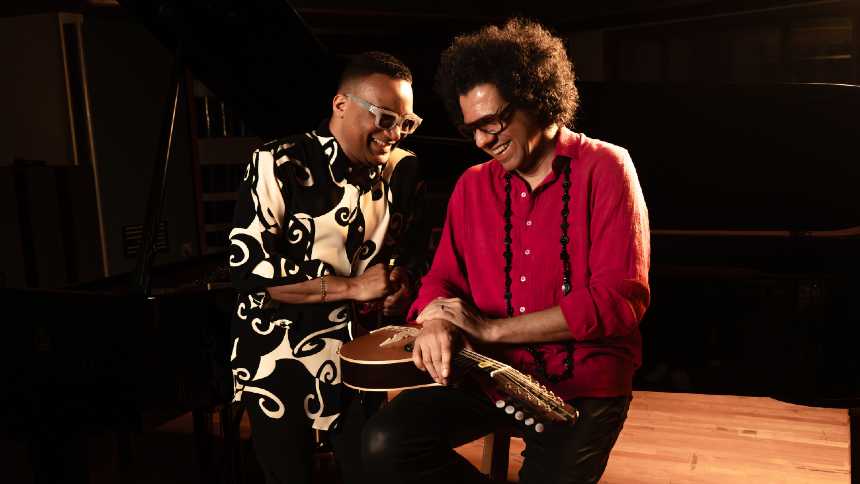
The first time Cuban pianist Gonzalo Rubalcaba visited Brazil , in 1991, he performed at the Memorial da América Latina in São Paulo . After that, he lost count of how many times he returned. And there were many encounters around the world with Brazilian musicians. Now, he's back, this time in partnership with mandolin player Hamilton de Holanda. Together they will perform on the stage of the Teatro de Cultura Artística on April 7th in São Paulo.
The Collab show is part of an international tour that continues in Europe in the coming months. It's a meeting without a clearly defined program, as it features two great improvisers and leading figures of their generation known precisely for this characteristic. It will be a dialogue between mandolin and piano with a repertoire that blends jazz , Brazilian music, and Afro-Cuban music.
"I think the first way to establish a loving relationship with Brazil is through music, and I was lucky enough to have that," says Rubalcaba, in a telephone interview with NeoFeed from Florida, in the United States , where he resides. In the past, the 62-year-old musician toured with Ivan Lins and João Bosco, each with their own group, and says that this gave him the opportunity to go to Rio , Florianópolis , Belo Horizonte, and many other cities.
“I was able to travel around the country a bit and also got to know the north. Brazil is practically a continent, with many contrasts between the north and the south, and further inland, between the jungle and the coast. There is so much to see, and when you fall in love with the Brazilian way of being, their way of being, the food, and the way they speak, you always want to come back,” she says.
Holanda, 50, spoke to NeoFeed from Buenos Aires , where he was performing, and explained that the meeting was the fulfillment of a long-held wish, as he has always been a big listener of the Cuban artist's records and an admirer of his musical culture. "I've wanted to play with Gonzalo for a long time."
He is a musician respected worldwide for having a very particular style. Because he's into jazz, but also Cuban and Latin music, and he really likes Brazilian music."
Three years ago, Holanda managed to realize that dream at Tuca, in São Paulo, when they played together for the first time. "It was a wonderful chemistry. We became partners, friends, and recorded an album [ Collab] , which was nominated for a Grammy in 2025," he recalls. "Last year, we started a big tour in Europe and now we're very well-oiled. So, this will be kind of a show to consolidate our partnership."
Both are highly awarded artists, winners of several Grammys. Holanda gained fame by revolutionizing the mandolin and creating a ten-string instrument with which he projected Brazilian choro music onto the global circuit. He has shared the stage with American pianist Chick Corea, trumpeter and composer Wynton Marsalis, and Brazilian multi-instrumentalist Hermeto Pascoal, who passed away last year at the age of 89.
Rubalcaba, nominated for and winner of the Grammy and Latin Grammy in different years, was discovered by none other than trumpeter Dizzy Gillespie (1917-1993), a great legend of American jazz. Along this path, he has been included by the specialized press among the world's great pianists.
Musical conversation
Speaking about the show, which will feature the repertoire from the album Collab , the mandolin player reveals that, in addition to compositions by the two of them, they will perform other songs by João Bosco with Aldir Blanc and by Stevie Wonder.
"The encounter has a lot to do with our roots – Brazilian and Cuban. Our music is Black in its essence, in its starting point, both choro and jazz and Afro-Cuban music, which creates an atmosphere when we play. And it makes these musicians from 100 or 200 years ago appear, in some way, to us, mainly from a rhythmic point of view," he says.
Rubalcalba situates the musical conversation between Brazil and Cuba on a ground of mutual admiration and warmth: "We have many things in common from a spiritual, religious, and musical point of view due to the Black and European presence in both cultures." All of this becomes visible in the interaction that happens on tours, he says.
"It's not just about sharing the stage, but these are moments that create a more intimate connection, resulting from traveling together, staying in the same hotels, sharing the same table. There's time to exchange ideas, to tell stories."
With so many Brazilian musicians he admires, the pianist finds it difficult to choose just one among his favorites. But he does mention Cartola.
“I would like to mention the song ‘As Rosas Não Falam’ (The Roses Don’t Speak) , which has something to do with a Cuban song movement that is more than just bolero, but a type of romantic, slow, more sophisticated song,” says Rubalcaba, who left Cuba at age 26, lived for six years in the Dominican Republic and now has a home an hour from Miami.
Holanda lives in Rio, travels all the time, and in the coming months will be going to China , India, Croatia, and the United States. Where does he most enjoy playing?
He laughs: “At the next show. Every place has a cool person, a warm feeling, great food. When I arrive in a city, I like to take a walk, feel the cold or the heat. In other words: today's show is the best, and tomorrow's will be even better.”