

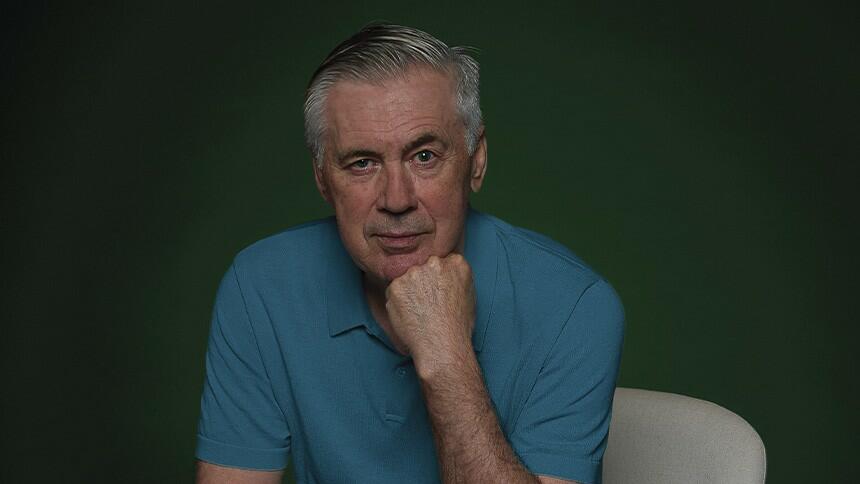
Carlo Ancelotti is the coach with the most Champions League titles in Europe and is the only manager to have won the five biggest leagues in Europe: Germany, Spain, France, England, and Italy. "It was luck," he says modestly, deflecting the question when asked about it.
The fact is that the current coach of the Brazilian National Team, and one of the great hopes of the Brazilian fans, has a career of triumphs. What the whole country expects is that he will bring home the sixth star, the sixth title, in the 2026 World Cup.
Working with Brazilians is nothing new for him, as he played with Falcão and Toninho Cerezo at Roma, and later coached icons such as Dida, Cafu, Rivaldo, Kaká, Ronaldo, Ronaldinho Gaúcho, and Vini Jr. Today, he lives in Barra da Tijuca, Rio de Janeiro, with his wife Mariann and stepdaughter Chloe.
The latter, incidentally, is producing a documentary about her stepfather's sporting life during his childhood in Reggiolo, Italy, and how that connects to his career. He also writes books about football, has acted in films in Italy and the US, and whenever he can, escapes to Madrid and Vancouver to relax.
He hasn't been able to set foot on the beaches of Rio de Janeiro during his time here, but he says he really wants to go. However, the mission of bringing home the trophy comes first.
Every coach needs luck. But the key to success is passion for the profession. I'm now celebrating 30 years as a coach and I'm still very passionate about football,” he says.
Check out excerpts from the interview, at the CBF headquarters in Rio de Janeiro.
Carlo, you have a history with sports since childhood, in Reggiolo, Italy. Could you pinpoint how and when you understood yourself as an athlete?
Football entered my life as a passion. It was what you could do back then. I'd come home from school, meet up with other kids, and play every day in the summer. I still maintain that interest today. I lived with my father, my mother, my sister, my grandfather, and my grandmother. It was a close-knit family. My mother didn't want me to leave home, but I did anyway. I moved to Parma when I was 15, and I still balanced sports with school.
And for a boy who loved the football pitch in the 1970s, was there much reference to Brazilian football on television?
My earliest memory of Brazil is from the 1970 World Cup final, when the Seleção beat Italy 4-1. I was 11 years old, but I remember Pelé, Jairzinho, Tostão, Carlos Alberto very well… Brazil had a great team. It was also the first time you could watch a match on television, and everyone was thrilled. There was anticipation on the part of the Italians, but Brazil was playing very well.
“There is a lot of pressure and the player needs to overcome the fear of making mistakes, after all, nobody is perfect. A World Cup isn't won by a perfect team. A World Cup is won by the team that is able to react to adversity.”
You turned professional playing for Parma, achieving success very quickly. What was that start to your career like?
I started playing in the third division, when I was coached by Cesare Maldini, who spoke about my talent to Nils Liedholm, the Roma coach in the Italian Serie A. He was interested, came to see me play, and at 20 years old, I went to Roma. It was 1979. I stayed there for eight years, until 1987, and went through many things, including knee injuries. One of them kept me out of the 1982 World Cup, and I was very upset. It was the year Italy won the World Cup, beating that incredible Brazilian team… [the Brazilian national team, coached by Telê Santana, which had Zico, Falcão, and Sócrates, won its first four games and enchanted the world until being eliminated by Italy in a 3-2 defeat in the second round].
In 1987 you went to Milan. Was that your best moment as a player? Did you expect to have so much success there?
It all started with a visionary, Silvio Berlusconi, then president of Milan. He sought a coach with a new mentality and brought in Arrigo Sacchi, who was coaching a club in the Italian second division, and signed the Dutch players Van Basten, Gullit, and Rijkaard, who helped build that winning team. Thanks to Sacchi's fantastic and innovative work, we had a positive period that made history.
As soon as you stopped playing, did the idea of becoming a coach come to you?
Arrigo Sacchi left Milan in 1991 and told me: “When you finish your career, I would like you to be part of my coaching staff with the Italian National Team.” His project was to prepare Italy for the 1994 World Cup, and I ended up accepting to join the group.
“I used to understand that a team's strategy was more important than an individual athlete's skill. But I realized I was wrong. The most important thing is the player. A coach needs to adapt to a star player's style of play, not the other way around.”
In the 1994 World Cup final between Brazil and Italy, there's a picture of you, already on the coaching staff, consoling Roberto Baggio, who missed the decisive penalty that ultimately gave Brazil their fourth World Cup title. What do you say to a star player at that moment?
Before a penalty shootout, you need to talk to the player, find out if he wants to take one or not. It's a normal question, even for a great athlete. At that moment, the psychological aspect is the most important. Some feel confident, others don't. I said that this is part of football. Those who have never missed a penalty are those who have never taken one. Those who have taken penalties have also missed. You can have perfect practice in training, but when it comes time to take a penalty, the pressure is immense. The emotional aspect is very influential. The psychological side speaks louder than the technical aspect at that moment.
I interviewed Kaká for Velvet a year ago, and he spoke extensively about Kaká's influence on his professional growth at Milan, which led him to become the best player in the world in 2007. Was Kaká a special player for you?
Kaká was one of the first midfielders capable of combining talent with physical prowess. His intensity on the field, his pace of play for a midfielder, was something rare to find in players of that position in previous years. He was the first to take advantage of this concept of modern football: talent and intensity.
And Ronaldo Fenômeno? What was your relationship with him like?
Ronaldo, for me, was the best player I've ever coached. He was pure talent, a player of great technical quality. And that's considering all the athletes I've coached, including foreign players.
Brazilian players have a natural talent and know how to improvise like few others. In Europe, the tactical aspect has always been more important, and our players have improved in that regard there. For the next World Cup, is it better to prioritize this technical quality of the players or to improve the tactical side in order to succeed?
That's a good question. I think creativity and talent have to be nurtured in all aspects. You always have to work on that. Talent can't be built. No matter how much I work with a player, I'll never be able to extract that from him if he doesn't have that quality. As for a talented athlete, you can give them many tools to improve their football collectively. But you have to be careful, because when you focus too much on tactics, you end up stifling creativity.
"For me, every Brazilian player is special. The country's ability to produce such talented athletes is impressive. I think the climate, the beaches, the culture—this combination makes these players stand out."
Does the technological aspect, such as performance analytics, also help?
Yes, I receive all kinds of statistical analysis, it helps me a lot, but that's not the most important thing. It's also necessary to analyze the athletes' physical data, which ends up being paramount. We know how many meters they ran in the matches and that helps us plan the training load. The technical part of the statistics shows us performance, such as shots on goal, passes, but that doesn't have a direct correlation when it comes to team selection.
After almost 30 years as a club coach, you've taken charge of a national team. And what we've noticed here is that it's been difficult for our best players to replicate the good performances they have in Europe. How do you work on that now on the other side?
I've coached Italian, French, German, Spanish, and Argentinian players, and many times they told me they were overwhelmed, that the travel was exhausting, and that they wished they could ask their national team coaches for time off. But that never happened with a Brazilian player. Never! They all want to play much more for the national team than for their club. They have a great desire to represent their country, but we need to work on that too. It's been 24 years without a World Cup title. Brazilian players have more pressure than those of other national teams. The whole country expects a victory and demands a lot from the players. The pressure on them is high. The key is to transform all of that into motivation.
Vinicius Junior is the only football player sponsored by Vivo, and when we signed that contract, there wasn't as much pressure regarding the racist attacks against him in Spain. Today, four years later, we see frequent episodes, and you, when you were at Real Madrid, were very vocal against these acts. What do you say to an athlete at that moment, and how do you combat racism?
It's always necessary to support him, obviously. Junior suffered a lot with this issue. In the beginning, as you said, he wasn't aware of it. But then, little by little, in Spain, he started to be treated very badly by rival fans. Real Madrid has always given him a lot of support, and I believe a large part of the local press has too. After everything that happened against Vinicius, I think there has been an improvement in cases of racism there. And Vini was undoubtedly a big part of that. But everything he went through was very difficult. With his character and seriousness, he has been able to win this fight. And he remains humble, which is a very rare quality for a player who is a star in world football.
"Tactical work only surpasses talent when talent doesn't work. That's why it's fundamental that a skilled player works harder, runs, is selfless, and gives everything for the team. The most important thing is that football is a team sport. It's not an individual sport."
Brazilians have been dissatisfied with the national team's performance in recent years, and, partly due to political reasons, there's no longer that pride in wearing the jersey. Do you feel that the national team is still distant from Brazilian fans?
Generally speaking, I think fans have lost some of that attraction to national teams. The match schedule is packed now. In Europe, for example, the big teams don't always face big opponents, and that ends up diminishing fan interest. But here in South America, I think it's not like that yet because of the football rivalries that exist between all the countries. That feeling of supporting your country remains alive, yes.
Your son Davide and your son-in-law, Mino, work with you. What's it like having family close by in your professional life as well?
I would never give my son such a big responsibility if he wasn't qualified. He graduated in Physical Education, studied hard, then became an assistant and has been working with me for many years. My daughter's husband has a degree in Nutrition and Supplementation and specialized in physical conditioning. I understand that I am surrounded by very competent people at the CBF (Brazilian Football Confederation). This applies to physical conditioning, medical aspects, logistics, and analysis. All of this is very important for a national team. And I've noticed that it's been very good to work with Brazilians on the technical staff. They are different from the English, the French, and the Germans. Brazilians are humble. I don't want to criticize the others, but Brazilians also have a lot of knowledge and are not arrogant.
How do you see the current situation of the Italian national team being eliminated from their third consecutive World Cup?
It's a generational problem. In recent years, good strikers haven't emerged. Italian football has always had its defensive system as a strong point, and now that has been somewhat lost with the attempt to keep up with modern, globalized football. The big Italian teams, Milan, Inter, Juventus, and Roma, don't have Italian strikers. They all have foreign strikers.
Are you practicing singing the Brazilian National Anthem?
It's very difficult, but at the World Cup I will sing. 100%! Here in the Brazilian National Team, players who are called up for the first time have to sing the national anthem in front of all their teammates. And many make mistakes, and start again, because it's very difficult.
Will working with the Brazilian National Team be the last job of your career?
I think so, I just don't know when yet. Whether it will be in 2034, 2038 or 2042 [laughs].
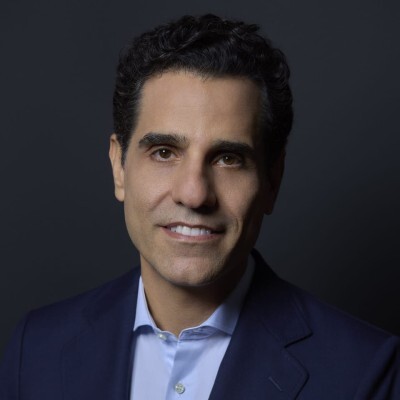
Christian Gebara is the president of Vivo and artistic director of Velvet magazine.