

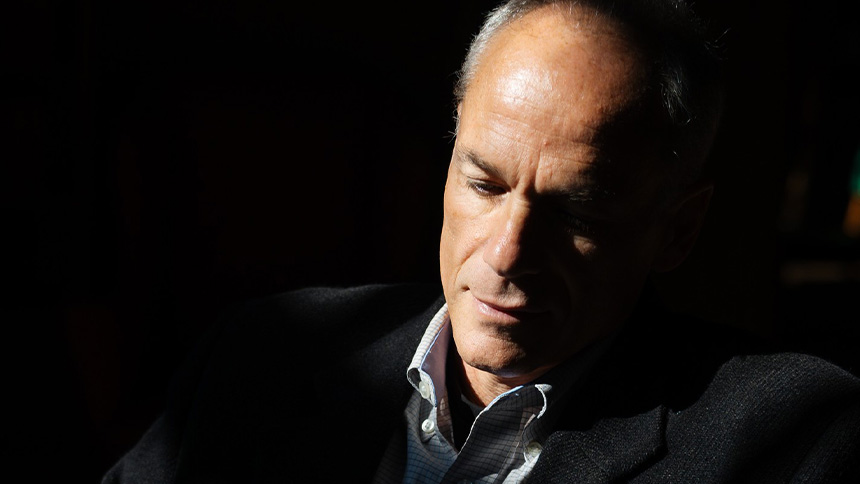
During the video call with Velvet, Marcelo Gleiser was at his home, an 800-year-old building in Tuscany, Italy, where he decided to live with his wife Kari and youngest son, 14, since the end of the pandemic. The idea was to reinvent themselves after leaving the US, where they lived.
“I reached the top and I would like to start over from scratch. It was a happy coincidence to find a place to live in Italy and I intend to stay here permanently, for as long as it lasts,” he states, paraphrasing the poet Vinicius de Moraes. The transformations we need to make on a personal and collective level, according to him, depend on the combination of poetry with what he calls a “plumber” or “fireman”—the metaphor describes the joining of ideas with realization.
Change is nothing new in his life, as Gleiser has known he can change his goals since his youth. He was once a volleyball player, dedicated himself to playing the guitar and considered pursuing a career in music, and ended up becoming, against the wishes of his father, who preferred that he study engineering, a leading physicist in the world.
From then until now, he has spent 20 years with a column in one of the country's most prestigious newspapers, Folha de S. Paulo ; segments on open TV programs such as "Fantástico" on Globo; numerous academic titles and awards; and 18 books published in various languages. Such success proves that defying his father and "counting stars," as his father used to curse physicists, was the right decision. Or, as he himself states, "no revolution comes only from the head, most begin in the heart."
Marcelo, you had a typically Rio de Janeiro youth, playing volleyball with Bernardinho. How did you end up in science? I heard your father didn't approve of the idea very much.
In fact, I played volleyball with Bernardinho and we were Brazilian Junior champions together at 16, which occupied a large part of my life. Until I was 15, I also didn't like math, but one day it clicked, I started to understand and like it. I also played the guitar very seriously and wanted to be a musician, but my father [Isaac, who was a dentist] said I would starve. So I told him I wanted to be a physicist and he thought even worse—who, according to him, would pay me to count stars? I ended up going into Chemical Engineering because I didn't know what to do. The only zero I ever got was on a Chemistry exam, which made it clear that my thing wasn't the laboratory, but working with ideas, which is what I've always wanted to do since adolescence. My interest lies in the big questions. Where did everything come from? What makes us different? I like the unknown. After two years of Chemical Engineering at a public university, I decided to study Physics at PUC. To pay the tuition, at 19, I gave private lessons, worked as a teaching assistant, and supported myself. It was the best thing I ever did in my life: taking a risk on an uncertain future.
And in that future, you ended up being a pioneer in popularizing science for ordinary people. What made you become a somewhat more media-savvy spokesperson for science?
I didn't plan it, but I've always felt a deep need to share my fascination with the world and with people. Much of my effort is a way of trying to inspire people to get closer to nature and look at the sky with curiosity. What science does today is something that ancestral peoples and traditional religions already did: help us in our search for meaning. I've always believed that scientists shouldn't keep the great discoveries and questions about the universe to themselves, because it belongs to all of us, and those who fund science are the people who pay taxes. So, those who stay hidden only in the science lab aren't doing what they should be doing: being transmitters of knowledge, not just in the classroom.
And the classroom has acquired countless formats over the decades and with the technological changes in communication.
Yes, I learned this when I wrote my first book, "The Dance of the Universe," and discovered that everyone wants to learn. It was 1997, and I participated in the "Roda Viva" program. There, I was invited to be a columnist for Folha de S. Paulo . I wrote for the newspaper for over 20 years! It became clear that there was interest in the subject, and I used that to leverage what I already thought. Today, we live in a different time, and with the democratization of the internet, a lot of nonsense is being spread. I realized there was a vacuum of content about science, philosophy, and religion, and I created a wide variety of content for YouTube, Facebook, and Instagram. That became a living mechanism for disseminating knowledge.
The book "Awakening of the Conscious Universe," from 2024, has a clear manifesto about who we are in the universe and how science has been co-opted by power and capital, taking away our priority, which was to preserve what we have here on Earth today. Do you still defend this?
I am increasingly convinced that science has always served power, ever since Archimedes in Ancient Rome, building catapults for attack and defense. The alliance between science and power is very old, and this hasn't changed. This ideology of infinite growth, which dates back to the Enlightenment, reduces the universe, society, and life to manipulable mechanisms. We need to think systemically, more openly, studying the connections that exist in various parts of the system. Objectifying nature has led us to the state we are in today, which threatens our civilizational project.
"Today, we believe we own the world, a dominion without moral implications over what we are doing to the planet. The ethics of belonging is the opposite: we cannot live without nature."
But how could we deal with this collapse of civilization that seems imminent?
I've been thinking about how we can deal with this problem and the existential crises we've been having without creating a dystopian scenario. It's easy to say the world is going to end and that it's going to be a horror. The fundamental question for me is what we can do to avoid getting there. What kind of ideological transformation can we have where our values are re-evaluated so that we don't have this defeatist way of thinking about the natural world? That's where the proposal I elaborate in the book comes in, which I call "biocentrism": putting life first and taking into account the ethics of belonging. Today, we believe we own the world, dominating what we are doing to the planet without moral implications. The ethics of belonging is the opposite: we cannot live without nature. Without oxygen, we cannot survive. There is a codependent relationship between all forms of life that, for me, should be the clearest thing. However, since the formation of agrarian civilization, 10,000 years ago, we have been forgetting it. We've moved far beyond that concept, living in cities that are concrete blocks. We need to rethink this narrative of dominance, not only at the corporate level but also at the personal level. No revolution comes solely from the mind; most begin in the heart. Transformation starts with a poet and a plumber or a firefighter. The poet has the vision, but needs the firefighter to work out the practical details.
Did your awareness of this issue stem from the finite nature of Earth's resources? And how is it possible to view all of this in a positive light?
It's a mindset : there are pessimists and optimists. Pessimists enter the field and don't even kick the ball. I don't want to live my life like that. I want to try. I think things are changing. I've always been very concerned about the environment, since I was a child. In childhood I already refused to eat meat; it was never natural for me. When they filled in Copacabana beach, I was 11 years old. They brought contaminated sand from Botafogo, and there was a hepatitis epidemic. I caught it. I understand that it was done to improve traffic on Avenida Atlântica with a two-way street, but the intrusion always bothered me. The idea that engineering can intervene in ecology without consequences is an exaggeration of confidence in scientific solutions to our problems. Today, people talk about sequestering CO2 and solving the problem. It won't solve it; at most, it can mitigate it. Every time a new technology is created, new problems are also created.
"We've come to believe that technology holds the power to save us, that the gods reside within it. It's quite a journey. You see a large number of tech billionaires believing in transhuman transformation..."
Is this what discussions about the emergence of AI have been warning about?
So, I asked GPT how much water he used to answer that question. He said he used about 0.5 liters of water. I asked how many questions like that he answered per minute, and he said it was more than 10 million, depending on the time of day. So that's 5 million liters of water per minute to cool the servers! There will always be new challenges arising from technological creations. The only way to address this problem is to think about an ideological transformation. To think about who we are as human beings. We've come to believe that technology holds the power to save us, that the gods are in it. It's a huge misstep. You see a large number of tech billionaires believing in transhuman transformation…
Taking advantage of the topic of billionaires, you were critical of space tourism. What is your view on this? Could you comment on the search for resources on other planets and what makes Earth so unique?
The more we learn about the universe, the less important we become. We started with Copernicus thinking that Earth was the center, and since then we've been losing importance. There are many planets, that's unquestionable. Now, saying that there are many planets with life or intelligent life has no scientific basis whatsoever. Billions of years ago, matter organized itself to create a living organism that uses energy to feed and reproduce. This transition is incredibly complex. You can't use intuition to say that there "must" be life because there's no metric for that. There's no life on Mars. Jupiter is gaseous, it doesn't even have a surface, you can't stand on it. I try to address these facts in a post-Copernican way: Earth is not the only planet, as he thought, but a completely different planet.
We've forgotten to be amazed by the fact that we live on a sacred planet. When Elon Musk says he's going to Mars, to me that's a complete disaster. Mars is a terrible place to live: it's freezing cold, there's less light… Then they say we can build a biosphere there, recreate the Earth's environment. And how many will go? A hundred? A thousand? There are 8 billion of us. Whoever stays will disappear with the Earth. This rhetoric is false, it's scientifically incorrect, and it leads to an even greater distancing between us and the planet, which is where our problems lie. This discourse of saying that our future is out there is putting the nail in the coffin.
Here at Vivo, we believe in the role of companies, which is why we've reduced emissions by 90% and have the largest recycling program, among other initiatives. But what about the individual? What is their role?
After this transhumanist dream of believing that technology will solve everything, it's important to understand that being human is fundamental. We need to choose companies whose values align with our worldview, because the role of the consumer is crucial. Empowering the individual to be an agent of transformation, as Gandhi said. We are a drop of water in an ocean of other drops, and then we grow larger, in a snowball effect that can cause a revolution. When companies start adopting this type of positioning, governments will also have to support it.
"The current mistake is that education no longer inspires people, it robotizes them. If children don't understand that meat should be avoided, take them to the slaughterhouse."
And education also plays an important role in convincing these individuals, I imagine.
The current mistake is that education no longer inspires people; it robotizes them. If children don't understand that meat should be avoided, take them to the slaughterhouse. That packaged meat in the market starts with a calf. And that resonates. Schools could do this and implement, for example, the doctrine of less. This implies spending less energy, less water, less meat—note that reducing consumption by 50% already has a significant impact. And the doctrine of more works with more exposure to the natural environment. More parks with trees, birds, sand, clouds, sun—everything you need to study physics, chemistry, biology. The playground is school before the blackboard. And only then do you go to the blackboard to talk about DNA. Education today is not experiential and should begin with the experience of being present in the world. Stuck in the city? Buy an orchid and grow it at home.
Is it difficult to provide these experiences to young people in such connected times? If books don't impact them as much as they did decades ago, how can we do it?
We shouldn't use modern technology as an enemy, but as an ally. You can have virtual immersions in a forest. There are ways to create experiences that generate a sense of wonder. Do you have a 14-year-old daughter who loves astronomy? Have you taken her to the planetarium? To the Museum of Tomorrow (Rio de Janeiro)? We need to make technology useful, but we have to be careful with algorithms because they are harmful to young people and to ourselves.
So, could you tell us about your experiences in Tuscany?
Tuscany was never planned. It was what we call a happy accident. After the pandemic, my wife [Kari Gleiser] and I thought about the time we lived in Rome, almost 30 years ago. At that time, we fell in love with Tuscany. At that moment in the US, we were very successful; she's a world-renowned psychotherapist, and I've reached the peak of my academic career. I proposed that we move to a new place, where we'd never lived before, and start from scratch, reinventing our lives. We looked for a house near a bilingual school, since we have a 14-year-old son of school age. And we found a villa in Tuscany, a majestic 800-year-old house with a church built in 1600 to house a painting of a "Madonna and Child" that they say has performed 39 miracles. What would I do with a house that has a good-sized church? I had already created a multidisciplinary engagement institute in the US and wanted to maximize the impact of my work on the world. One of the formats was to bring C-level groups for immersions—which I don't call retreats, I call insights sessions. I think we need to take care of people's souls above all else. I bring in prominent people, small groups, and for five days we sit together to discuss important issues.
These are questions like: is there purpose in the universe or not? What is intelligence? The model is working very well and we are fully booked until 2027. People want this. And I'm in Tuscany, we provide a very beautiful experience, exposing guests to the best the region has to offer in terms of gastronomy, music, and wines.
You just released the book "Blind Spot" in Brazil. What are these blind spots?
I invited Adam Frank and philosopher Evan Thompson, who are the co-authors, to spend three weeks with me at Dartmouth (USA) thinking about problems in modern science. One of the blind spots is objectivity. It works well for certain areas of science, such as observing the movement of the moon or the reproduction of a bacterium. But for many studies, subjectivity is necessary, such as in quantum physics, where object and subject are intertwined. There are questions we ask of nature that affect the behavior of what we are studying. Ignoring this exacerbates problems. To create a scientific model, it is necessary to make assumptions. Questions about the origin of the universe are difficult to answer—if not impossible. We cannot escape who we are to answer questions about the human unconscious objectively.
I've read you saying that universal mechanics doesn't need God, but people might need God. Do you need God?
My spirituality has nothing to do with God, but I need my spirituality. And it's completely connected to immersion in nature. We need to be integrated with nature, to understand that our temple is the world. This business of running in the mountains [Marcelo is an ultramarathon runner] works to enter into communion with nature. We are a reorganization of things that have existed for billions of years, stardust, trying to understand ourselves. We are the voice of the universe trying to understand itself, and that is precious and profoundly spiritual.
Christian Gebara is the president of Vivo and artistic director of Velvet magazine.