

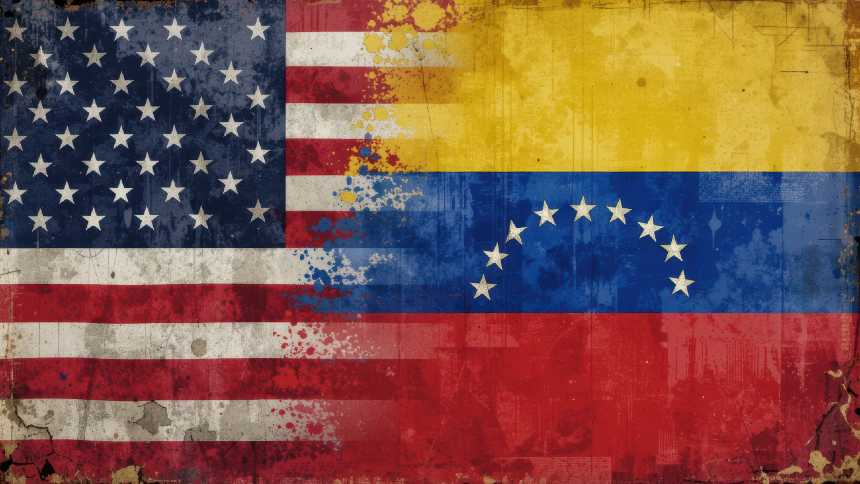
There is no doubt that the president of Venezuela, captured by the United States on Saturday, January 3, is a despicable dictator who rigged the 2024 elections to remain in power, where he has been since 2013, when Hugo Chávez died.
During this period, a United Nations (UN) report detailed Maduro's abuses, accusing him of murder, torture, sexual violence, and arbitrary detentions of political opponents.
Given the country's economic and political instability since the Chávez era (who first assumed the presidency in 1999), it is estimated that 15% of the Venezuelan population has left Venezuela in search of a better life in neighboring countries, especially Colombia and Brazil.
None of this, however, justifies the United States operation that captured Maduro on charges of drug trafficking and terrorism. The real interest, as Donald Trump made clear, without mincing words, lies in Venezuela's gigantic oil reserves, the largest in the world. This is because the discourse of confronting narcoterrorism doesn't hold up when Trump himself pardoned former Honduran President Juan Orlando Hernández, who was sentenced in the US last year to 45 years in prison for drug trafficking.
The United States' actions also violate international law and American legislation itself, which requires Congressional authorization for military operations of this magnitude. Trump is reverting to the times of the Monroe Doctrine and the "Big Stick" policy in the 21st century.
The Monroe Doctrine, created in 1823 by President James Monroe, was a US foreign policy that established that any European intervention in the American continent would be seen as hostile, but it evolved to justify interventionism in Latin America, with the aim of consolidating its influence and hegemony in the region. The Big Stick, on the other hand, was the style of diplomacy used by President Theodore Roosevelt Jr. (between 1901 and 1909) and is self-explanatory.
Donald Trump declared that the United States will “run Venezuela” until a proper transition occurs. The phrase sounds like an echo of colonial times, when powerful nations decided the fate of sovereign peoples. The inevitable question is: would Trump have the same courage to do this with Saudi Arabia or Qatar, which are authoritarian regimes? The answer is obvious: no. When economic and geopolitical interests align, the rhetoric of “liberation” disappears.
The action in Venezuela inaugurates a new dark era for international relations and for the Latin American region. On the global front, superpowers may consider themselves entitled to intervene in any country. Russia, for example, may consider itself empowered to take over Ukraine once and for all. And China, which recently conducted exercises with live ammunition near Taiwan, may gain the courage to invade the country that Beijing considers a rebellious province.
From a Latin American perspective, Trump's doctrine sets a dangerous precedent and allows the President of the United States to interfere in sovereign nations of the region. The next target could be Cuba, Nicaragua, or perhaps even Brazil.
Political scientist Ian Bremmer, president of the Eurasia Group and one of the most influential names in international affairs analysis, made it clear in a video that Trump's message in intervening in Venezuela goes beyond Venezuela. According to him, by demonstrating the capacity to remove an undesirable government, the United States makes "national sovereignties much more vulnerable," especially in its regional environment.
“If Trump doesn’t like a leader and thinks he can remove him, he’ll do it,” Bremmer states in the video. And he concludes: “That’s the law of the jungle.” Trump’s actions are making the planet more unstable. And that’s not good for anyone in the world or in Brazil – whether you’re right-wing or left-wing.