


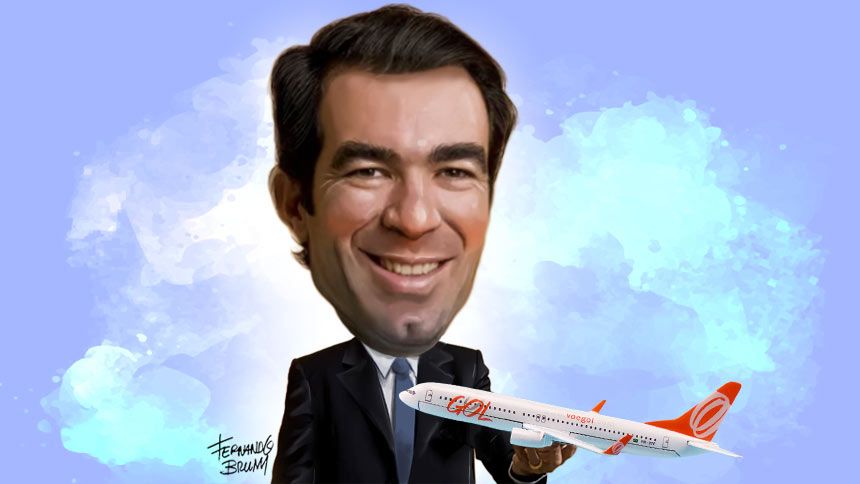
There was a time when crossing the borders of this continental Brazil by air was a privilege for the few. But a young entrepreneur looked at this scenario and saw not an immutable social hierarchy, but rather an inefficiency that needed to be corrected. This was Constantino de Oliveira Júnior, or simply Junior, as he was known.
He saw millions of Brazilians spending days and nights on precarious roads to embrace their loved ones. He not only saw it, but experienced it firsthand. After all, Júnior is one of the sons of Constantino Oliveira, known as Nenê Constantino, the man who founded the Breda group, owner of road transport companies. And, if his father had been successful on the roads, he would do the same in the heavens.
When he founded Gol Linhas Aéreas in 2001, Júnior wasn't just building a transportation company; he was leading a democratic revolution. By bringing the "low-cost/low-fare" model to national aviation, he broke the chains of an industry that stubbornly clung to old practices.
Thanks to his vision, the schoolteacher, the small shopkeeper, and the family from the countryside were able, for the first time, to fasten a seatbelt and cross Brazil at twelve thousand meters altitude. Júnior didn't just sell tickets; he sold social inclusion, he sold time, and he provided reunions and discoveries.
Initially, competitors mocked him. Wagner Canhedo, from the former Vasp airline, even said at the time that Gol was an adventure. But, as time passed, they hastily tried to follow that path. Few succeeded. The Gol model came to prevail throughout the national aviation industry. It was, with apologies for the pun, a one-way trip.
Vasp itself fell by the wayside. Varig, which held sway over the sector, ended up being bought by Gol. Despite his surname and family fortune, he built his own path of entrepreneurship and innovation. Júnior was repeatedly named "Executive of Value" by economic critics, but he never allowed himself to be seduced by the futile glare of the spotlight.
He felt much more comfortable in the day-to-day operations. His language was one of efficiency, and his guiding principle was invariably passenger safety and business sustainability. And Gol has faced many challenges since its founding. The company's trajectory is a portrait of resilience and constant adaptation.
Gol faced structural challenges, starting with the cyclical nature of the national economy and the volatility of the financial market. But Júnior had a plan: an innovative company, with a young fleet, led by some of the most seasoned executives in the sector, such as David Barioni and Tarcísio Gargioni.
It was the first airline in Brazil to abolish printed tickets. It combined a fair, transparent product with a unified fleet of Boeing 737s, almost all brand new, at prices well below those charged by some of its competitors. The idea, as we know today, succeeded.
Gol achieved another pioneering feat: it was the first airline in Brazil to conduct its IPO (Initial Public Offering) on June 24, 2004. The operation was historic for the Brazilian market, as it marked the first time in four years that a national company had simultaneously listed on the Brazilian stock exchange (Bovespa, now B3) and the New York Stock Exchange (NYSE). It was a success.
When everything seemed to be going smoothly, fate had a different plan for Júnior and Gol. The disaster of flight 1907, which occurred on September 29, 2006, was one of the most tragic and significant episodes in the history of Brazilian aviation. The accident involved a Boeing 737 and a Legacy 600 executive jet, which collided over the region of Peixoto de Azevedo, Mato Grosso.
The Boeing disintegrated and crashed in a dense forest area, resulting in the death of all 148 passengers and six crew members. Júnior acted exceptionally well in the days following the tragedy: he went to the front lines, did not shirk his responsibility, and shed heartfelt tears for the pain of the victims' families and friends. His actions speak volumes about the man behind the airline owner.
Starting in 2020, the sector was hit by the devastating impact of the COVID-19 pandemic, which disrupted cash flow and generated debt that required drastic measures. This scenario culminated in the filing for Chapter 11 bankruptcy protection in the United States, initiated in 2024 .
This process led Gol to renegotiate billions in debt and seek deeper integration with the Abra Group, the holding company that also controls Avianca . In addition to financial issues, the company had to manage intense domestic competition, especially with the consolidation of Latam and the strong presence of Azul.
But Júnior's true success wasn't measured solely by the stock market performance, but by something very precious to him: the loyalty of his employees, the "Eagles." Júnior understood that an airplane is just a metal structure if it doesn't have a soul—and the soul of GOL has always been its people.
He treated the ground mechanic with the same respect and attention he gave to heads of state, because he knew that in aviation, as in life, every part and every person is vital for a safe flight and the achievement of the destination.
His passing was felt by industry leaders. Celso Ferrer, current president of Gol, told NeoFeed : “I am grateful to have had the privilege of working for 22 years alongside the great man Constantino Júnior. Passionate about aviation, passionate about his family, passionate about Gol. What struck me most was his humble manner and his ability to listen. To everyone.”
Paulo Kakinoff, who was CEO of Gol for a decade and now heads Porto Seguro, spoke with NeoFeed and said that “Júnior was an extremely humane leader, adored by everyone. He was very reserved in his family life, cultivating a few solid friendships like no one else,” he says. “He had this gift of knowing how to speak and listen, a natural empathy. We worked side by side for many years. Júnior leaves a huge void. Businesses come and go, but people like him are irreplaceable.”
Leonel Andrade, who structured Smiles, Gol's loyalty program, and took it to the IPO, said that “Júnior was the most elegant executive I've ever known. He loved seeing people succeed. He celebrated every achievement of his colleagues, and was always very loyal to everyone who had been with him since the founding of Gol. He loved to say that his greatest pride was creating jobs. He is a person who made the world a better place,” he told NeoFeed .
His competitors also admired him. And one of them recognized his legacy for national aviation. On social media, John Rodgerson, CEO of Azul, said that it was “a loss for Brazilian aviation. His leadership, his entrepreneurship, and his legacy for the airline sector will never be forgotten. Thanks to him, millions of Brazilians were able to fly for the first time.”
In recent years, Júnior, who was 57 years old, faced his most difficult and silent battle: cancer. He confronted the illness with the same serenity and discretion with which he managed the turbulence of the financial market: with courage, without fanfare, and with a faith that served as an anchor for everyone around him. Even in his most fragile moments, his mind continued to chart courses and think about the future of Brazil.
*Gianfranco “Panda” Beting is an aviation consultant and publisher of Flap International magazine. A commercial aviation executive, he was marketing director of Transbrasil, as well as co-founder of Azul Linhas Aéreas Brasileiras and Breeze Airways in the United States. A speaker on the sector, he has written eighteen books on aviation.