


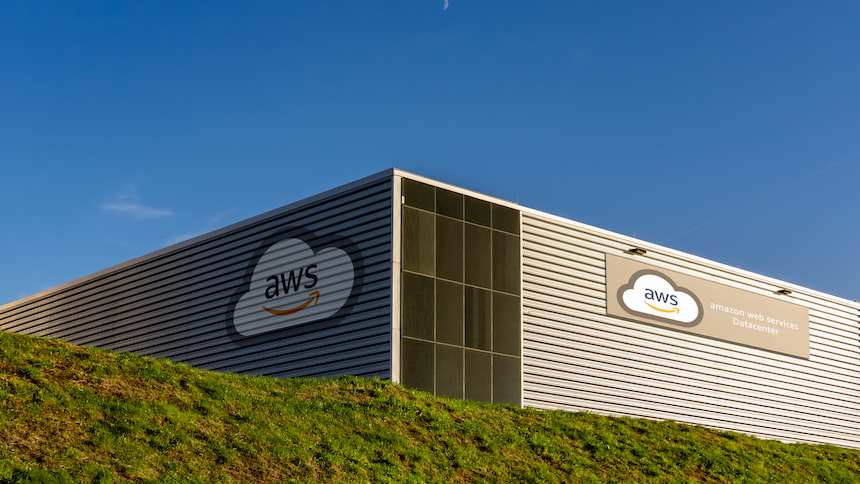
The war between the United States and Iran and the escalation of the conflict to other countries in the Middle East have already affected, in practice, the expansion of data centers in the region. Amazon Web Services (AWS) is the first major technology giant to feel the initial impact of the conflict.
Jeff Bezos' company's cloud division reported that it has suspended operations at its processing center in Bahrain due to a drone strike. This is the second time operations at the site have been affected by the war.
The company stated that it is helping customers migrate to alternative AWS regions while they recover, although it did not provide further details, such as the extent of the damage or how long it anticipates the outage will last.
“As this situation evolves, and as we have previously advised, we request that those with workloads in the affected regions continue to migrate to other locations,” Amazon said in a statement.
The company did not specify, however, whether its facilities in Bahrain were directly hit by a drone strike or if the disruption was caused by nearby airstrikes.
In early March, AWS reported that its facilities in Bahrain and the United Arab Emirates experienced power outages due to the conflict. They stated they were working to restore service, including transferring computing workloads to other regions.
"These electrical discharges caused structural damage, interrupted or provided power to our infrastructure, and in some cases required firefighting actions that resulted in additional water damage," the company stated.
As a result, Amazon stated that it anticipates a "prolonged" recovery due to structural damage to equipment in the United Arab Emirates and Bahrain.
"In the United Arab Emirates, two of our facilities were directly hit, while in Bahrain, a drone strike near one of our facilities caused physical damage to our infrastructure," AWS added.
US tech giants are positioning themselves in the Middle East as a regional hub for artificial intelligence computing, essential for services like OpenAI's ChatGPT.
In November, Microsoft announced plans to invest $15 billion by the end of 2029 in its data centers in the region, using Nvidia chips.
"In previous conflicts, regional adversaries such as Iran and its allies attacked oil, refineries, and oil fields in Gulf partner countries. In the computer age, these actors have also been able to attack data centers, the power infrastructure that supports computing, and fiber optic choke points," stated the Center for Strategic and International Studies (CSIS) in Washington.
In addition to Amazon and Microsoft, Google and Oracle also have significant facilities in the Middle East, in countries such as Bahrain, the United Arab Emirates, Qatar, Saudi Arabia, and Israel.
AWS is now fundamental to the functioning of many internet portals and government operations. It is also the company's main profit driver.
Amazon closed 2025 with revenue of US$717 billion. AWS represents about 18% of this total, with revenue of US$128.7 billion last year, a 19% increase over the previous year.
The plan is that, driven by advancements in artificial intelligence (AI) technologies and the need to expand the number of mega data centers worldwide, cloud segment revenue will reach US$600 billion within a decade.
On Nasdaq, Amazon shares are trading lower on Tuesday, March 23. Around noon (local time), the shares were down 1%. Year-to-date, the company has appreciated 2.4%. The company is valued at US$2.24 trillion.