

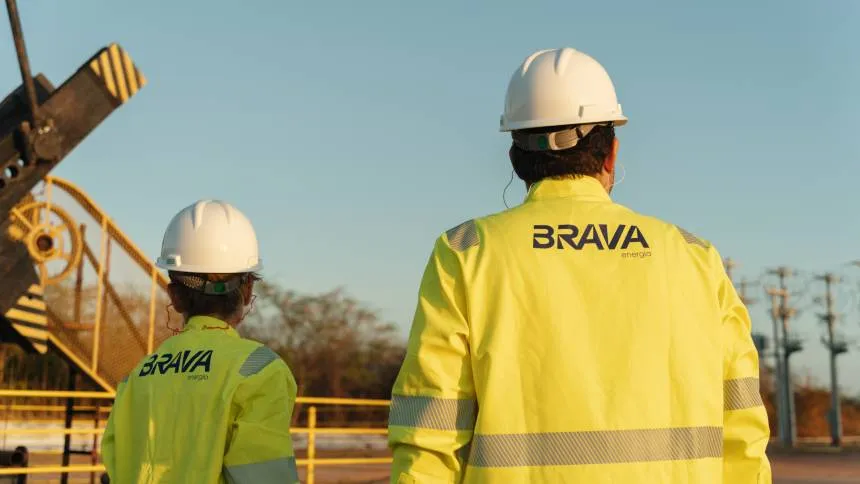
Brava Energia announced the purchase of a 50% stake in the Tartaruga Verde and Espadarte – Module III fields, currently owned by Petronas Petróleo Brasil, in a transaction valued at US$450 million.
Payment for the transaction will be made in installments. Of the total US$450 million, US$50 million was paid upon signing the contract, while US$350 million will be disbursed upon closing the deal. Two further installments of US$25 million each will be paid 12 and 24 months after the completion of the transaction, subject to approval by the Administrative Council for Economic Defense (Cade).
The Tartaruga Verde and Espadarte Module III fields are located in the southern portion of the Campos Basin, in water depths ranging from approximately 700 to 1,620 meters, with reservoirs at depths of approximately 3,000 meters.
The assets are operated by Petrobras, which retains the other 50% stake through the FPSO Cidade de Campos dos Goytacazes, in operation since 2018.
Currently, the complex has 14 producing wells and recorded an average production of approximately 55,600 barrels of oil equivalent per day in 2025, considering all assets.
The acquisition comes days after the company announced, on Monday, January 12th, a change in leadership, with the replacement of Décio Oddone by Richard Kovacs, who previously served as Chairman of the Board. Alexandre Cruz will replace Kovacs as the new chairman.
The change will take effect at the beginning of February, with the succession process extending until January 31st. The market expects that Richard Kovacs' arrival will usher in a more active management phase at Brava Energia, with a greater focus on buying and selling assets and reviewing the portfolio.
Analysts see the change in leadership as a sign of greater financial pragmatism, with attention to cash generation, deleveraging, and monetization of mature fields, in line with a more dynamic capital allocation strategy.
“Richard Kovacs brings deep knowledge of the asset base, and his alignment with Queiroz Galvão should preserve strategic continuity while accelerating execution,” says BTG Pactual in a report.
Analysts at Santander also believe that the CEO change reduces the risk of misalignment between management and shareholders, given that Jive, along with Queiroz Galvão and Ebrasil, holds approximately 21% of the company .
Formed by the merger between Enauta and 3R Petroleum, Brava Energia ended the fourth quarter of 2025 with an average production of 76,800 barrels of oil equivalent per day (boe/d), according to preliminary data released to the market.
For the full year 2025, the company recorded an average production of 81,300 boe/d, a 46% increase compared to the previous year, with particular emphasis on the Papa-Terra and Atlanta fields, which achieved their best historical results in production and operational efficiency.
In the third quarter of 2025, Brava Energia reported a net profit of R$ 120.7 million, following a financial result pressured by expenses associated with the anticipation of receivables and the cost of debt. Leverage decreased from 3.1 times EBITDA to 2.3 times in dollars. The fourth-quarter results are expected on March 11. On the stock exchange, the company has a market value of approximately R$ 8.16 billion.