


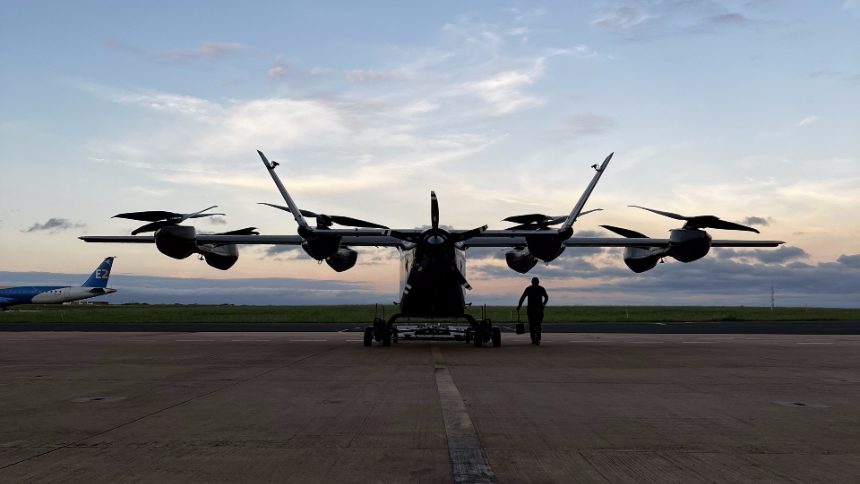
A spin-off from Embraer , Eve is the Brazilian manufacturer's bet to occupy its seat in the still nascent market of "flying cars" . And it reached an important milestone by completing the inaugural flight , in full scale, of its unmanned prototype on December 19th, in Gavião Peixoto (SP).
Alongside this progress, other local names are also making moves to position Brazil and help it take off in this new airspace. This is the case with the investment boutique Arton Advisors and Elyx, an urban air mobility company.
Elyx wants to raise R$100 million in a structured funding round managed by Arton. The goal? To build, implement, and operate vertiports, structures similar to helipads designed for electric vertical takeoff and landing (eVTOL) aircraft, also known as flying cars.
“The general public may think these vehicles are still a long way off. But they’re not,” says Julio Nakano, CEO of Elyx, to NeoFeed . “There are aircraft flying, vertiports being built. Eve already has more than 2,500 orders from established companies. So, it’s no longer something futuristic. It’s going to happen.”
Arton's founding partner, Manoel Fernandes, points out that Eve has its first deliveries scheduled for early 2027. "So, we're going to seek long-term, patient capital from someone who truly believes in this transformation of the transportation model and in the real estate and technological infrastructure that's coming," he says.
Other figures reinforce the perception that eVTOLs are here to stay. The consulting firm Grand View Research, for example, predicts that this market will register a compound annual growth rate of 54.9% until 2030, when it should generate US$ 28.6 billion.
With this scale in mind, Elyx was created this year by IGE2A, a holding company focused on infrastructure, mobility, and energy, with participation in projects such as lines 2, 4, and 5 of the São Paulo metro and the Rodovia dos Tamoios highway (São Paulo), as well as solar power plants and electric car charging networks.
The people behind the new company were already involved with the topic of eVTOLs, but for some time. And, with the structuring of the company, they understood that it was time to seek a partner to raise funds and put this concept into action.
The choice fell on Arton Advisors. With approximately R$10 billion under management, the boutique was founded in 2022 by former executives from Citi, JPMorgan, Credit Suisse, and Itaú. BTG Pactual is a minority partner.
“Our thesis is to move away from the trivial and not restrict ourselves to traditional investments,” says Fernandes. “And when the opportunity arose to look at this new eVTOL market, what caught our attention was the background of the Elyx team.”
With 100 professionals – from engineers to geologists, many of them from the Technological Institute of Aeronautics (ITA) – Elyx has estimated the initial structure to support the development of flying cars in the country. “We’re not a startup on paper, in Excel. We’re already getting our hands dirty,” says Nakano.
Initial connections
To begin building a network in this mode, the plan is to raise R$100 million within 12 to 24 months, dates that coincide precisely with the forecasts for the first deliveries of Eve and the debut of commercial flights with these eVTOLs – at the end of 2027.
“The data shows that the growth of this market will be exponential, but it’s difficult to pinpoint the exact date when this escalation will begin,” says Nakano. “The fact is that our vertiports need to be built and certified when this happens.”
These initial resources will be applied to the construction of 6 to 7 vertiports, starting in São Paulo and its metropolitan area. The plan also includes locations in Rio de Janeiro and Brasília. In the medium and long term, Elyx is also aiming for units in markets such as the United States.
Although he did not reveal further details, Fernandes says that the partnership already has memoranda of understanding (MOUs) signed with players in the São Paulo real estate market for the start of implementation of the first vertiports of this package in the first half of 2026.
One of these negotiations even involves talks for a company to acquire the naming rights to one of the vertiports. Arton Advisors and Elyx do not rule out extending this model to other units in the portfolio.
At the same time, both companies are already participating in groups with municipal and federal agencies in São Paulo to discuss and accelerate the implementation of specific regulations for these structures.
The estimated investment in each vertiport is, on average, between R$10 million and R$15 million. This value may vary, however, depending on factors such as location, unit size, and the possibility of converting a helipad into a structure of this size.
Replacing helicopters is precisely one of the factors in which the partnership sees a roadmap for eVTOLs to begin to gain scale. And, from this perspective, the pair understands that these aircraft can offer a cheaper – and more widely used – alternative to this mode of transport.
“Of course, in 20 or 30 years, there’s a good chance we’ll have more compact aircraft for private use,” says Fernandes. “But we’re talking about transporting four, five, or six people, traveling at least two or three times between points over the course of an hour.”
Obviously, there is still a long way to go before flying cars become a truly accessible mode of transportation for a large portion of users. However, Nakano provides an example to highlight how this mode of transportation, right from the start, can be somewhat more "democratic" than helicopters.
“Today, if you take a helicopter from Faria Lima to Cumbica Airport in Guarulhos, you will pay, on average, between R$ 2,500 and R$ 2,600,” says Nakano. “According to our estimates, with the eVTOL, on the same route, the price will drop by half right from the start.”