

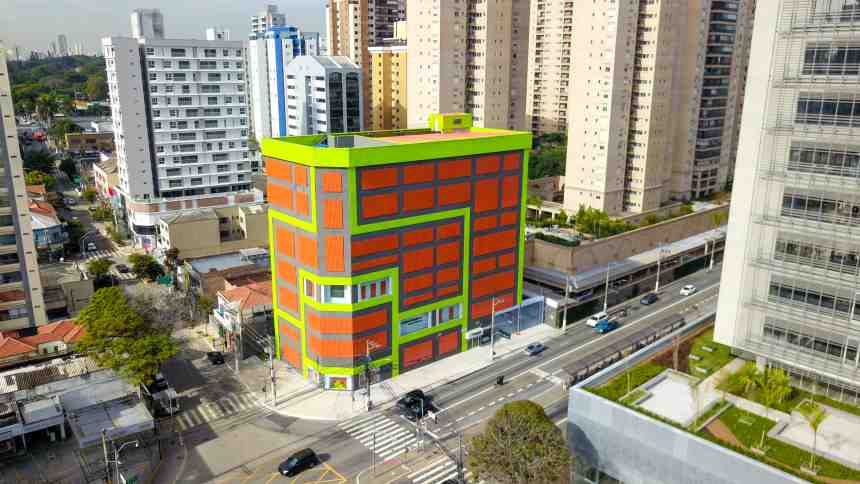
Anyone walking through São Paulo will inevitably come across a building in the orange and green colors of GoodStorage , which started as a self-storage company and, in recent years, has become a one-stop shop for urban storage.
With a portfolio of over 500,000 square meters of gross leasable area – from 1-square-meter lockers for individuals to 20,000-square-meter logistics modules – the company is beginning a new cycle of expansion.
GoodStorage plans to invest R$1 billion to double its storage capacity, taking advantage of urban densification and the popularization of e-commerce , which have transformed a previously "unsexy" segment of the real estate market into a highly demanded business.
“Residential launches are increasingly focused on smaller units, without storage infrastructure. And everyone started consuming online during the pandemic, a habit that remains,” says Thiago Cordeiro, founder and CEO of GoodStorage, to NeoFeed . “This asset class has found its 'place in the sun' and the trend is to advance.”
With 72 assets, the company plans to expand its three business lines – self-storage , logistics warehouses, and spaces for small and medium-sized enterprises – in addition to investing in technology, back-office services, and personnel. Today, it has 260 employees.
The focus remains on São Paulo, despite having assets in Rio de Janeiro, Brasília, and Belo Horizonte, due to the assessment that the São Paulo market is larger and has more depth, with opportunities to be captured.
The logistics warehouse sector, with nine assets, is expected to account for a significant portion of the expansion, given the demand and size of the projects. The company entered this market in 2017 to serve companies needing to meet the so-called " last half mile" needs, within a 15-kilometer radius of the city of São Paulo.
With clients such as Mercado Livre and Shopee , GoodStorage has 150,000 square meters in its portfolio. Last year, it inaugurated the expansion of its logistics park in Lapa, in the West Zone, which has approximately 45,000 square meters, and now intends to invest in a "large project" in the South Zone in the coming years, which Cordeiro did not detail.
In the self-storage business, which has 55 units, the idea is to continue expanding into the neighborhoods. Cordeiro has two projects in Itaim Bibi and another in Perdizes, both in the West Zone. Although it has incorporated the concept of logistics warehouses to gain scale, self-storage remains important for GoodStorage because of the return it provides.
“The average rent for self-storage is three times higher than that of a warehouse. To balance the results, warehouses need to be three times larger, and we haven't reached that point yet,” says Cordeiro. “Interest in self-storage continues, but naturally, given the size of the investments, the logistics business should catch up soon.”
Another area that GoodStorage intends to develop is spaces for small and medium-sized businesses. Called Flex, the product, created in 2021, has similar characteristics to self-storage, such as monthly contracts, cancellation without penalty, and no guarantor required, but offers larger spaces, from 100 to 500 square meters, compared to 1 to 50 square meters in traditional self-storage facilities.
With the portfolio doubling, the expectation is that revenue will follow the same trend. For 2026, the projection is R$ 350 million, up from R$ 300 million in 2025.
To achieve its objectives, GoodStorage relies on the support of Evergreen , a private equity firm that has been a partner of the company since its inception and invests resources from the Washington state public employees' pension fund in real estate assets around the world.
Cordeiro emphasizes that this audience means the company isn't obligated to constantly rotate its portfolio to deliver returns, because its purpose is to contribute to the retirement of these employees. "It's much more of a dividend business, generating yield , than developing, operating, stabilizing, and selling, going through a sales cycle. That's why we've never sold any assets," says Cordeiro.
Because it is a long-term investment, GoodStorage sees no need to actively seek out assets to acquire, prioritizing organic growth, even though it has been involved in M&As in the past.
In 2024, the company acquired GuardeAqui, which previously had the support of Sam Zell , who made a name for himself in the American real estate market, along with Patria Investimentos . Before that, in 2019, it acquired MetroFit, an investment of Goldman Sachs .
“In self-storage, we don't see the need, especially since it's a very fragmented market, and in that fragmentation, the units belong to entrepreneurs who saw an opportunity, but the property is rented. Our properties are owned by us, so that we can capture income and dividends,” says Cordeiro.
In the case of logistics warehouses, he sees few opportunities, with the major developers working in cities around São Paulo. "If there are any, and we are interested, the purchases should be in logistics warehouses," he says.