

Nubank 's IPO turned four years old on Wednesday, December 9th. The operation, which raised US$2.3 billion, was an important step in the fintech's consolidation. Now in 2025, another major step has been taken as it has become the most valuable company in the country, with a market cap of US$80.8 billion.
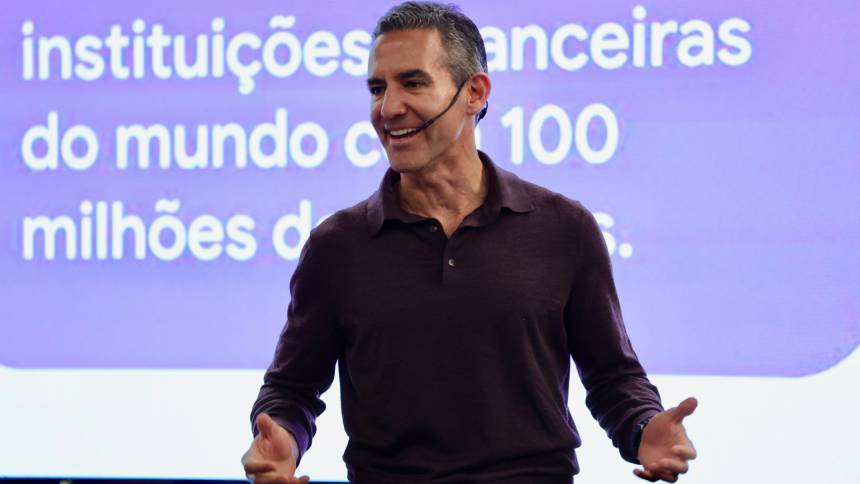
But for David Vélez , these achievements represent only a small part of his plans. In a meeting with journalists at Nubank's headquarters in São Paulo, he stated that the focus for 2026 is to advance internationalization, taking the company's strategy to the United States , where he intends to pursue major banks, just as he did in Brazil.
"The great opportunity we see in the United States is to bring a new way of doing banking to a large percentage of the population," said Vélez.
Although there is no release date yet, he said that the licensing process is moving faster than expected and that there is an opportunity to gain ground in the American market, as he sees many opportunities for disruption.
Even while looking to the future and beyond Brazil, Vélez didn't shy away from addressing topics Nubank has recently been involved in. Alongside Livia Chanes, CEO of Nubank Brazil, he revisited the issue of taxation, stating that the institution has paid the most taxes in Brazil in 2025 so far – which is undoubtedly a sign of the success of its business model.
Vélez also addressed the issue of banking licenses, stating that it is simply a matter of aligning with the Central Bank's (BC) new guidelines on the use of the word "bank" by fintechs. Chanes, in turn, did not rule out the possibility of acquiring an institution to accelerate the process. "We are evaluating all possibilities," said the executive.
At one point in the conversation, Vélez offered self-criticism on two points: the hybrid work model, which he regrets not having adopted sooner, and the acquisition, which he considered a "big mistake."
Below are the main highlights of the meeting:
PROVEN MODEL
VÉLEZ – Today, we are celebrating the fourth anniversary of our IPO. It's impressive what we've accomplished since then. We were the last major Brazilian IPO. The stock has risen more than 80% in these four years, we've brought in more than 80 million customers, our revenue has multiplied tenfold to US$4.2 billion. Our gross profit has also multiplied tenfold to US$1.8 billion. We had an accounting loss during that period, leading many to question the company's financial model. But today, in the last quarter, we had US$773 million in net profit, with a ROE of 31%. We went from a moment of skepticism about the business model, about whether the numbers would add up, to being seen as a clearly superior banking model in Brazil and Latin America, with higher profitability than any other Brazilian retail bank.
TAXES AND COMPETITION
VÉLEZ – As I mentioned in my LinkedIn post, in the first three quarters of 2025, we paid over R$ 8 billion in taxes. We were the financial institution in Brazil that paid the most taxes. This is the first time this has happened in Brazilian history, a startup, 12 years old, in its 12th year, paying over R$ 8 billion in taxes. We are a very successful case. Brazil should be proud of this, that a bunch of engineers, foreigners, without political connections, without special connections, manage to compete with the largest Brazilian industry, compete with better products and services, create a great company, leave Brazil very well off, and where everyone wins: consumers, society, employees, and the government. It's a win-win situation for everyone. But unfortunately, several narratives are emerging attacking this type of success story.
Banking License in Brazil
VÉLEZ – Since the Central Bank introduced regulations for banking conglomerates, there is no difference whether a finance company, a bank, or a financial institution leads the conglomerate. We have been regulated as a banking conglomerate for several years. A banking license entering this conglomerate changes absolutely nothing. We hadn't requested a banking license because there was no reason to go through that process. All the products we wanted to offer, we can offer today. It's the same regulation we have, the same capital requirements, the same Basel principles. We decided to request the banking license because of the Central Bank regulation that states that if you have "bank" in your name, you need a banking license.
APPETITE FOR M&A
CHANES – We are not ruling out that possibility. We could obtain the license organically or by purchasing it. We are evaluating all possibilities. The tax implications will depend heavily on the arrangement we are making within the conglomerate, so we don't have visibility on that. That is not our reason, it is not our central motivation for why we are requesting the license today.
Banking License in the United States
VÉLEZ – Licensing in the United States has always been very time-consuming, but under this administration it has moved much faster. Since January, with President Trump, the process has been much quicker. We are seeing this process going much faster than we imagined. They usually said it would take two to three years [to obtain a license], but it should be much faster than that.
The plan for the American market.
VÉLEZ – It's quite feasible that we [once we obtain the license] will start with a product plan similar to the playbook that has been in place in all countries so far. The great opportunity we see in the United States is to bring a new way of doing banking to a large percentage of the population. There will be specific niches where we will start to focus, because the market is gigantic, representing half of the global financial market. So it makes sense to start in certain niches.
COMPETITION
VÉLEZ – In terms of global fintechs that are trying to build a global digital bank, Revolut is probably the most advanced in that direction. In the United States, the major competitors will be the large American banks because those who have the largest market share in the United States today are the big banks.
SIGNINGS FOR THE 'MAJOR LEAGUES'
VÉLEZ – Our team is complete; we brought many new people to our team this year. Eric [Young] as the new CTO, who has been excellent. He was CTO at Snapchat, and before that he was at Amazon and Google. Ethan [Eismann], who was at Slack, as our Chief Design Officer. We've been bringing in people on a global scale. We've said this from the beginning, that we never saw ourselves as a Brazilian or Latin American startup. We always saw ourselves as a global startup, with global reach. And given that, we always tried to bring in a team with global experience, looking for the best people in each area of the world. Many of the hires we made this year really prepare us to compete in the big leagues.
HYBRID WORK
VÉLEZ – I would have done it sooner [implementing the hybrid work regime]. The hybrid model is the best of both worlds. The model we're already adopting, on the one hand, creates weekly space for all teams to be physically together, which is fundamental to what we do. Creativity, communication, innovation, productivity—you need to be physically present somewhere. But also, the hybrid model gives people a certain flexibility to work from home and focus on certain tasks. The hybrid model is probably the future of work. When it's 100% remote, especially the culture-building and product-building aspects, it becomes very difficult. Invention and creativity happen when you have a lot of people in a room together, brainstorming, thinking about problems, discussing crazy ideas, dreaming big. That's how we started the company.
NEW HEADQUARTERS
CHANES – In São Paulo, we need to expand because there isn't enough room for everyone here [current headquarters, in the Pinheiros neighborhood]. We're staying here, at least for now. We're opening offices in Campinas, Rio de Janeiro, and Belo Horizonte. In addition to our international offices. Today we don't have offices in those cities; we'll have to start opening them there. And in São Paulo, we need to expand our physical space due to limitations. The last time Nubank operated 100% in person was in 2020. Since then, our staff has quadrupled or quintuple. We no longer have enough physical space.
BIGGEST MISTAKE
VÉLEZ – The acquisition of Easynvest was a big mistake because integrating the systems for Nubank was much more difficult than we imagined. Our general bias is to build everything from scratch. And the decision was a bit rushed, when interest rates in Brazil were very low and there was a rush for equities. We came to the conclusion that we had to be in that market already, and so we decided to accelerate the purchase and enter that industry via acquisition. But interest rates went up, everyone left equities, and we underestimated the integration of Easynvest. If I could go back in time, I would probably build the investment side from scratch.