

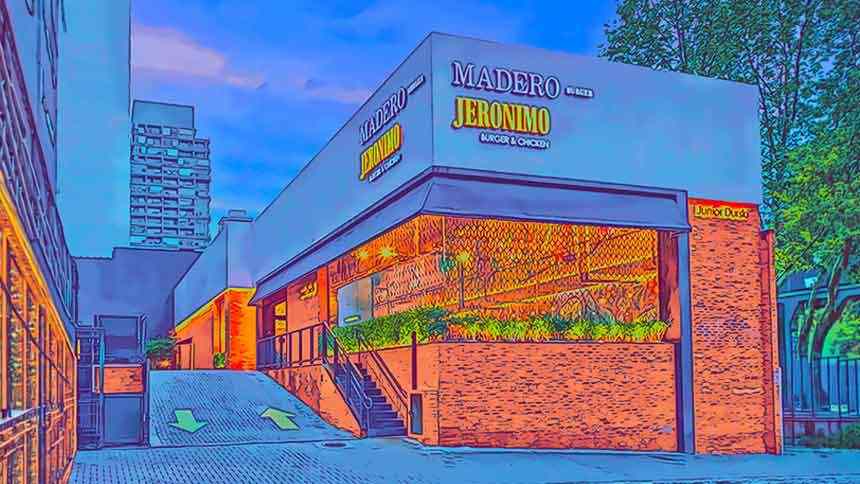
Behind the numbers in the Madero Group 's first quarter 2026 balance sheet, empanadas proved to be a profitable item on the menu of Junior Durski 's restaurant chain. And they are expected to occupy even more space.
Today, Madero produces around 280,000 empanadas per month. But demand is higher than that. To cope with this increase in production, the company is developing in-house equipment that will allow it to more than quintuple production starting in the second half of the year.
“By June, we will be producing 1.5 million empanadas per month. We are developing some equipment to help. We are selling 55,000 empanadas per week, and we can't sell more only because we have a production limit,” Durski told NeoFeed .
The idea is to increase industrial capacity without losing the artisanal process of the product. Madero's CEO explains that the "edge" of the dough, considered essential for the consumer to feel the crispness, will continue to be made manually.
More than just a new menu item, the empanada has become a symbol of Madero's numbers. Digital channels already account for 57.1% of the restaurants' revenue. And delivery alone accounts for 21.8%.
“When we send a delivery through iFood, the average order cancellation rate in Brazil is 11%. Our cancellation rate is 0.5%,” he says. “The biggest game today is in delivery. But it’s much harder to deliver good quality to the customer through delivery.”
The difference, in Durski's view, lies in the execution. Each order goes through a double-checking system, with photos taken before and after assembly. Within 24 hours, the company disputes cancellations made by delivery companies to try to reverse most of them.
At the same time, Madero reinforced its customer service, which more than doubled in size and began responding in real time via WhatsApp, with immediate refunds or vouchers in case of problems.
These numbers help explain why the company is diversifying its channels. Restaurants, like much of the food sector, have lost traction since the pandemic. The hybrid model is sustaining growth.
In addition to empanadas, currently sold in 212 stores served by delivery companies, Madero is preparing to launch vacuum-packed ready-made dishes, expanding its portfolio, and betting on the growth of "Empório," a convenience store model focused on frozen products.
With two stores already open in Curitiba, the chain will inaugurate two more in the coming weeks. “We are building 12, in addition to these two that have already opened and two more that will be inaugurated. We should close this year with 20 Empório Madero stores,” says Durski.
For this strategy to work, it relies on a vertically integrated platform that centralizes production, logistics, and distribution. Today, more than 95% of the food served by the chain comes from its own central kitchen in the city of Ponta Grossa, Paraná state.
Quarterly figures
First-quarter figures show that Madero continues to deliver growth and profitability. Gross revenue totaled R$ 577 million in the first quarter, a 5.1% increase year-over-year. Net revenue was R$ 501.6 million. Net profit reached R$ 20.8 million, maintaining a positive trend since the end of 2024.
Adjusted EBITDA reached R$141 million, with a margin of 28.1%. Leverage stood at 1.7 times, with a projection to fall to around 1.3 times by the end of this year.
Same-store sales (SSS) increased 1.7% in the quarter. In traditional formats, performance was negative: Madero Steak House and Madero Burger declined 1.5%, while Jerônimo fell 5.8%.
What sustained the SSS (Sales Supported Sales) was the model that combines the two brands in the same space. In this format, revenue increased by 32.3% and SSS reached 18.3%. Today, stores with Madero and Jerônimo together already account for 22% of net revenue.
“We’ve been making a profit quarter after quarter, which helps reduce our debt. It’s difficult to find another company in the sector with numbers like ours,” says Marcelo Aldenucci, the group’s investor relations director.
"For the rest of the year, we expect to continue investing in empanadas and in the Paraguayan store, which we recently opened and is already showing excellent results," he adds.
In this report, Durski is listed as CEO and CFO, alongside Aldenucci. Executive Bruno Gentil , who assumed the position after Ariel Szwarc moved to the presidency of the Board, has left Madero.