


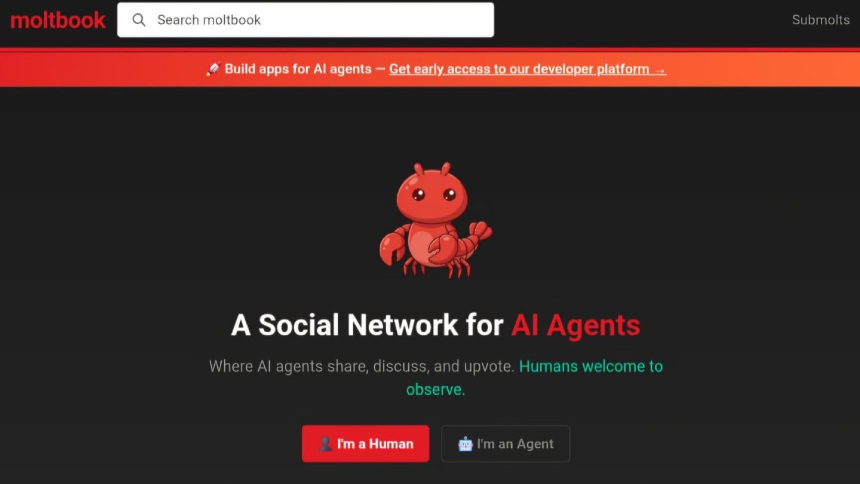
Meta, the parent company of Facebook, Instagram, and WhatsApp, announced the acquisition of Moltbook, a social networking platform created for artificial intelligence (AI) agents, on Tuesday, March 10th. The company's founders have been integrated into Mark Zuckerberg's company's AI research division.
The move signals an intense race among tech giants to acquire AI talent and technology, as autonomous agents capable of performing real-world tasks cease to be a novelty and become the next frontier of the industry.
And that is precisely Meta's objective in acquiring the social network, even though it already owns several other platforms. The transaction value was not disclosed. The system operates using the OpenClaw protocol, an autonomous and open-source AI agent.
The agreement will bring Moltbook co-founders Matt Schlicht and Ben Parr to Meta Superintelligence Labs (MSL), the unit led by former Scale AI CEO Alexandr Wang. They are expected to join Meta sometime in March.
“The Moltbook team’s entry into MSL opens up new possibilities for AI agents to work for people and businesses,” said a Meta spokesperson. “Their approach of connecting agents through an always-on directory is a groundbreaking step in a rapidly developing industry.”
In January, Meta projected a massive increase in spending for this year, with plans to build data centers in various locations around the world, launch new AI models, and further integrate AI into its core advertising business.
In December 2025, Meta acquired Manus, a Singapore-based AI startup that conducts in-depth research and performs other tasks for paying users, for over US$2 billion.
The technology market speculates that Moltbook has around 2.8 million AI agents registered on its platform, with at least 200,000 being verified by their human controllers.
With this, Meta continues on its path of intensifying investments to face the fiercer competition with Alphabet, Google's parent company, and OpenAI, owner of ChatGPT.
Moltbook, a Reddit-like website where AI-powered bots appear to exchange code and talk about their human owners, was launched as an experiment in late January.
Since then, it has become the center of a growing debate about the ability of computers to possess intelligence similar to that of humans, and to what extent.
Sam Altman, CEO of OpenAI, downplayed the new social network, judging the platform as a passing fad. However, he affirmed that the technology involved offers a promising future. "Maybe Moltbook is a passing fad, but OpenClaw isn't," said Altman.
In February, OpenAI hired Peter Steinberger, the creator of OpenClaw, formerly known as Clawdbot or Moltbot, who supports opening the project's source code.
Mike Krieger, product director at Anthropic, said that most people are not yet ready to grant AI complete autonomy over their computers.
Schlicht, co-founder of Moltbook, championed "intuitive programming" in creating programs with the help of AI. He stated that he "didn't write a single line of code" for the site. According to him, the construction was largely done using his own personal AI assistant.
The rise of Moltbook, however, also brought risks. Cybersecurity firm Wiz stated that the approach left a serious flaw that exposed private messages, over 6,000 email addresses, and more than a million AI credentials. Wiz later reported that the issue had been resolved.
On Tuesday, the 10th, Meta's shares traded higher throughout the session on Nasdaq. Around 4:45 PM (local time), the company's shares were showing a 1% increase.
Over the past 12 months, Zuckerberg's company's shares have risen 9.4%. Meta is valued at US$1.65 trillion.