

Thursday, December 11th, marks the first “AI Day,” promoted by Rivian , the electric car manufacturer that debuted on the stock exchange in 2021 as “Tesla 2.0,” but has struggled to achieve scale. The idea behind the event is to convince investors that it is a software company before it is a vehicle manufacturer.
With the global electric car market sluggish, Rivian is still burning through billions of dollars a year. In the third quarter, the company's sales fell 14%, and its targets were revised downwards.
Even so, although the shares have depreciated by almost 80% since the IPO, this year Rivian's stock is up more than 30%, driven more by expectations of what the company can achieve than by its results.
Barclays and Deutsche Bank point out that much of the recent rise in Rivian's shares already reflects the expectation that the company will be able to rapidly advance in autonomy – something that has not yet been proven.
Therefore, "AI Day" has been seen as an attempt by Rivian to rewrite its own history and present to Wall Street the narrative that the electric vehicle manufacturer has become an artificial intelligence company.
The problem is that since its founding, Rivian has marketed itself as a "vertically integrated, software-defined" technology company. But, so far, the rhetoric has been accelerating faster than the engineering.
The current generation of R1 vehicles has only recently begun allowing hands-off driving in certain scenarios – a level that traditional competitors had already achieved years ago.
“We believe Rivian’s differentiator will be our end-to-end AI-centric approach,” said Robert Scaringe, CEO and founder of the automaker, on the third-quarter call.
The ambition is to compete in a space currently dominated by Waymo and Tesla , but this is a race that Rivian is still lagging behind in.
Despite the growing hype surrounding autonomy and AI in the automotive sector, the financial market remains divided. Morgan Stanley, for example, downgraded the stock to underweight in early December, drawing attention to the lack of scale and the fragility of the balance sheet at a time when the industry demands heavy investments in chipsets, sensors, data centers, and machine learning teams.
The bank projects that, in 2026, Rivian will still register US$4.2 billion in cash burn and a strong dependence on the next investment from Volkswagen, expected to happen after the winter tests that will be carried out by the joint venture formed by the companies.
For this expectation to become a conviction, Rivian needs to deliver consistent numbers. Supporting this claim is the $5.8 billion joint venture with the Volkswagen Group, named RV Tech .
The goal of this business is to develop a modern electrical architecture and software stack for future mass-market electric vehicles from the Volkswagen, Audi, and Scout brands.
On one hand, Rivian delivers software, zonal architecture, and know-how, while Volkswagen provides volume, scale, and capital.
The platform created by RV Tech will be tested in prototype vehicles as early as the first quarter of 2026. The first production car to use the architecture will be the Volkswagen ID.Every1, scheduled for 2027.
If it works, Rivian will have something that no young automaker has achieved to date: licensing automotive technology on a global scale, a kind of "Android for vehicles".
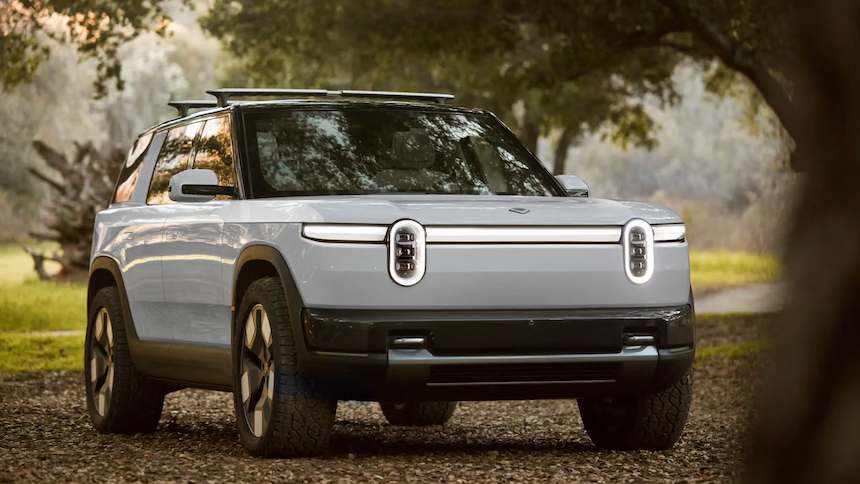
The R2, Rivian's SUV arriving in the first half of 2026, will be the automaker's first vehicle entirely conceived using this architecture. It is an essential part of proving whether the theory holds up.
But despite expectations, the company remains under operational pressure and faces a recall of nearly 35,000 vehicles in the United States, in addition to having lost the federal tax benefit that was revised by Donald Trump.
And it needs to gain scale to reduce costs at a time when the automotive sector is still trying to determine if there is real demand for advanced autonomy.