

Barcelona - On the third day of the Mobile World Congress (MWC), the focus remains on the major electronics launches from the sector's largest global companies, while the number of panels featuring the big names in the technology industry at the event decreases.
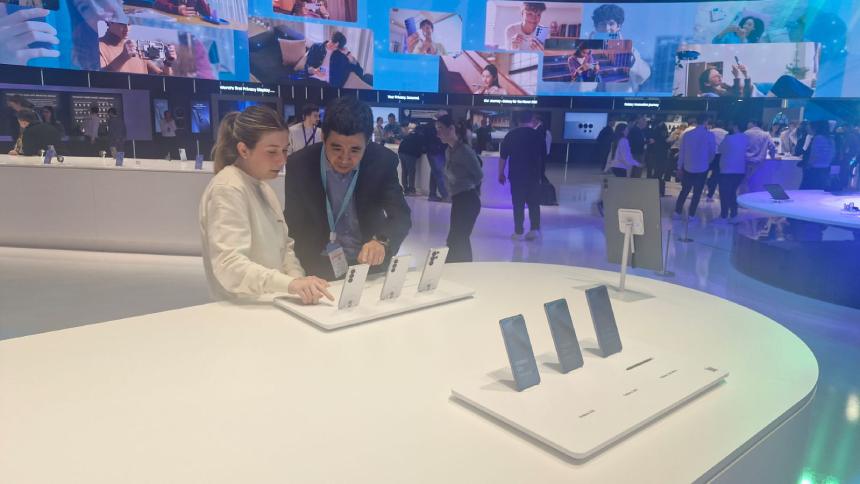
In the case of South Korean company Samsung, the greatest demand at the company's booth is for explanations about the models in the S26 line, which had its global launch, including in Brazil, on February 25th.
And despite the short time the devices have been available for pre-order, the company is already pleasantly surprised by the Brazilian market. In five days, of all the new line's phones sold in the country, 80% were the Ultra model, the most expensive (which costs no less than R$ 10,000). This far exceeded Samsung's expectations.
The value of privacy
The expectation was that the top-of-the-line model would represent up to 70% of total sales in Brazil. But it exceeded 80%. Speaking to NeoFeed , Samsung's Senior Vice President for Latin America, Antonio Quintas, explained the reasons for this surprise.
"The devices are lasting longer and offering more features. Consumers are seeing more value in buying a high-end product because they perceive a greater return on investment," he stated.
According to him, the privacy screen was the main attraction. That, of course, in addition to the bank balance needed to secure the model.
Guaranteed payment plan
In the case of Brazil, the S26 will be produced in factories in Campinas (SP) and Manaus (AM). In any case, the tax barrier – a strong factor in Brazil – is a fundamental point in deciding which products will be sold in the country. This, of course, is in addition to consumer interest.
“What guides our decision is the demand and volume that justify local production or importation. For example, in the foldable category, we haven't yet identified sufficient demand in Latin America for more sophisticated products in this line. And the price range is also important,” said Quintas.
Samsung's VP stated that, despite the high cost of the new device, the company is offering a higher price on used devices and is also expanding financing options.
Closed path
While the topic of the war between the United States and Iran wasn't directly discussed among the top executives of technology companies in Barcelona, the fact remains that the military operation ordered by US President Donald Trump directly affected a significant portion of the audience that was headed to MWC.
The participation of Chinese people at the event, especially at Huawei's enormous booth, is very significant in Barcelona. But it could be much larger. What many executives were saying in the event's corridors was that many Asians stopped crossing the continent to reach Spain. And this was directly related to Trump's actions.
Stay home
Just as many Chinese were beginning to leave the country for MWC, Dubai airport, an almost obligatory stopover for a large portion of flights in the region, was targeted by Iranian attacks in the early hours of Saturday to Sunday.
The result is that, according to leaders who had information about the Asian delegation, at least 10,000 Chinese people did not travel to Spain. A loss for the event, and for Barcelona's economy itself.
Tariff increase versus AI
Another type of war, the trade war (which also has Trump at its center), is one of the main concerns among companies participating in a global study released on Wednesday, March 4th, by the British consulting firm EY, at the company's booth at MWC.
The survey, which polled 1,590 companies from 25 countries, including Brazil, between October 2025 and February 2026, showed that issues such as tariff increases generate more concern when deciding on investments in artificial intelligence (AI). In the survey, 81% said they see tariff disputes as a significant barrier to advancing the topic in their companies.
Caution and chicken broth
“Is there a risk that my company might not be able to use a supplier from Asia because there’s been a ban on contracting a service abroad? This dynamic requires a reassessment of business risk,” Leonardo Donato, EY’s lead partner in Latin America, told NeoFeed at the company’s booth at MWC.
The war between Iran and the US itself is a cause for concern regarding the risk of affecting business performance, precisely because of the isolation of important suppliers located in countries at war.
That's why, according to Donato, Brazilian companies have adopted a more cautious approach when contracting AI services. "A large Brazilian operator cannot be dependent on the risk of a possible conflict involving China, for example."
A discussion that is likely to continue even after MWC. And still in the midst of the conflict in the Middle East. "If I had a cloud provider there, I would be worried," says the EY managing partner.
The journalist traveled at Vivo's invitation.