

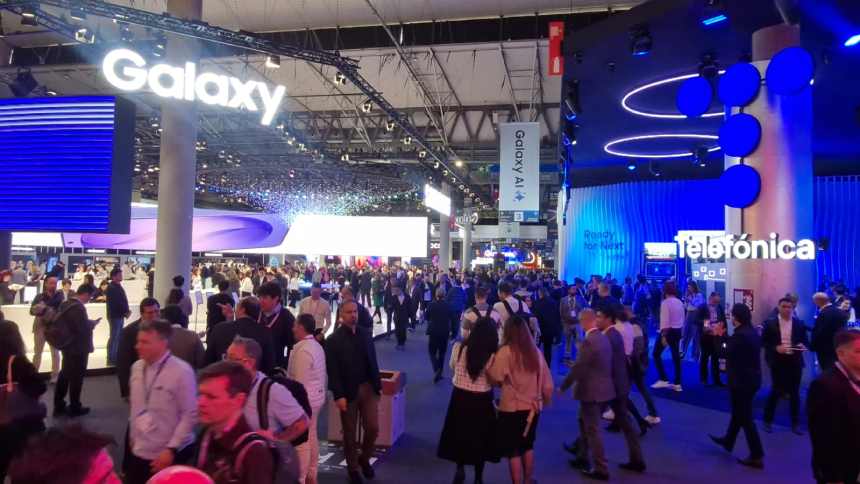

Barcelona - The main global conflict of the moment, the war between the United States and Iran, does not yet seem to be present in the main corridors or in the most sought-after lectures at the Mobile World Congress (MWC), which began this Monday, March 2nd, and is now in its second day.
But the issue of national sovereignty was addressed. And this involves advancing connectivity in the world. This discussion arose in the panel that included the president of SpaceX, Gwynne Shotwell, who gave an indication of the ambitious growth plan of Elon Musk's company, before its initial public offering (IPO).
While his former partner Donald Trump focuses on advancing his geopolitical ambitions and gaining territory through armed conflict, in a "War" style, Musk makes no secret of his desire to win the race to "colonize" Mars and the Moon.
And this should happen through its Starlink network. According to the president, the company already operates with almost 10,000 satellites in Earth orbit and has just surpassed the mark of 10 million subscribers.
From space to the cell phone
The company's focus now is to expand its satellite service model to offer internet services directly to mobile phones. The second generation of Starlink Mobile will begin operating in 2027.
In practice, this will make mobile telephony no longer solely dependent on terrestrial antennas. The plan is for it to start as a hybrid, functioning as a second option to maintain the device's connectivity.
Riding on the tail of the rocket
And to achieve this, it will put pressure on its rockets. With the Starship model, the company wants to launch more than 50 satellites per flight. "Our goal is to implement a constellation capable of providing continuous global coverage within six months. That represents 1,200 satellites," said the president.
But for all of this to work, Musk will depend on agreements with local telephone operators. And that involves diplomacy and dialogue, topics somewhat distant from the billionaire's recent actions.
Who's going to take care of the lamppost?
As a member of the Brazilian parliamentary delegation at MCW, Senator Espiridião Amin (PP-SC) listened attentively to the complaint made by Vivo's CEO, Christian Gebara , regarding the lack of regulation of electricity poles, which generates an annual cost of R$ 3 billion for mobile phone operators.
The rapporteur for the bill currently under consideration, which seeks a solution to this problem, Amin assured that he is doing his part. Speaking to NeoFeed , the congressman stated that the proposal should be voted on by the Committee on Justice next week. He also indicated what the most relevant point of his text is.
“The solution is decentralization. A municipality with more than 100,000 inhabitants needs to have the authority to take care of the utility poles and oversee their organization. This regulation requires a law. I built the project with this in mind,” the senator stated.
“Fifty years ago, the utility pole had three actors: the municipality, the electric power company, and the telephone company, which was state-owned. Now, there are thousands of agents using the pole, both legally and illegally. And it becomes chaotic.”
But the congressman mocked the government, saying that care must be taken to ensure that Brazil does not soon end up with a state-owned company called "Postebras," with political appointments being the subject of disputes.
Why don't you shut up?
There was a royal visit at MWC. King Felipe VI visited the 1,000 square meter (m²) booth of the Spanish company Telefónica, on a courtesy visit to the company, one of the largest in the country. In the exclusive space, he learned about technological solutions presented by the company, such as the advanced network model for use in critical missions, in the areas of emergency, security and defense.
Felipe is the son of Juan Carlos I, the former Spanish monarch who reigned until 2014, when he abdicated, and who, in 2007, uttered the famous phrase "Por qué no te callas?" to the then-president of Venezuela, Hugo Chavez, during an Ibero-American summit in Santiago, Chile.
In the case of the mobile phone congress, it was the king himself who remained silent. He waved, greeted company executives, listened attentively, but didn't say a single word. And he left a few minutes later.
Lula here
Speaking of visits by heads of state, the common opinion among Brazilian executives from telephone companies in the corridors of the MWC is that President Luiz Inácio Lula da Silva will visit Barcelona in April to participate in a summit with Spain, followed by a meeting with other Latin American countries.
According to sources familiar with the preparations for the Brazilian delegation's visit, Lula wanted the meeting to be in Madrid, but Felipe VI insisted it be held in the city that hosts the largest global mobile telephony conference.
And the reason is political: the Spaniard has more influence among the leaders in the Catalonia region, while he sees political adversaries in power in the Spanish capital. He wants to welcome the Brazilian in a more friendly environment.
The journalist traveled at Vivo's invitation.